New Software Models MnPASS HOT Lane Changes

Until recently, Minnesota drivers could only enter or exit high-occupancy toll (HOT) lanes via select ramps and access points. But MnDOT has changed most of its MnPASS express lanes to an open-access system to allow more movement between general purpose and high-occupancy toll (HOT) lanes.

Although MnDOT prefers this open access system, there could safety concerns for allowing lane changes in certain locations, especially if traffic patterns change. A new design tool developed by MnDOT-sponsored research enables traffic engineers to evaluate existing or prospective HOT corridors and determine the impact of open or closed access. When data shows changes in traffic patterns and congestion, the software also allows technicians to model and design changes in MnPASS access to improve drive mobility and safety.

“Nothing like this has been developed anywhere else. There is a lot of debate around the country about high-occupancy designs. This tool helps us develop designs and monitor existing corridors,” said Brian Kary, Director of Traffic Operations, MnDOT Regional Transportation Management Center.

Background

In Minnesota, high-occupancy toll (HOT) lanes are used by buses, carpools and motorists with transponders that trigger payments for rush hour use. During rush hour, fees increase as congestion increases; at other times, the lanes are free for all users.

MnDOT research in 2014 concluded that both closed and open HOT lane configurations effectively and safely improve traffic capacity. But researchers anticipated that roadway sections on an HOT lane corridor may eventually experience safety and mobility problems if toll prices are lowered or traffic volume increases. During heavy traffic, driving speeds often vary dramatically between HOT and general purpose lanes. Drivers moving into MnPASS lanes may force other drivers to brake suddenly to avoid collisions and trigger shockwaves of slowed or stopped traffic behind them. MnDOT prefers open-access designs for the increased options they offer road users, but it was not clear how best to manage access to reduce the incidence of shockwaves and the safety and mobility problems they create.
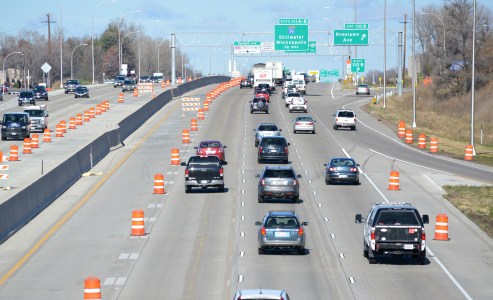
A section of a MnPASS express lane.
MnDOT has changed most of its MnPASS lane markings from double solid lines to skipped double lines to allow more open movement between general purpose and HOT lanes. A new software tool allows RTMC engineers to reassess MnPASS access to respond to changing traffic patterns.

The goal of this research implementation effort was to develop a software tool that the Regional Transportation Management Center (RTMC) could use to assess corridor operations and design. Based on design recommendations from earlier research, the tool would allow RTMC users to predict the safety and mobility impacts of a change from open to closed HOT lanes, and estimate where in the corridor such changes could be implemented safely and effectively.

What Did We Implement?

This effort leveraged findings from three previous MnDOT studies. Models and methods from “Evaluation of the Effect of MnPASS Lane Design on Mobility and Safety” (Report 2014-23) were used for the architecture of this new system. Investigators drew on “Expanding and Streamlining of RTMC Freeway Network Performance Reporting Methodologies and Tools” (Report 2014-05) to implement methods for retrieving historical data from RTMC’s system, cleaning the data and integrating it into the new software package. The project team then incorporated data from “Safety Impacts of the I- 5W Improvements Done Under Minnesota’s Urban Partnership Agreement (UPA) Project” (Report 2017-22) to develop and calibrate the new tool for estimating traffic impacts and shockwaves. A car-following and lane-changing model developed in a 2013 University of Minnesota study provided effective methods for ensuring realistic vehicle modeling and shockwave generation.

How Did We Do It?

Investigators developed this system with links to MnDOT’s database to draw on historical data to identify patterns of traffic demand over time and generate predictions of points in the MnPASS lanes at which shifts from open- to closed-access HOT lanes will offer the most benefit. The program’s code integrates the various models, data sets and tools mentioned above into software that integrates smoothly with the RTMC’s current software and capabilities for collecting speed and volume data, developing interfaces to model impacts of changing open designs at certain points in the freeway corridor to closed designs. The tool includes a module for access design, a module for generating data and a web application.

“This tool is calibrated for the Twin Cities. It takes real-time data and diagrams each location separately for lane changes and reaction time. It took theoretical ideas and made them usable,” said John Hourdos, Director, Minnesota Traffic Observatory, University of Minnesota.

What Was the Impact?

After receiving training in using the new software, RTMC engineers have embraced the MnPASS design tool to regularly report MnPASS performance to the Federal Highway Administration and to generate quarterly and annual analyses and recommendations for changing specific locations from open access to closed access. Closing requires restriping and changing signage—operations that allow MnDOT to respond quickly and easily to shifts in traffic patterns and potential mobility and safety impacts.

The project also offers data for the broader transportation community in which experts debate the relative merits of open- and closed-access HOT designs. With MnPASS, MnDOT has emerged as a leader in open design; this software allows sophisticated modeling of design impacts for the national traffic operations community.

What’s Next?

The MnPASS design tool effectively monitors corridor behavior and design changes. Improvements may yet be made to allow data calibration and validation for slower traffic speeds that represent mobility breakdowns, and to refine aspects of car-following and shockwave models. Increased density scenarios can also be further improved to better accommodate traffic density increases in regular lanes alongside HOT lanes.

In its current form, the tool will be used to analyze open- and closed-access designs on the Interstate 394 corridor to determine the best locations for changes to MnPASS lanes, and positions MnDOT and the RTMC to respond to traffic demand changes in the future.

This post pertains to Report 2018-11, “A Tool for Designing MnPASS
Access Spacing,” published March 2018. The full report can be accessed at
mndot.gov/research/reports/2018/201811.pdf.
 

Research Provides Foundation for Chloride Mitigation Efforts

The accumulation of chloride in our waters has become a widespread concern. In a recent study sponsored by MnDOT and the Local Road Research Board, researchers measured the transport and accumulation of chloride from road deicers in a metro-area watershed. The findings revealed a greater infiltration of chlorides into soil and subsurface waters than previously assumed.

“The results of this research provide us with knowledge we did not
have before,” says William Herb,a research associate with the University of Minnesota’s St. Anthony Falls Laboratory and the study’s principal investigator. “It will help investigators and policymakers explore ways to capture chlorides and mitigate their damaging environmental effects.”

Road salt (sodium chloride) is used in most states that experience snow and ice, with growing impact. For example, chloride levels in some lakes and streams in the Minneapolis–Saint Paul metro area exceed state and federal water quality
standards, and a recent study showed that levels in more than one-quarter of shallow groundwater wells in the metro were above drinking-water taste standards.

“This is a real concern because even in low concentrations, chloride can be lethal to sensitive plants and some aquatic species, and many of our lakes, wetlands, and streams show acute or chronic levels of chloride,” Herb says.

To learn how chlorides from road salt deicers are transported in urban watersheds, researchers installed field instruments at eight sites in a Roseville watershed. They monitored water and chloride levels nearly continuously over three winter seasons; this included runoff directly from sources (roads and parking lots), transport in ditches and sewer networks, and retention in and release from detention ponds and wetlands. Computer modeling was used to generalize results.

2017-50-p1-image
This drain along State Highway 36 was one of the roadway runoff discharge sources used in the study.

Overall, the team observed substantial chloride retention via infiltration to soils and groundwater. For example, monitoring the runoff from a vegetated highway ditch showed that more than 95 percent of the chloride applied to the highway infiltrated
from the ditch into the soil, and less than 5 percent was exported from the site in surface runoff. “Interestingly, substantial chloride export from the ditch was observed in November rainfall runoff prior to application of any new road salt for the upcoming winter, suggesting long-term storage in soils and groundwater in and near the ditch,” Herb says.

Researchers also found that winter rain-on-snow events and the first major
prolonged thaw each season moved surface chlorides most effectively into the watershed.

The research team then used the data and modeling to examine potential strategies for reducing or mitigating the spread of chloride, including capturing low flows, seasonal runoff capture, and capture based on salinity.

Wayne Sandberg, deputy director of the Washington County Department of Public Works, chaired the study’s technical advisory panel. “Based on this research, we now know that deicer chemicals are staying in the soil and moving in the watersheds, and this should change how we manage ice and snow control,” he says. “The next questions are what can we do with that knowledge and what changes can we make.”

This article originally appeared in CTSs Catalyst Newsletter, March 2018 and pertains to Technical Summary 2017-50TS. The full report, “Study of De-icing Salt Accumulation and Transport Through a Watershed” 2017-50, published December 2017 can be accessed at mndot.gov/research/reports/2017/201750.pdf.

Darkness in Box Culverts Not a Likely Barrier to Topeka Shiner

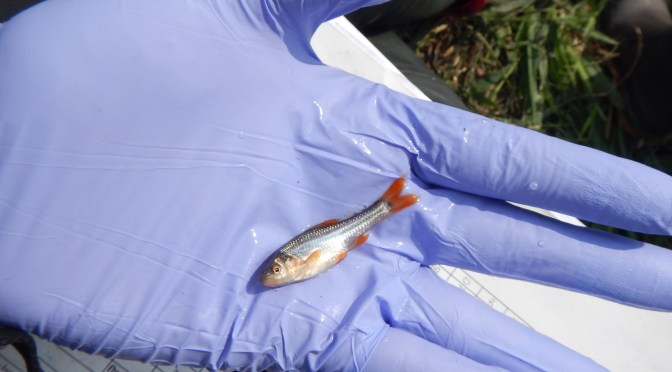
Darkness box culverts does not present a complete barrier for southwestern Minnesota fish species, according to a new MnDOT study. The findings will reduce the cost and  delay of future box culvert replacement projects.

“This research will allow MnDOT to save both time and money when replacing other box culverts in southwestern Minnesota by eliminating the need for a fish passage study for each one,” said Scott Morgan, Principal Hydraulics Engineer, MnDOT District 7.

The research project is one of several undertaken by MnDOT and the Local Road Research Board to better understand fish passage (more at mndot.gov/research), and ultimately develop a Minnesota culvert design manual for accommodating aquatic species.

What Was Our Goal?

In this study, researchers developed several objectives in their efforts to assess the effect of low light levels on fish passage through replacement box culverts. As part of this effort, they wanted to determine typical light levels in the replacement culvert and other box culverts in the region. They also sought to determine if the Topeka shiner and other fish move through culverts in the same numbers they pass through control areas in the same stream, and whether light levels affect frequency of movement. Finally, if a barrier is determined, researchers sought to design or recommend a method for mitigating light in the culvert.

What Did We Do?

In the field, researchers characterized light in long box culverts (at least 8 feet by 8 feet) by collecting many light levels with a light meter at the water surface within the three culverts and at control reaches. They also measured light levels within the water column to characterize the light conditions a fish would experience.

To determine whether Topeka shiners passed through culverts in similar numbers as through control reaches of the same stream, and whether light levels affected their passage, researchers employed a mark-and-recapture process. They caught fish upstream and downstream from the culverts or control reaches, marked them with an identifier indicating where they were caught and released, and then resampled to see where fish moved. They also noted other culvert features that could affect passage, such as water depth and velocity.

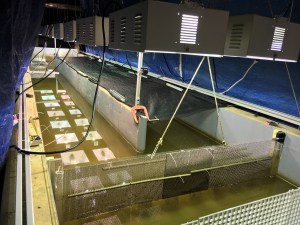
Image of fish tank.
In light manipulation experiments at the St. Anthony Falls Laboratory, Topeka shiners and fathead minnows were allowed to choose channels to swim along. The degree of shade in one channel was adjusted from light to deep shade.

To control for confounding variables that could affect fish movement, a laboratory study measured Topeka shiner preference for light or dark channels. Researchers used a 25-foot-long double channel box with water diverted from the Mississippi River. Fish could choose to swim along light or shaded lanes as they preferred in this light manipulation experiment.

What Did We Learn?

Although there has been increasing concern over the potential for culverts to create behavioral barriers for fish and other organisms, this was the first study that quantified these behavioral effects for fish passage. Light levels in large box culverts were not identified as a potential barrier to the fish communities present in southwestern Minnesota. Two out of the three culverts monitored showed reduced fish passage compared to the control reaches; however, fish—including Topeka shiners—were able to pass through all three.

The longest and darkest culvert had the greatest difference in movement between the culvert and the control, but this variation could not be attributed solely to light levels. This finding was supported by experiments at the St. Anthony Falls Laboratory, where fish that could select either a shaded or lighted channel showed no avoidance of the shaded channel regardless of the shading level.

The light measurements in three culverts yielded an extensive data set that can be used to model light levels through culvert barrels. Light levels at the water surface depended on the culvert entrance, dimensions, construction material, orientation and elbows, while light levels in the water column were also affected by turbidity.

What’s Next?

The conclusions of this study apply only to Topeka shiners and other small warm water fish species, and to large box culverts like those studied. Additional research is required to investigate possible barriers created by smaller, darker culverts to light-sensitive fish species and the interactions between light and other variables such as velocity.

This post pertains to Report 2017-44, “Culvert Length and Interior Lighting Impacts to Topeka Shiner Passage,” published November 2017. The full report can be accessed at mndot.gov/research/reports/2017/201744.pdf.

MnDOT installs safety countermeasures at stop signs, stop lights

MnDOT is working on ways to reduce crashes at intersections by making stop signs and stop lights more visible to motorists. The agency will apply reflective red metal strips on nearly 1,000 stop sign posts and fluorescent yellow tape around 100 traffic signal lights across the state this summer.

“We think these two low-cost safety countermeasures will help reduce crashes at these higher risk intersections,” said Derek Leuer, traffic safety engineer.

13-JuneSafetyMeasures_400
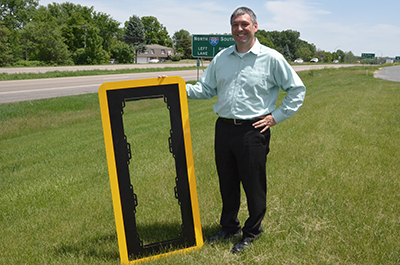
Derek Leuer, traffic safety engineer, displays what the yellow reflective tape looks like around the back plate of a traffic signal light. This tape will be installed on 101 signals statewide this summer. Photo by Sue Roe

The stop sign project will be implemented on locally owned roads that intersect with two-lane, two-way state highways. The highways chosen are considered moderate- and high-risk crash corridors.

The reflective red strips will be installed on the stop sign post directly beneath the stop sign.

Rural intersection crashes are a serious issue in Minnesota, according to Leuer. From 2008 to 2012, there were 533 serious and fatal injury crashes at rural state highway intersections.

“This project aims to reduce those fatal and serious injury crashes in the state by making the stop signs easier to see,” he said. “Fatal right-angle crashes often are the result of one or more drivers failing to comply with a stop sign.”

The traffic signal project includes installing fluorescent yellow tape around the rectangular back plate that contains the green, red and yellow traffic signal bulbs. Leuer said this is a proven Federal Highway Administration safety countermeasure already used by other states.

“The reflective tape will make the signals look bigger and help motorists be more aware of them,” Leuer said. “This will be especially helpful at night and in low-visibility conditions.”

The florescent yellow tape will go on signals at intersections that are considered higher risk for crashes and may have a record of past crashes.

Cost of both projects is about $500,000.

MnDOT will evaluate both projects for effectiveness on an ongoing basis over the next three years.

“The installation of red reflective strips to stop sign posts and yellow fluorescent tape around signal lights may become another low-cost tool to help MnDOT improve roadway safety and move Minnesota toward zero deaths,” Leuer said.

This article by Sue Roe originally appeared in the June 13, 2018 MnDOT Newsline.