
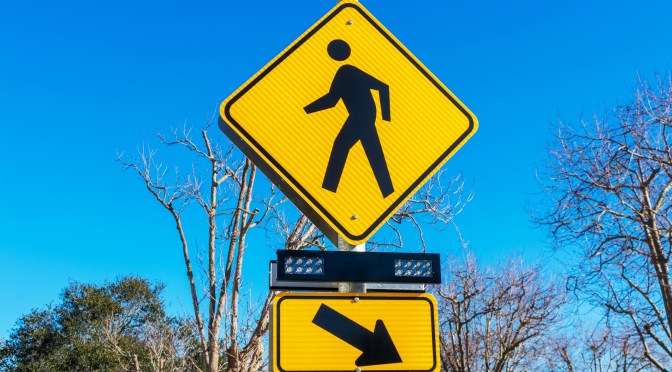
Pedestrian hybrid beacons (PHBs) are one tool to help pedestrians safely cross roads. PHBs provide red-signal control for vehicular traffic when needed at lower installation costs and reduced traffic delays than full traffic signals.
Continue reading New Project: User Understanding of Pedestrian Hybrid Beacon OperationTag Archives: traffic & safety

Guidelines for Implementing Mini-Roundabouts
Increasingly, roundabouts are the solution of choice for many intersections because they improve safety and traffic flow and reduce pollution due to less vehicle delays. Traditional roundabout design typically requires a larger footprint than a conventional four-way intersection.
Continue reading Guidelines for Implementing Mini-Roundabouts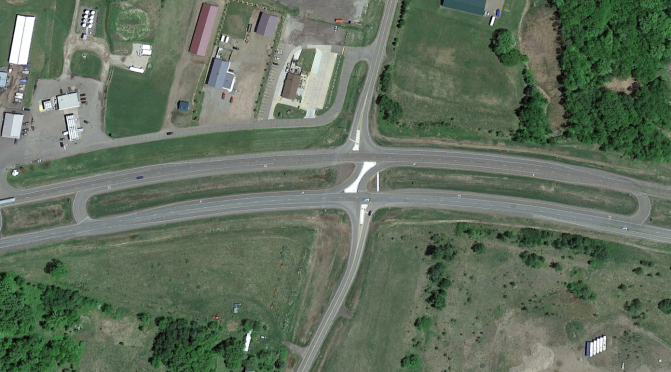
Evaluating the Traffic Safety Benefits of J-Turns in Minnesota
MnDOT traffic engineers are increasingly installing J-turn intersections on high-speed, multilane expressways to limit potential crash points. An analysis of crash data from intersections before and after the installation of J-turns demonstrated significant safety benefits from this alternative design. MnDOT researchers also explored crash history differences among J-turn intersections with varying characteristics. Consistent with the results from a previous study, this analysis found a clear decrease in fatal and other serious crashes after a J-turn was installed.
Continue reading Evaluating the Traffic Safety Benefits of J-Turns in Minnesota
A Mobile App to Report Driver Intrusions Into Work Zones
Transportation workers face critical safety risks when drivers fail to comply with traffic control instructions in work zones. These intrusions threaten not only the flaggers who are directing traffic, but all workers on the job site and the drivers themselves. Knowing the nature and frequency of intrusions is necessary to develop effective prevention strategies. A new mobile phone app enables workers to quickly and easily report incidents, allowing MnDOT to analyze risks and improve worker safety.
Continue reading A Mobile App to Report Driver Intrusions Into Work Zones
Guidance for Cities Considering Speed Limit Changes
The issue of reducing speed limits to increase public safety is an emotional, political, and controversial topic that has been debated by safety advocates, engineers, politicians, transportation officials, and the public for many years. A statutory change in 2019 put a spotlight on the topic, requiring a deeper look into how speed limits are established and the effectiveness that lowering speed limits has on reducing vehicle traveling speeds, as well as the impacts on pedestrian and bicycle traffic.
Continue reading Guidance for Cities Considering Speed Limit Changes
Impacts of Autonomous Vehicles on Operation and Maintenance of Minnesota Roads
As autonomous vehicle technology evolves, transportation agencies want to understand how road maintenance and traffic operations may also need to evolve. New research begins to identify potential needs and further questions for winter road maintenance, work zones and traffic flow.
Continue reading Impacts of Autonomous Vehicles on Operation and Maintenance of Minnesota Roads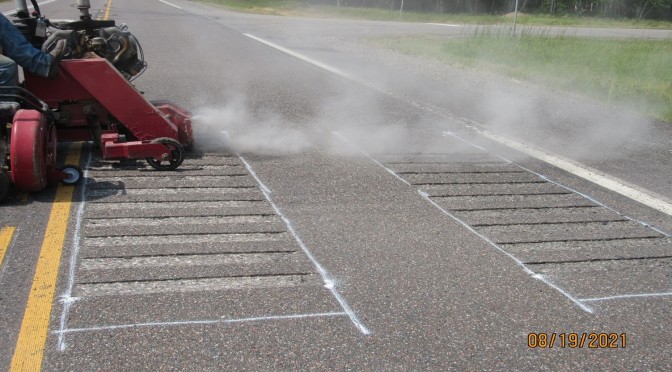
Using Rumble Strips to Encourage Stops at Rural Intersections
Vehicle crashes in rural areas often happen at intersections. Transverse rumble strips placed before a stop sign can be an effective safety measure that warns drivers approaching an intersection. Recent research has provided an increased understanding of the most effective rumble strip designs and noise characteristics to help county traffic engineers decide when and where to deploy the strips.
Continue reading Using Rumble Strips to Encourage Stops at Rural Intersections
New Project: Using Apps to Notify the Public of Local Road and Bridge Closures
The traveling public increasingly relies on navigation systems to get to their destinations. Currently, there is not a system, tool, or process being used by cities and counties in Minnesota to report road or bridge closures for use by transportation agencies to display to the traveling public or for use by third-party mapping/navigation companies (e.g., Waze, TomTom, HERE Technologies, Google Maps) to provide to the public.
This project will document up to three best practices for manual local road closure reporting, describe an approach that the Local Road Research Board could use to develop or implement an existing user-friendly road closure reporting system, and provide guidance on how to report closures to third-party mapping/navigation companies.
Objectives
MnDOT already operates and maintains a statewide traveler information reporting system known as CARS. This project will review and summarize the options and approach for adapting it for local road entry. As part of the study, researchers will:
- Develop best practices for reporting systems by documenting four examples used in other states for establishing and operating tools to report local road closures.
- Define three options for how to make a user-friendly system for local Minnesota agencies using the outcomes of the best practices summary.
- Prepare users guide for entering information into existing mapping tools that will assist in understanding the process to submit road closures and mapping updates to established mapping/navigation providers.
Project Details
- Estimated Start Date: 12/19/2022
- Estimated Completion Date: 03/31/2024
- Funding: Local Road Research Board
- Principal Investigator: Dean Deeter
- Technical Liaison: Perry Clark
Details of the research study work plan and timeline are subject to change.
To receive email updates about this project, visit the Local Road Research Board to subscribe.
 Crossroads