This article was originally published in Catalyst, August 2020.
Using “green” infrastructure is a useful strategy for handling city stormwater, which may contain deicers and other contaminants from streets and sidewalks. Choosing the right method and ensuring it doesn’t cause unforeseen damage, however, is another matter.
Climate change scenarios have been fairly well-tested and vetted. Moore et al. (2015) found that one of the noteworthy impacts on upper Midwest cities is an increase of storm magnitude of 39% (moderate scenario) to 163% (pessimistic scenario). However, the impact of these scenarios on stormwater infrastructure are not well understood and documented. There are some important financial decisions that need to be made for stormwater infrastructure in the present and near-future, requiring demonstration and discussion of the impacts of climate change on stormwater infrastructure.
This article was originally published in Catalyst, April 2020.
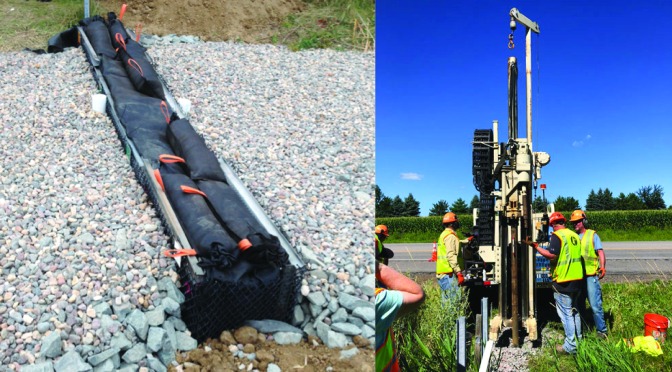
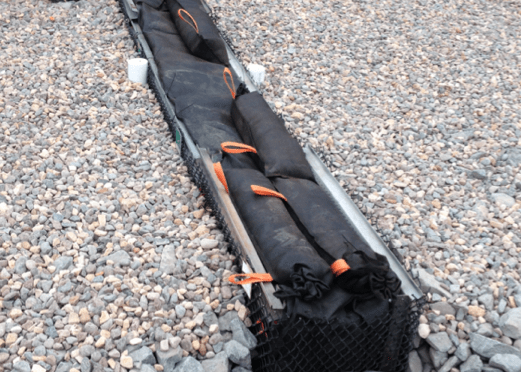
The Minnesota Department of Transportation (MnDOT) is exploring innovative ways to filter pollutants from stormwater runoff and meet permit requirements for construction projects. In a recent study, U of M researchers documented the performance of an iron-enhanced ditch check filter to remove phosphates from stormwater. They found that the filter was effective, though its performance decreased over time.
Researchers determined that
natural soil amended with locally sourced materials performed well in bioslopes
and bioswales. This practice will allow MnDOT to avoid hauling in costly
commercial materials for stormwater management installations.
Researchers documented
performance of an iron-enhanced ditch check filter to remove phosphorus from
stormwater over three years. The filter was effective, but its performance
decreased over time, and it will require relatively frequent maintenance. Several
design changes may be considered.
Soil carried away in stormwater runoff from road construction sites can pollute lakes and rivers.
Stormwater settling ponds provide a place for this sediment to settle before the water is discharged into local bodies of water. However, since stormwater ponds have limited space, a mechanism is needed to remove clean water from the pond to prevent the overflow of sediment-laden water.
MnDOT-funded researchers have designed temporary stormwater ponds with floating head skimmers that can remove clean water from the surface of the settling pond, using gravity to discharge water into a ditch or receiving body.
The Marlee Float from the SW Fee Saver is one of five available floating-head skimmers that researchers identified.
This is a new approach for MnDOT and Minnesota cities and counties, so research was needed to provide practical guidance for how to use these devices on construction sites.
“This was a small-scope implementation project for professionals to use as they design temporary stormwater ponds that meet state parameters,” said Dwayne Stenlund, MnDOT Erosion Control Engineering Specialist.
A new MnDOT study identifies five methods for “skimming” stormwater ponds that can improve a pond’s effectiveness by 10 percent. MnDOT researchers also created designs for temporary stormwater ponds on construction sites with the capacity to remove approximately 80 percent of suspended solids.
These designs will help contractors meet federal requirements for stormwater pond dewatering. Researchers also determined how often a pond’s deadpool must be cleaned, based on watershed size and pool dimensions.
“When sediment settles, it’s hard to determine when to clean out a pond. Based on the density of the sediments in the Minnesota River and the loading rates we computed, we were able to calculate how often we need to clean out a pond so sediment doesn’t reach the height of the skimmer,” said Joel Toso, principal of Wenck Associates and a consultant for the project.
Resources
Reducing Construction Pollution by Skimming Stormwater Ponds – Technical Summary (PDF, 2 MB, 2 pages); Final Report (PDF, 3 MB, 43 pages)





 Crossroads