

Automated vehicle (AV) features such as adaptive cruise control could significantly increase driver safety and mobility. But in some circumstances, these features can alter vehicle movement and spacing, and interfere with traffic flow. This project analyzed the integration of varying levels of AVs with human-driven vehicles (HVs) and the impact on ramp meter operations to measure the effects and identify potential solutions and modifications.
Continue reading Impacts of Automated Vehicle Feature IntegrationTag Archives: MnDOT

Incorporating Sustainability into the Procurement Process
The production and use of construction materials for transportation projects have varying impacts on the environment based on factors such as production process, transportation and material inputs. To mitigate negative outcomes, MnDOT sought to incorporate environmental impacts into the procurement process for concrete mixtures and concrete pavement. This project provided a framework for considering environmental impacts and standardizing a reporting system to encourage the use of low-carbon construction materials in infrastructure projects.
Continue reading Incorporating Sustainability into the Procurement Process
Enhancing Safety for Pedestrians and Bicyclists at Roundabouts
Compared to traditional intersections, roundabouts have been proven to decrease serious crashes. However, because drivers yield rather than stop upon entering roundabouts and at crosswalks, public concerns about pedestrian and bicyclist safety remain. Research and field evaluations into driver yielding and speed behaviors generated insights to guide local transportation agencies and MnDOT to further enhance pedestrian safety at roundabouts.
Continue reading Enhancing Safety for Pedestrians and Bicyclists at Roundabouts
TZD Traffic Safety Hotdish: Research in Action—Perspectives from Minnesota’s Traffic Safety Research Ecosystem
July 16, 2025
1:00–2:15 p.m. Central
Virtual via Zoom
Join us as our very own “Roads” Scholars share more about their recent traffic safety research. Presenters from the University of Minnesota and Minnesota Department of Transportation (MnDOT) will share findings from recent projects and talk about the collaborations that drive traffic safety research throughout Minnesota.
Speakers
- Jackie Jiran, PE—MnDOT
- Max Moreland, PE, PTOE—MnDOT
- Nichole Morris, PhD—University of Minnesota
- Mark Wagner, PE—MnDOT
- Kyle Shelton, PhD—University of Minnesota; Moderator
Registration
The webinar is free to attend, but registration is required. Once you have registered, you will receive an email confirmation with a Zoom link. The link should not be shared with others; it is unique to you.
Credit
Attendees are eligible for 1.25 Professional Development Hours (PDHs). Download the PDH credit form (PDF) for your records.
For complete information, go to TZD Traffic Safety Hotdish.
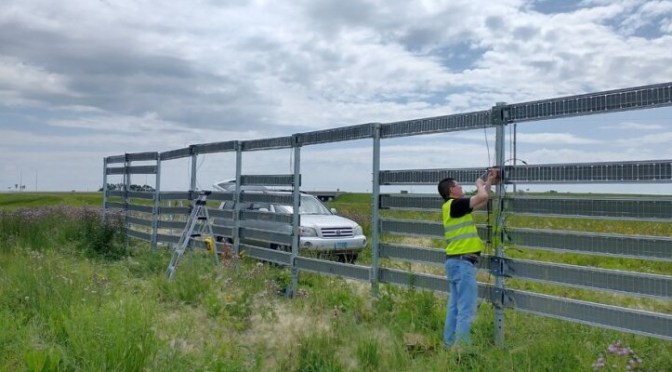
Solar Snow Fence Controls Drifting Snow While Generating Power
Solar snow fences not only retain the benefits of a traditional snow fence by controlling blowing and drifting snow in winter, they create green energy throughout the year. However, to be effective, the fence must withstand harsh weather elements and produce enough energy to justify the use and cost of solar panels. This project evaluated the installation and performance of a 100-foot solar snow fence for 18 months to determine its functionality and economic feasibility.
Continue reading Solar Snow Fence Controls Drifting Snow While Generating Power
Establishing Post-Construction Roadside Vegetation Growth
Roadside vegetation is essential for managing stormwater and mitigating soil erosion. Using organic and proprietary amendments to improve the topsoil after road construction projects are completed may help reestablish vegetation more quickly and provide better outcomes.
Continue reading Establishing Post-Construction Roadside Vegetation Growth
Impact of Start Time on Students Walking and Biking to School
To increase the number of students who walk or bike to school, policymakers first need to understand the primary factors that prevent students, parents and caregivers from choosing these travel modes. A look at the factors that influence this decision provided information to address barriers to walking and biking for children and families in Minnesota communities.
Continue reading Impact of Start Time on Students Walking and Biking to School
Increasing Service Reliability by Adding a Dedicated Right of Way for Buses
In dense urban areas, public transit is a primary mode of transportation for people to commute to work, complete errands and connect with their community. If transit is not reliable, riders may choose other forms of transportation that could negatively affect riders, transportation agencies and communities. To improve service reliability, MnDOT investigated the use of dedicated rights of way (ROWs) for transit service across route segments within the system.
Continue reading Increasing Service Reliability by Adding a Dedicated Right of Way for Buses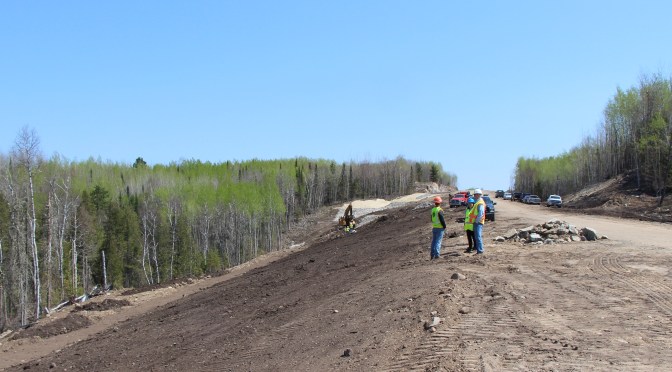
Industrial by-products prove sustainable options for managing roadside stormwater
Reprinted from CTS News, March 25, 2025
Roadside soil plays a crucial role in stormwater management. Naturally vegetated roadsides can filter and control runoff, helping to keep pollutants out of bodies of water and minimizing flooding to communities. However, soil left behind from road construction does not adequately support filtration and plant growth unless it’s amended with organic matter—and traditional mixtures for doing so, such as with sand and compost, can be costly and resource-intensive.

To find a more sustainable solution, U of M researchers partnered with MnDOT and the Minnesota Local Road Research Board. Building on previous research, a team led by CTS scholar David Saftner, principal investigator and associate professor in the UMD Department of Civil Engineering, tested sustainable roadside soil mixtures using locally available waste materials and by-products generated from forestry, agriculture, and industrial activities.
In this project, nine materials were selected for testing, including a peat/biochar mix; dredged river sediment; pine and ash sawdust; VersaLime (a by-product of sugar beet processing); lime mud, bottom ash, and degritter (from a pulp and paper mill); and recycled concrete aggregate (RCA). All nine materials proved efficient at removing pollutants, though some were more effective than others. After extensive laboratory testing, the five top-performing materials were selected and used to create three engineered soil blends:
- RCA (80%) and ash sawdust (20%)
- RCA (80%) and peat/biochar (20%)
- Dredge sediment (80%) and degritter (20%)
Field testing of these three engineered soil blends took place in outdoor plots. The team studied infiltration rate, pollutant removal, and plant growth from grass and flower seed. Through a life-cycle assessment, the researchers also evaluated material collection and transport, energy demand, human health and ecosystem impacts, climate change, and water use.
Their research revealed that all three engineered soil blends were effective at capturing and filtering the first inch of excess stormwater runoff, offering a viable alternative to traditional soil mixes. Other key findings:
- Of the engineered soil mixes, organic and coarser materials were better at allowing water to pass through.
- Greenhouse tests showed promising plant growth, while field plots experienced challenges—possibly due to seasonal dryness.
- The dredge sediment and degritter soil mix had substantially higher impacts than the other two soil mixes as well as the most CO2 emissions.
- The RCA and ash sawdust soil mix had the lowest impacts, with the RCA and peat/biochar soil mix producing similar results.
Based on their findings, a design guide was developed for road engineers outlining best practices for using local by-products and waste materials to create engineered soil mixes while still adhering to regulatory standards. These recommendations are designed to be standard, common, and repeatable.
“This was a great project and I’m especially happy with the design guide,” Saftner says. “Determining how to implement new procedures is tougher than using tried-and-true methods. Our hope is that the guide will simplify things for practicing engineers looking for more cost-effective, sustainable, and locally sourced solutions.”
The study results also highlighted many of the benefits of engineered soil mixtures including the reuse of waste materials, reduced spending on sand and compost, lower transportation costs, and fewer environmental impacts of transporting material.
Further research on the reuse of waste materials includes another multi-phased project incorporating biochar. The first phase of that project should be finished this summer, with the second phase kicking off in summer 2026.
—Krysta Rzeszutek, CTS digital editor
Related Resources
- Article: Waste materials go to work as pollutant filter
- Article: Treating stormwater with local by-products reduces road construction costs, minimizes waste
- Re-use of Minnesota Waste Material in Sustainably Design Soils. Part 2
- Reusing Local By-Products to Create Sustainable Roadside Soil
- Re-use of Regional Waste in Sustainably Designed Soils: Part 1

Pavement Markings to Support Automated Vehicles
Automated vehicles (AVs) using advanced driver assistance systems depend on pavement markings to accurately track roadway lanes. While MnDOT continues to ensure human drivers easily and effectively detect and interpret various pavement markings, the agency also wanted to understand marking designs and characteristics that support AV functions. Field observations in different locations, during the day and at night, using different data collection methods allowed researchers to evaluate the impact of various pavement marking properties on AV lane-keeping functions. Results support MnDOT in producing pavement marking guidance that is responsive to changing needs.
Continue reading Pavement Markings to Support Automated Vehicles Crossroads