

Aggregate materials used in the base and subbase layers of pavements provide structural support and drainability to Minnesota roads. But the supply of locally available high-quality aggregate material is becoming increasingly scarce. This project explored sustainable and cost-effective solutions for constructing durable flexible pavement roads with lower quality aggregate material.
Continue reading Evaluating Road Designs That Use Lower Quality AggregateTag Archives: MnDOT

Human behavior insights are driving transportation safety forward
Reprinted from CTS News Catalyst, September 11, 2025
To better understand how roadway crashes can be prevented, it’s essential to explore the human behaviors that contribute to them. This objective is core to the work of the U of M’s Human Factors Safety Laboratory (HFSL). Research Associate Professor and CTS scholar Nichole Morris, who directs the lab, outlined its mission and impact in a recent Toward Zero Deaths (TZD) webinar highlighting Minnesota’s traffic safety research ecosystem.
Minnesota TZD is the state’s cornerstone traffic safety program, employing an interdisciplinary approach to reducing traffic crashes, injuries, and deaths on the state’s roads. CTS partners with TZD to provide program administration, event coordination, and communications.
The HFSL brings together behavioral scientists and engineers dedicated to reducing roadway and occupational injuries and fatalities. They combine research on human behavior with the design and testing of user-centered systems to create solutions that work better for everyone.
“Human factors is the intersection between people and systems,” Morris explained. From in-vehicle technologies and roadway signage to partnerships with larger organizations such as law enforcement, transportation systems involve a wide range of human-system interactions.
Four research tracks shape the lab’s work:
- Crash reporting. Although projects often intersect, crash reporting is foundational to the other research tracks. Morris refers to it as the lifeblood of transportation safety—without crash data, researchers don’t know what’s working and what isn’t. In one of its more consequential projects, the HFSL helped rebuild the front end of MNCrash—an application designed for law enforcement to document and report crashes. In close collaboration with the Minnesota Departments of Transportation and Public Safety as well as multiple law enforcement agencies, the HFSL team helped to streamline the user experience and improve data completeness and accuracy. Since deploying the updated version in 2016, MNCrash has been adopted by all law enforcement agencies across Minnesota. It’s featured in the sixth edition of the USDOT’s Model Minimum Uniform Crash Criteria and has become the national standard for crash reporting.
- Maintenance and work-zone safety. In one project, leveraging the expertise and methods gained from MNCrash, the lab collaborated with MnDOT and maintenance workers on a streamlined app to make documenting work-zone intrusions easier. After its launch in 2022, the team continued work, using low-cost sensors and radar to help reduce select work-zone driving speeds in real time.
- Pedestrian and non-motorist safety. The Stop for Me campaign, a collaboration with MnDOT, St. Paul, Ramsey County, and Western Michigan University, has been adopted in communities across Minnesota. The campaign—which combines enforcement and engineering treatments to improve yielding at crosswalks—has inspired similar efforts in more cities around the country. Other projects include studies on dedicated right-turn lanes and temporary and permanent pedestrian infrastructure to reduce conflicts between drivers and pedestrians.
- Infrastructure and signage. The lab’s work on J-turns, which have proven effective at reducing fatal crashes, has helped to identify and address several navigational errors drivers may make when first encountering this type of intersection. The researchers have found that poor or confusing first experiences with J-turns can lead to negative community perceptions and result in pushback on J-turn implementation. The research has found specific pavement markings to help guide drivers and facilitate successful use of J-turns—leading to fewer crashes and better driver experiences.
Morris emphasized that investment in sound research methods and collaborations across partner institutions, organizations, and communities is what creates successful research outcomes. While studies may yield results in the moment, she says investing in methodology is what really carries the work forward. The HSFL’s work continues to inspire other states and agencies, Morris added.
—Krysta Rzeszutek, CTS digital editor
Related research from Nichole Morris
- Work Zone Intrusion Report Interface Design
- In-Vehicle Work Zone Messages
- In-Vehicle Sign Systems May Improve Safety When Supplementing Road Signs
- Examining Optimal Sight Distances at Rural Intersections
- User-Centered Smart Traffic Sign Development Study
- Pedestrian Engineering and Enforcement at Signalized Intersections
- Assessment of Pedestrian Safety and Driver Behavior Near Automated Vehicles
- Identification and Assessment of Preventative Methods to Mitigate Cognitive and Physical Declines Which Influence Driving Performance of Older Drivers
- Human-Centered Testing of Rear-Facing Display to Reduce Vehicle Collisions with Snowplows
- Rural Intersection Enhancement and Driver Behavior Study
- School Zone Research
- Exploring Completeness and Accuracy of Driver Crash Reporting of Property Damage Only Crashes
- Human Factors: Optimizing Crosswalks and Aesthetic Surface Treatments (a.k.a. Pavement Art) for Pedestrians with Disabilities

Developing Biochar Specifications for Stormwater Management
Effective stormwater management helps keep roadway contaminants from entering Minnesota’s lakes and streams. Management practices include soil and vegetation in roadside bioretention systems that filter heavy metals and hydrocarbons created by vehicles. Based on other studies, retention and transformation of roadside pollutants should be improved by biochar application to existing or engineered soils. Abundant sources of biomass can be used to produce biochar, a soil amendment with numerous benefits. MnDOT and local agencies identified biochar specifications for effective use in stormwater treatment to support the next phase of testing and development of biochar design guidance.
Continue reading Developing Biochar Specifications for Stormwater Management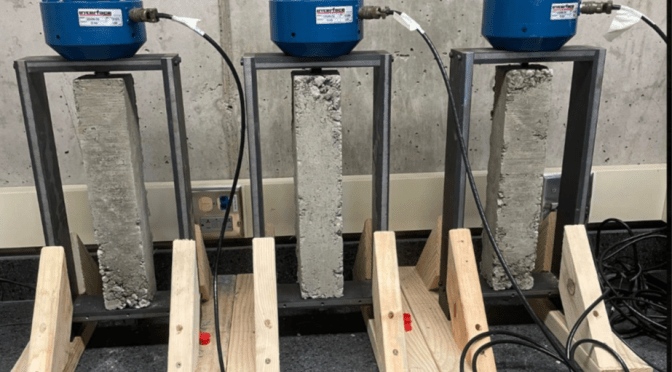
Evaluating Strategies to Prevent Early-Age Bridge Deck Cracking
Premature cracking in reinforced concrete bridge decks is expensive to repair and may lead to rapid bridge deterioration. Despite changes to mix designs, transverse cracking after casting continues to be a problem in Minnesota. This project evaluated alternative concrete mix designs and reinforcement strategies to mitigate early-age bridge deck cracking, reduce maintenance costs and extend bridge deck service lives.
Continue reading Evaluating Strategies to Prevent Early-Age Bridge Deck Cracking
Detecting Endangered Turtles with Environmental DNA
More than 60% of the world’s turtle species are endangered, including Blanding’s and wood turtles, which are native to Minnesota and may be found in the state’s wetlands, ponds, lakes and streams. To protect these vulnerable populations and their habitats, a cost-effective tool developed in this study will efficiently allow for the early detection of these turtles at transportation project sites.
Continue reading Detecting Endangered Turtles with Environmental DNA
Increasing School Bus Stop-Arm Compliance
A significant number of school bus stop-arm violations occur every day throughout the country. In Minnesota, violation and citation data suggests these incidents are grossly underreported and underenforced due to a time-consuming reporting and enforcement process. This project examined current processes and recommended improvements to encourage higher rates of reporting and enforcement.
Continue reading Increasing School Bus Stop-Arm Compliance
Testing Recycled Plastics in Asphalt and Concrete Pavement Mixes
Addressing the increasing need for pavement materials coincides with an increasing supply of plastic waste. Incorporating recycled plastic into aggregate for transportation infrastructure is of growing interest. Testing plastic waste material in both asphalt and concrete pavement mixtures revealed promising results and the need to explore long-term performance and durability.
Continue reading Testing Recycled Plastics in Asphalt and Concrete Pavement Mixes
Evaluating the Friction of Pavement Markings and Colored Pavement
Pavement markings make travel safer for all road users. However, the material used for retroreflectivity can be slicker than the surrounding pavement. To maximize the safety of bicyclists, motorcyclists and pedestrians, MnDOT and local agencies explored the friction values of different marking materials. Project results produced valuable information on relative friction between pavement and marking materials and, importantly, identified effective testing tools to evaluate and compare products.
Continue reading Evaluating the Friction of Pavement Markings and Colored Pavement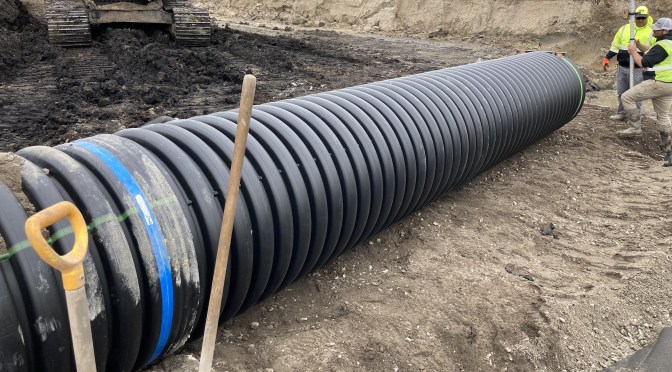
Evaluation of Corrugated Pipes Manufactured with Recycled Materials
MnDOT currently requires corrugated high-density polyethylene (HDPE) pipes to be made with 100% virgin materials. However, recent changes to federal standards allow for the use of corrugated HDPE pipes manufactured with more sustainable postconsumer and postindustrial recycled content. This project examined and compared the performance of both types of corrugated pipes to determine the suitability of using HDPE pipes manufactured with recycled materials in Minnesota.
Continue reading Evaluation of Corrugated Pipes Manufactured with Recycled Materials
Strategies for Addressing Deteriorated Concrete Roads
Treating early deterioration in concrete pavement can extend a road’s service life and defer costly replacement. An assessment of different strategies years later demonstrated that over time, asphalt overlays made the roadways smoother for travelers.
Continue reading Strategies for Addressing Deteriorated Concrete Roads Crossroads