

Automated vehicles (AVs) using advanced driver assistance systems depend on pavement markings to accurately track roadway lanes. While MnDOT continues to ensure human drivers easily and effectively detect and interpret various pavement markings, the agency also wanted to understand marking designs and characteristics that support AV functions. Field observations in different locations, during the day and at night, using different data collection methods allowed researchers to evaluate the impact of various pavement marking properties on AV lane-keeping functions. Results support MnDOT in producing pavement marking guidance that is responsive to changing needs.
Continue reading Pavement Markings to Support Automated VehiclesCategory Archives: Research
General research posts.

New Clear Roads Research: Managing Liquid Deicing Storage Systems
Reprinted from Clear Roads News, March 19, 2025
Agencies selecting a new or replacement storage system for their liquid deicers have a lot to consider, such as safety, environmental impacts, and cost-effectiveness.
Continue reading New Clear Roads Research: Managing Liquid Deicing Storage Systems
Refining Max-Pressure Traffic Signal Control to Improve Traffic Flow
Effective traffic signal control technologies facilitate optimal traffic flow and travel time. Building on previous research, this project made significant progress toward field implementation of a novel adaptive signal control technology. This research phase demonstrated the max-pressure traffic signal algorithm can successfully integrate into Hennepin County traffic signal hardware and respond to changing traffic conditions in real time, providing confidence to move to the next step and test the system in the field.
Continue reading Refining Max-Pressure Traffic Signal Control to Improve Traffic Flow
Adding fibers to concrete may help create long-lasting roads
Originally published in CTS News, March 19, 2025
Thin pavements—in which new pavements are constructed over an existing base layer—can be an economical option for low- and moderate-volume roads. However, thinner concrete roads are prone to distress caused by weather and traffic loads. The solution, U of M researchers found, may be to add small synthetic fibers to the concrete.
Continue reading Adding fibers to concrete may help create long-lasting roads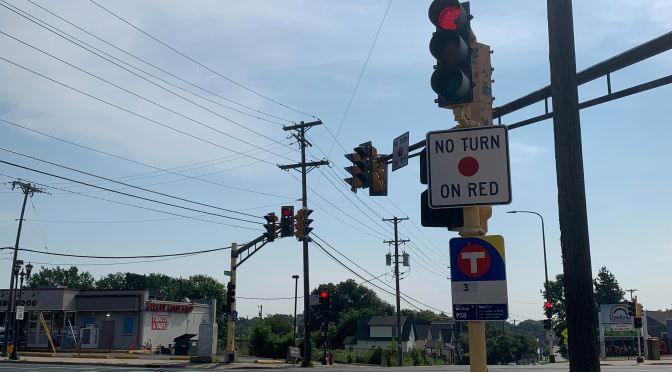
Comparing the Effectiveness of No Right Turn on Red Sign Types at Traffic Signals
Preventing right turns on red at traffic signals is a generally effective pedestrian safety measure. But when pedestrians are absent, allowing right turns on red can improve traffic flow. Unlike static signs that prohibit right turns on red, dynamic No Right Turn on Red (NRTOR) signs can be activated when pedestrians are present. Comparing driver compliance with dynamic and static signs indicated that each sign type may have its own benefits.
Continue reading Comparing the Effectiveness of No Right Turn on Red Sign Types at Traffic Signals
Examining off-peak transit behaviors to improve transit equity
Originally published in Catalyst, February 19, 2025
Transit service planning has traditionally focused on peak trips and the needs of “rush hour” commuters rather than off-peak travel. Often, off-peak trips are taken by shift-based essential workers and those who cannot or do not drive. The COVID-19 pandemic further underscored the need for a closer examination of these trips to improve social equity.
Continue reading Examining off-peak transit behaviors to improve transit equity
Understanding the Performance of Road Base Stabilization Additives
Full-depth reclamation (FDR)—an effective and efficient pavement reconstruction method—can be made even more sustainable by strengthening the road base. Laboratory and field testing of proprietary stabilizers used to amend FDR material illustrated improvements in pavement stiffness and economic benefits over time. New pavement design standards for base stabilizers can guide road engineers in choosing the optimal products for sustainable roads.
Continue reading Understanding the Performance of Road Base Stabilization Additives
New Clear Roads Research: Dashboards for Improving Winter Operations
From Clear Roads, March 5, 2025
Transportation agencies collect vast amounts of data about their winter operations. Dashboards can help to summarize the information, measure performance, inform decision-making during winter weather events and improve planning for future storms.
This Clear Roads project examined the use of dashboards among transportation agencies to assess current strategies and identify innovative and effective practices. The results offer guidance to transportation agencies that are considering implementing or expanding their dashboard use to enhance winter maintenance operations.
Download the final report and two-page brief: CR 22-05 – Use of Dashboards for Winter Operations, December 2024.

New Project: Roundabouts, J-Turns, etc. – Understanding Their Economic Impacts
Roundabouts and J-turns have consistently shown significant improvements in safety and traffic flow in Minnesota and across the U.S. Still, some community residents and businesses oppose replacing traditional intersections with alternative intersections like roundabouts or J-turns.
Continue reading New Project: Roundabouts, J-Turns, etc. – Understanding Their Economic Impacts
New Smartphone App Uses GPS Technology to Warn Drivers of Lane Departures
Preventing vehicles from drifting out of traffic lanes is a top safety priority for transportation officials. An ongoing research project has produced a smartphone app that alerts drivers when their vehicles drift from a lane. The current phase of the project improved upon earlier versions of the app by adding GPS and significantly increasing the effectiveness of lane departure detection.
 Crossroads