Category Archives: Research

General research posts.

Human behavior insights are driving transportation safety forward

Reprinted from CTS News Catalyst, September 11, 2025

To better understand how roadway crashes can be prevented, it’s essential to explore the human behaviors that contribute to them. This objective is core to the work of the U of M’s Human Factors Safety Laboratory (HFSL). Research Associate Professor and CTS scholar Nichole Morris, who directs the lab, outlined its mission and impact in a recent Toward Zero Deaths (TZD) webinar highlighting Minnesota’s traffic safety research ecosystem. 

Minnesota TZD is the state’s cornerstone traffic safety program, employing an interdisciplinary approach to reducing traffic crashes, injuries, and deaths on the state’s roads. CTS partners with TZD to provide program administration, event coordination, and communications.

The HFSL brings together behavioral scientists and engineers dedicated to reducing roadway and occupational injuries and fatalities. They combine research on human behavior with the design and testing of user-centered systems to create solutions that work better for everyone.

“Human factors is the intersection between people and systems,” Morris explained. From in-vehicle technologies and roadway signage to partnerships with larger organizations such as law enforcement, transportation systems involve a wide range of human-system interactions.

Four research tracks shape the lab’s work:

  • Crash reporting. Although projects often intersect, crash reporting is foundational to the other research tracks. Morris refers to it as the lifeblood of transportation safety—without crash data, researchers don’t know what’s working and what isn’t. In one of its more consequential projects, the HFSL helped rebuild the front end of MNCrash—an application designed for law enforcement to document and report crashes. In close collaboration with the Minnesota Departments of Transportation and Public Safety as well as multiple law enforcement agencies, the HFSL team helped to streamline the user experience and improve data completeness and accuracy. Since deploying the updated version in 2016, MNCrash has been adopted by all law enforcement agencies across Minnesota. It’s featured in the sixth edition of the USDOT’s Model Minimum Uniform Crash Criteria and has become the national standard for crash reporting.
  • Maintenance and work-zone safety. In one project, leveraging the expertise and methods gained from MNCrash, the lab collaborated with MnDOT and maintenance workers on a streamlined app to make documenting work-zone intrusions easier. After its launch in 2022, the team continued work, using low-cost sensors and radar to help reduce select work-zone driving speeds in real time.
  • Pedestrian and non-motorist safety. The Stop for Me campaign, a collaboration with MnDOT, St. Paul, Ramsey County, and Western Michigan University, has been adopted in communities across Minnesota. The campaign—which combines enforcement and engineering treatments to improve yielding at crosswalks—has inspired similar efforts in more cities around the country. Other projects include studies on dedicated right-turn lanes and temporary and permanent pedestrian infrastructure to reduce conflicts between drivers and pedestrians.
  • Infrastructure and signage. The lab’s work on J-turns, which have proven effective at reducing fatal crashes, has helped to identify and address several navigational errors drivers may make when first encountering this type of intersection. The researchers have found that poor or confusing first experiences with J-turns can lead to negative community perceptions and result in pushback on J-turn implementation. The research has found specific pavement markings to help guide drivers and facilitate successful use of J-turns—leading to fewer crashes and better driver experiences.

Morris emphasized that investment in sound research methods and collaborations across partner institutions, organizations, and communities is what creates successful research outcomes. While studies may yield results in the moment, she says investing in methodology is what really carries the work forward. The HSFL’s work continues to inspire other states and agencies, Morris added.

—Krysta Rzeszutek, CTS digital editor

Related research from Nichole Morris

TZD Traffic Safety Hotdish: Research in Action—Perspectives from Minnesota’s Traffic Safety Research Ecosystem

July 16, 2025
1:00–2:15 p.m. Central
Virtual via Zoom

Join us as our very own “Roads” Scholars share more about their recent traffic safety research. Presenters from the University of Minnesota and Minnesota Department of Transportation (MnDOT) will share findings from recent projects and talk about the collaborations that drive traffic safety research throughout Minnesota.

Speakers

  • Jackie Jiran, PE—MnDOT
  • Max Moreland, PE, PTOE—MnDOT
  • Nichole Morris, PhD—University of Minnesota
  • Mark Wagner, PE—MnDOT
  • Kyle Shelton, PhD—University of Minnesota; Moderator

Registration

The webinar is free to attend, but registration is required. Once you have registered, you will receive an email confirmation with a Zoom link. The link should not be shared with others; it is unique to you.

Credit

Attendees are eligible for 1.25 Professional Development Hours (PDHs). Download the PDH credit form (PDF) for your records.

For complete information, go to TZD Traffic Safety Hotdish.

New Clear Roads Research: Understanding the Effects of Deicer Additives

Originally published in Clear Roads News April 7, 2025

items used in the freezing point determination test (ASTM D1177)
Items used in the freezing point determination test (ASTM D1177)

Combining road salt with common additives such as corrosion inhibitors, anticaking agents, cold temperature modifiers, thickeners and friction enhancers can increase the effectiveness of the deicer, allowing it to work more quickly or remain on the pavement longer.

To determine how well mixed salt products perform at lower temperatures and inform transportation agencies’ winter maintenance decisions, this Clear Roads project tested eight solids and prewet solids to evaluate the influence of additives on chloride-based deicer performance, including the freezing point or eutectic temperature, ice-melting capacity using the rocker test and pavement friction.

Download the final report and two-page briefCR 22-03 – Effects of Additives in Deicing Salts at Lower Temperatures, February 2025.

Industrial by-products prove sustainable options for managing roadside stormwater

Reprinted from CTS News, March 25, 2025

Roadside soil plays a crucial role in stormwater management. Naturally vegetated roadsides can filter and control runoff, helping to keep pollutants out of bodies of water and minimizing flooding to communities. However, soil left behind from road construction does not adequately support filtration and plant growth unless it’s amended with organic matter—and traditional mixtures for doing so, such as with sand and compost, can be costly and resource-intensive. 

sample plots
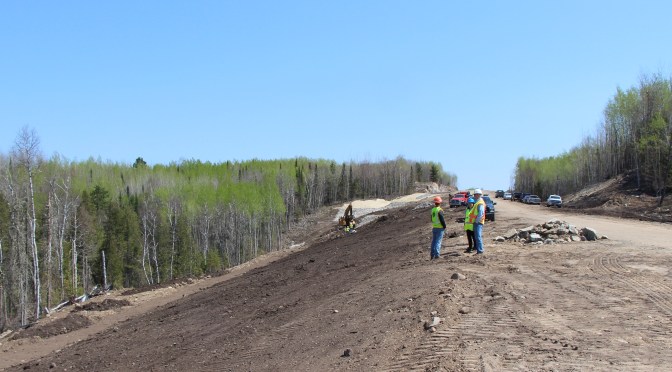
Field plots adjacent to the Natural Resources Research Institute parking lot were used to test the infiltration capacity, pollutant removal, and vegetative support capabilities of the soil mixtures.

To find a more sustainable solution, U of M researchers partnered with MnDOT and the Minnesota Local Road Research Board. Building on previous research, a team led by CTS scholar David Saftner, principal investigator and associate professor in the UMD Department of Civil Engineering, tested sustainable roadside soil mixtures using locally available waste materials and by-products generated from forestry, agriculture, and industrial activities.

In this project, nine materials were selected for testing, including a peat/biochar mix; dredged river sediment; pine and ash sawdust; VersaLime (a by-product of sugar beet processing); lime mud, bottom ash, and degritter (from a pulp and paper mill); and recycled concrete aggregate (RCA). All nine materials proved efficient at removing pollutants, though some were more effective than others. After extensive laboratory testing, the five top-performing materials were selected and used to create three engineered soil blends:

  • RCA (80%) and ash sawdust (20%)
  • RCA (80%) and peat/biochar (20%)
  • Dredge sediment (80%) and degritter (20%)

Field testing of these three engineered soil blends took place in outdoor plots. The team studied infiltration rate, pollutant removal, and plant growth from grass and flower seed. Through a life-cycle assessment, the researchers also evaluated material collection and transport, energy demand, human health and ecosystem impacts, climate change, and water use.

Their research revealed that all three engineered soil blends were effective at capturing and filtering the first inch of excess stormwater runoff, offering a viable alternative to traditional soil mixes. Other key findings: 

  • Of the engineered soil mixes, organic and coarser materials were better at allowing water to pass through.
  • Greenhouse tests showed promising plant growth, while field plots experienced challenges—possibly due to seasonal dryness.
  • The dredge sediment and degritter soil mix had substantially higher impacts than the other two soil mixes as well as the most CO2 emissions.
  • The RCA and ash sawdust soil mix had the lowest impacts, with the RCA and peat/biochar soil mix producing similar results.

Based on their findings, a design guide was developed for road engineers outlining best practices for using local by-products and waste materials to create engineered soil mixes while still adhering to regulatory standards. These recommendations are designed to be standard, common, and repeatable. 

“This was a great project and I’m especially happy with the design guide,” Saftner says. “Determining how to implement new procedures is tougher than using tried-and-true methods. Our hope is that the guide will simplify things for practicing engineers looking for more cost-effective, sustainable, and locally sourced solutions.”

The study results also highlighted many of the benefits of engineered soil mixtures including the reuse of waste materials, reduced spending on sand and compost, lower transportation costs, and fewer environmental impacts of transporting material. 

Further research on the reuse of waste materials includes another multi-phased project incorporating biochar. The first phase of that project should be finished this summer, with the second phase kicking off in summer 2026.

—Krysta Rzeszutek, CTS digital editor

Related Resources

Lessons from shuttle project helping shape future of AVs

Reprinted from CTS News, January 24, 2025

Since October 2022, five self-driving shuttle vans in Grand Rapids, Minnesota—with onboard operators for safety—have offered free, on-demand rides as part of the Minnesota Autonomous Rural Transit Initiative (goMARTI). This pilot project is a collaborative effort between multiple stakeholders and partners to conduct a first-of-its-kind demonstration of self-driving shuttles in a rural setting.

Continue reading Lessons from shuttle project helping shape future of AVs

Pavement Markings to Support Automated Vehicles

Automated vehicles (AVs) using advanced driver assistance systems depend on pavement markings to accurately track roadway lanes. While MnDOT continues to ensure human drivers easily and effectively detect and interpret various pavement markings, the agency also wanted to understand marking designs and characteristics that support AV functions. Field observations in different locations, during the day and at night, using different data collection methods allowed researchers to evaluate the impact of various pavement marking properties on AV lane-keeping functions. Results support MnDOT in producing pavement marking guidance that is responsive to changing needs.

Continue reading Pavement Markings to Support Automated Vehicles

Refining Max-Pressure Traffic Signal Control to Improve Traffic Flow

Effective traffic signal control technologies facilitate optimal traffic flow and travel time. Building on previous research, this project made significant progress toward field implementation of a novel adaptive signal control technology. This research phase demonstrated the max-pressure traffic signal algorithm can successfully integrate into Hennepin County traffic signal hardware and respond to changing traffic conditions in real time, providing confidence to move to the next step and test the system in the field. 

Continue reading Refining Max-Pressure Traffic Signal Control to Improve Traffic Flow

Adding fibers to concrete may help create long-lasting roads

Originally published in CTS News, March 19, 2025

Thin pavements—in which new pavements are constructed over an existing base layer—can be an economical option for low- and moderate-volume roads. However, thinner concrete roads are prone to distress caused by weather and traffic loads. The solution, U of M researchers found, may be to add small synthetic fibers to the concrete.

Continue reading Adding fibers to concrete may help create long-lasting roads

Comparing the Effectiveness of No Right Turn on Red Sign Types at Traffic Signals

Preventing right turns on red at traffic signals is a generally effective pedestrian safety measure. But when pedestrians are absent, allowing right turns on red can improve traffic flow. Unlike static signs that prohibit right turns on red, dynamic No Right Turn on Red (NRTOR) signs can be activated when pedestrians are present. Comparing driver compliance with dynamic and static signs indicated that each sign type may have its own benefits. 

Continue reading Comparing the Effectiveness of No Right Turn on Red Sign Types at Traffic Signals