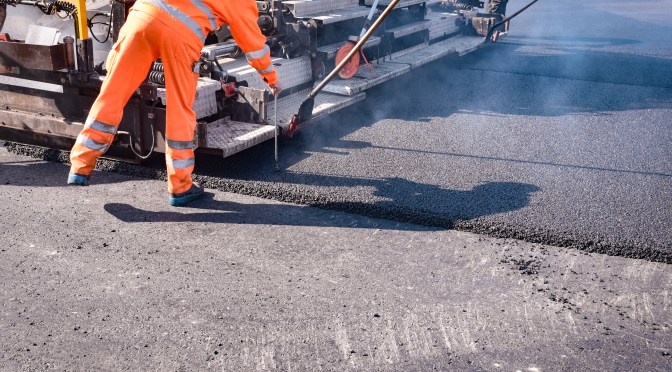
High Friction Surface Treatments (HFST) are pavement treatments that involve applying a high-quality aggregate and binder to pavement surfaces to help maintain friction. The treatment has significantly reduced crashes and injuries in wet and dry road conditions in high crash areas. However, HFST can be a costly treatment. Researchers, funded by MnDOT and the Local Road Research Board, are evaluating if taconite, a readily available Minnesota byproduct, can be an effective alternative treatment in low volume areas.
Continue reading Testing High Friction Aggregates using SCRIM Technology at MnROADCategory Archives: Materials and Construction
New Project: Vulnerability Assessments of Critical Slope Areas Using Advanced Monitoring Techniques
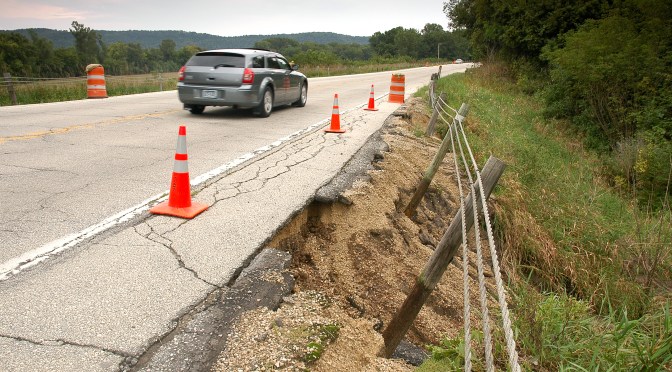
MnDOT continues working on systematically and proactively assessing stability of slopes along its highway system. Efforts are aimed at minimizing the potential for slope failures that could result in threats to public safety and costly repairs.
Continue reading New Project: Vulnerability Assessments of Critical Slope Areas Using Advanced Monitoring TechniquesNew Project: Long-Term Field Performance Evaluation of Chip Seals
Chip seals are an economical road surface treatment that MnDOT and counties use to enhance existing pavement performance and service life. A thin layer of asphalt emulsion sprayed on the pavement surface and mixed with aggregate chips can address minor pavement distresses and seal the pavement surface to reduce the impacts of further wear.
Continue reading New Project: Long-Term Field Performance Evaluation of Chip SealsPFAS “Forever Chemicals” Can be Reduced in Highway Construction and Maintenance Projects
Taken from TRB Weekly – June 25, 2024
Per- and polyfluoroalkyl substances (PFAS) are a class of more than 6,000 contaminants of emerging concern that can harm both ecosystems and human health. These anthropogenic compounds contain carbon–fluorine bonds that make them stable and persistent in the environment, earning them the nickname “forever chemicals.”
Continue reading PFAS “Forever Chemicals” Can be Reduced in Highway Construction and Maintenance ProjectsSolutions to Mitigate Dowel/Tie-Bar Propagated Cracking – Phase 1
Cracking and spalling of concrete pavements reduce the service life of the roadway and result in added costs to an agency and disruptions to the traveling public when the damage is repaired.
Continue reading Solutions to Mitigate Dowel/Tie-Bar Propagated Cracking – Phase 1Development of Mix Designs and Matrix of Materials for MnROAD Low Carbon Concrete Test Site
To address climate change mitigation goals, highway agencies are seeking alternative concrete paving mixtures that have a reduced embodied carbon content (ECC).
The research team first focused on developing a matrix of reduced ECC concrete mixtures to be tested at MnROAD. The 16 concrete mixtures selected for inclusion in the test matrix met minimum engineering requirements to ensure constructability and performance and were approved by MnDOT.
Between July 27 and August 9, 2023, 16 test cells were constructed at the MnROAD I-94 facility to evaluate reduced ECC concrete paving mixtures. The purpose of constructing these cells was to assess the in-service performance, environmental impact, and constructability of various alternative supplementary cementitious materials (ASCMs) that may reduce the embodied carbon content of concrete, while providing an opportunity to assess test results and in-service performance in coming years.
A preliminary environmental assessment showed that most mixtures were expected to have either a similar or lower ECC compared to the control mixture representative of typical MnDOT paving-grade concrete. Quality assurance testing conducted on field-cast specimens revealed generally acceptable results; most of the materials had similar performance compared to the control mixture, but the cells will continue to be monitored.
Finding High-Performing Aggregate Bases for Long-Lasting Pavement
Two county roads provided a testing ground for three combinations of aggregate bases and asphalt binders. Results from more than two decades of research and monitoring of pavement test sections validated previous conclusions. A larger gradation aggregate base showed superior performance over the pavement life cycle when compared with the standard aggregate base. Additionally, sections constructed without transverse joints to allow natural thermal cracking outperformed sections with sawn and sealed joints.
Continue reading Finding High-Performing Aggregate Bases for Long-Lasting PavementNew Project: Improving and Developing Pavement Design Inputs and Performance Functions for Cold Recycled Pavement Layers
Local agencies in Minnesota use cold recycling technologies for flexible pavement rehabilitation because of their economic and environmental benefits. The three main methods are cold in-place recycling (CIR), cold central plant recycling (CCPR), and stabilized full-depth reclamation (SFDR).
Continue reading New Project: Improving and Developing Pavement Design Inputs and Performance Functions for Cold Recycled Pavement LayersAdapting Asphalt Mixtures for Tougher Rural Roads
Seasonal and daily temperature variations, freeze-thaw cycles and other environmental factors lead to pavement distress on low-volume rural roads. Modifying asphalt mixtures could improve pavement resistance to these environmentally driven distresses. A comparison of the mechanical properties and performances of selected asphalt mixtures identified a mixture and method that hold considerable promise for improving performance and longevity on low-volume roads.
Continue reading Adapting Asphalt Mixtures for Tougher Rural RoadsMeasuring Pavement Density for Sustainable Centerline Joints
Longitudinal joints, created when lanes are paved sequentially, often need significant maintenance as the joints crack or deteriorate. While materials, construction methods and other factors may cause joint deterioration, insufficient pavement density is primarily responsible for weak joints, and measuring density has not traditionally been a widespread practice. New recommendations for joint construction and quick, nondestructive methods of measuring density during construction will support local agencies in laying longer-lasting pavement.
Continue reading Measuring Pavement Density for Sustainable Centerline Joints