

Boulevards play an important role along a roadway. This open space located just behind the curb provides snow storage for roads and sidewalks, a place for rain and runoff to soak into the ground, and attractive green space in our city neighborhoods. In addition to their aesthetic appeal, trees planted in the boulevard along a roadway offer valuable environmental benefits. They save energy and lower temperatures, reduce greenhouse gases, and reduce stormwater runoff.
Continue reading Creating a Leafy Boulevard: Best Practices for Tree SelectionAll posts by Julie Swiler

Guidelines for Implementing Mini-Roundabouts
Increasingly, roundabouts are the solution of choice for many intersections because they improve safety and traffic flow and reduce pollution due to less vehicle delays. Traditional roundabout design typically requires a larger footprint than a conventional four-way intersection.
Continue reading Guidelines for Implementing Mini-Roundabouts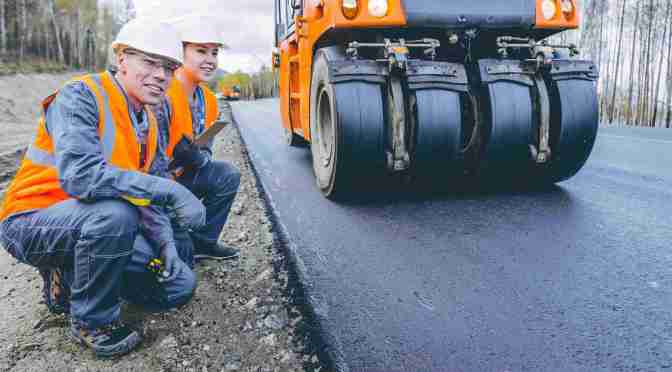
Staffing up: Resources to Grow Your Roadway Maintenance Workforce
Local transportation agencies in Minnesota continue to face worker shortages as many struggle to hire and retain employees. Recognizing this challenge, the Minnesota Local Road Research Board partnered with Minnesota LTAP to develop marketing resources for local transportation agencies to use to recruit and retain roadway maintenance workers.
Continue reading Staffing up: Resources to Grow Your Roadway Maintenance Workforce
NCITE Webinar: LRRB Mini-Roundabout Guidance
Tuesday, August 6, 10-11 a.m., free to attend
Increasingly, local agencies are opting for mini-roundabouts for some locations instead of traditional roundabouts, which typically require a larger footprint than a standard four-way intersection. Mini-roundabouts are characterized by a small diameter and fully traversable islands (central island and splitter islands).
Join the Apex Engineering Group for a presentation on the Local Road Research Board project, Mini-Roundabout FAQs. Project team members Michael Marti and Zach Heimer with SRF Consulting Group and Jon Pratt with the City of Detroit Lakes will discuss this new guidance.
The guidebook defines mini and compact roundabouts and provides selection criteria on when to use them as well as details regarding the center treatment. The FAQ format provides easy navigation to technical information.
If you have difficulty accessing the meeting, use the meeting ID and passcode:
- Meeting ID: 251 050 866 163
- Passcode: tGP6ix

New Project: Improving and Developing Pavement Design Inputs and Performance Functions for Cold Recycled Pavement Layers
Local agencies in Minnesota use cold recycling technologies for flexible pavement rehabilitation because of their economic and environmental benefits. The three main methods are cold in-place recycling (CIR), cold central plant recycling (CCPR), and stabilized full-depth reclamation (SFDR).
Continue reading New Project: Improving and Developing Pavement Design Inputs and Performance Functions for Cold Recycled Pavement Layers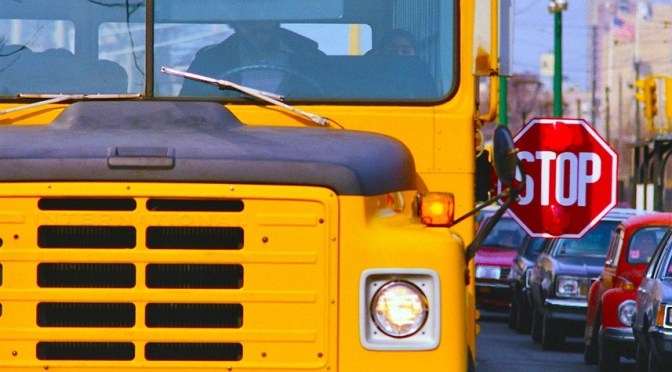
New Project: Development of a System to Report School Bus Stop Arm Violations
When a motorist ignores an extended school bus stop arm, it creates a direct and serious risk to children boarding and exiting a school bus. Capturing information about such incidents is a critical step in better understanding why they occur and how they can be prevented.
Continue reading New Project: Development of a System to Report School Bus Stop Arm Violations
New Project: Evaluation of Static and Dynamic No Right Turn on Red Signs at Traffic Signals
Making signalized intersections safer for pedestrians can be achieved by reducing points of conflict between pedestrians and vehicles. One source of conflict occurs when a vehicle makes a right turn on red (RTOR) onto a street in which pedestrians are crossing. During this turn, the driver must cross the path of pedestrians while at the same time searching for gaps in conflicting vehicle flow.
Continue reading New Project: Evaluation of Static and Dynamic No Right Turn on Red Signs at Traffic Signals
New Project: Assessing Methods to Mitigate Cognitive and Physical Declines That Influence Driving Performance of Older Drivers
Supporting older drivers to safely age in place as they experience age-related declines is important as many Minnesota drivers are reaching retirement age. Minnesotans, 65 years and older, are expected to represent 20% of the state population by 2025, with an overall increase of 122% from 2010-2040. While older drivers are generally safe drivers, those aged 75-85 face the highest risks from injury.
Continue reading New Project: Assessing Methods to Mitigate Cognitive and Physical Declines That Influence Driving Performance of Older Drivers
New Project: Mitigating Tenting of Transverse Cracks and Joints in Asphalt Pavement
More than 60% of Minnesota’s roadways consists of asphalt pavement. When transverse cracks occur in asphalt, our frigid winters can cause a secondary distress known as pavement tenting, crack heaving, or lipping. As ice accumulates in the base materials underneath, it causes pavement on both sides of the transverse cracks and joints to heave.
Continue reading New Project: Mitigating Tenting of Transverse Cracks and Joints in Asphalt Pavement
New Project: Using Apps to Notify the Public of Local Road and Bridge Closures
The traveling public increasingly relies on navigation systems to get to their destinations. Currently, there is not a system, tool, or process being used by cities and counties in Minnesota to report road or bridge closures for use by transportation agencies to display to the traveling public or for use by third-party mapping/navigation companies (e.g., Waze, TomTom, HERE Technologies, Google Maps) to provide to the public.
This project will document up to three best practices for manual local road closure reporting, describe an approach that the Local Road Research Board could use to develop or implement an existing user-friendly road closure reporting system, and provide guidance on how to report closures to third-party mapping/navigation companies.
Objectives
MnDOT already operates and maintains a statewide traveler information reporting system known as CARS. This project will review and summarize the options and approach for adapting it for local road entry. As part of the study, researchers will:
- Develop best practices for reporting systems by documenting four examples used in other states for establishing and operating tools to report local road closures.
- Define three options for how to make a user-friendly system for local Minnesota agencies using the outcomes of the best practices summary.
- Prepare users guide for entering information into existing mapping tools that will assist in understanding the process to submit road closures and mapping updates to established mapping/navigation providers.
Project Details
- Estimated Start Date: 12/19/2022
- Estimated Completion Date: 03/31/2024
- Funding: Local Road Research Board
- Principal Investigator: Dean Deeter
- Technical Liaison: Perry Clark
Details of the research study work plan and timeline are subject to change.
To receive email updates about this project, visit the Local Road Research Board to subscribe.
 Crossroads