Originally published in Catalyst, February 19, 2025
Transit service planning has traditionally focused on peak trips and the needs of “rush hour” commuters rather than off-peak travel. Often, off-peak trips are taken by shift-based essential workers and those who cannot or do not drive. The COVID-19 pandemic further underscored the need for a closer examination of these trips to improve social equity.
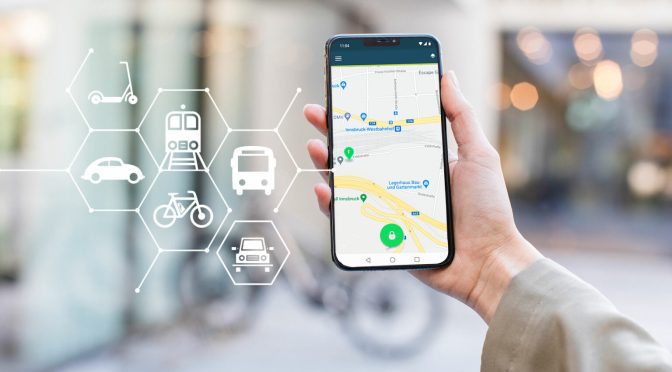
Mobility-as-a-Service (MaaS) transit planning apps provide a simple, convenient way for transit users to plan trips, make payments, and book on-demand rides—enhancing the user experience and encouraging more transit use. While prevalent in urban areas, these apps are uncommon in rural settings.
Freight transportation is evolving rapidly, and its future success will require managing increased residential demand, planning for equity, and incorporating micro-delivery options such as cargo e-bikes. At the 2024 CTS Transportation Research Conference, three experts shared their knowledge of these trending topics in a session focused on the future of urban freight.
In response to the increasing demand for residential package delivery spurred by the shift towards online shopping, U of M Department of Industrial and Systems Engineering PhD student Can Yin shared her research on mobile parcel locker scheduling. Yin explained that in the growing ecommerce market, last-mile delivery is the most expensive and time consuming. While door delivery is commonly used, it can be unsecure and inconvenient for customers.
“Parcel lockers are an alternative, but they come with the disadvantages of limited locations, expensive fixed cost, and the inability to adapt to varying demand,” Yin said.
A newer, more flexible alternative is the use of mobile, vehicle-based parcel lockers, which offer greater flexibility, higher accessibility, and lower fixed costs—particularly if autonomous vehicles eliminate the need for driver salaries. However, mobile parcel lockers also create challenges for e-commerce businesses such as estimating demand and customer choices.
To address these challenges, Yin’s research team developed a mobile parcel locker demand-estimation model. Additionally, the researchers found that compared with stationary lockers, mobile lockers offer a better value and demand fulfillment.
Another challenge surrounding the rapid growth of e-commerce and urban freight is racial equity in urban freight planning. In his presentation, University of Washington Urban Freight Lab researcher Travis Fried explained how his research is seeking to better understand these inequities and create a framework for mitigating them.
The past and present systems that perpetuate the segregation of people and neighborhoods have been well documented. However, Fried said there is little research exploring how these patterns play out in freight planning and their impacts on air quality, health, and road safety for people of color. Fried’s research looked at high-volume traffic exposure and found that low-income populations of color were disproportionately exposed to e-commerce traffic.
“By our most conservative estimate, BIPOC [Black, Indigenous, and people of color] populations were exposed to 35 percent more traffic related to last-mile home delivery on average, despite ordering less than half as many packages as white populations,” Fried said. That’s because delivery facilities and highways are disproportionately located near historically marginalized neighborhoods, he explained.
In light of this finding, Fried emphasized the importance of including equity considerations when prioritizing urban freight strategies. “Solutions focused on the upper end of the distribution chain have outsized benefits for marginalized communities, so we need to consider that in our cost-benefit evaluations and engagement strategies,” he added.
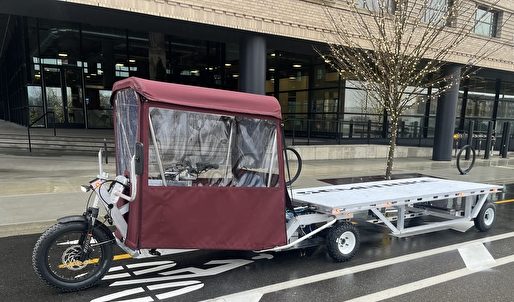
Using cargo e-bikes for last-mile freight delivery was the topic of the session’s final presentation from Marc Liu of Civilized Cycles. Liu explained how his company’s innovative semi-trike—which has as much cargo capacity as a small delivery van—can be used to move a significant amount of cargo over short distances, particularly within campus environments such as universities, hospitals, residential developments, and military bases.
Semi e-trike from Civilized Cycles
“Regardless of what these campuses are moving, they have the same core challenge of moving as much cargo as possible while keeping operating costs as low as possible,” Liu said. “On top of that, emissions and safety are key concerns because most of this happens in pedestrian-heavy areas.”
Liu explained that the first customers for the cargo e-bikes are micro-mobility fleet operators at the forefront of sustainable transportation including Lime, Net Zero Logistics, and Amazon. Moving forward, the company is targeting campus environments for expansion. Liu said that “economics drives adoption” and believes the key to adoption is offering an affordable, American-made product that reduces vehicle fleet costs, increases safety, improves efficiency, and reduces greenhouse gas emissions.
To better understand how Minnesota’s small public airports affect their local economies, researchers from the Transportation Policy and Economic Competitiveness Program (TPEC) at the University of Minnesota’s Humphrey School of Public Affairs chose three to profile from across the state. They shared their findings at the 2024 CTS Transportation Research Conference in a presentation highlighting the complex roles and community impacts of local airports.
“We were prompted by questions from several stakeholders, including TPEC advisory board members, to see if there were any travel changes or other impacts from the COVID-19 pandemic or high levels of inflation that had happened since those other studies were completed,” said Frank Douma, director of state and local policy and outreach at the Humphrey School’s Institute for Urban and Regional Infrastructure Finance (IURIF) and the project lead. The research team also included Barbara Rohde, IURIF researcher and licensed pilot, and Audrey Clark, an urban/regional planning graduate student.
Data for the three airport profiles was gathered through interviews with airport and city officials in February and May of 2024.
Granite Falls Municipal Airport
Unique among the three airports studied, the Granite Falls Municipal Airport in west central Minnesota receives no federal funding and attributes its ongoing success to the support of MnDOT and the local business community. A primary user for this 152-acre, one-runway airport is one of the biggest energy and ethanol firms in the Midwest—Fagen, Inc. The company hosts visitors from all parts of the US who travel to Granite Falls in corporate jets for meetings and tours.
The airport is also an active UPS hub—vital for supporting local resident and business needs—and draws tourists with a local bi-annual airshow held in association with the Fagen Fighters WWII Museum that showcases a collection of working aircraft from the era.
Mankato Regional Airport
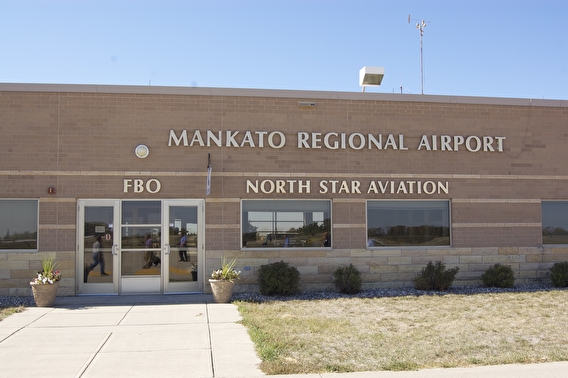
“It may be a surprise to some, but the Mankato Regional Airport is the second busiest in the state, following Minneapolis-St. Paul International,” Douma said of the airport located in south-central Minnesota.
Most of the operations on the airport’s two runways support and serve student pilots; North Star Aviation, a major US flight school, trains 700 aviation students who log more than 40,000 flight hours annually. “As a person who has taken many flight school lessons, I was so impressed,” said Rohde. “These kids fly until 11 at night to get their time in.” The school provides a direct recruitment pipeline to Minneapolis-based Sun Country Airlines.
The airport also serves the area’s retail, agriculture, and health care industries, which include:
A 450,000-square-foot Walmart Distribution Center that opened in 2015 and is undergoing a major expansion.
Veterinarians who board planes every morning to travel the country for swine testing.
Mayo Clinic helicopters, based here to take advantage of the central location.
Roseau Municipal Airport
Ten miles south of the Canadian border, Roseau Municipal Airport mostly serves the Polaris company’s 1,500-employee manufacturing facility, ferrying executives and researchers across the US from the airport’s single paved runway. Additionally, the airport focuses on supporting community development and health care access with medevac transportation.
Conclusions and next steps
Local airports contribute significantly to the economic competitiveness, community pride, and identity of the Minnesota cities that host them, the researchers found. However, the nature of those contributions is different for each airport, encompassing transportation links, business facilitation, tourism, and emergency services.
A subgroup of TPEC advisory board members recently formed to further expand this research and seek national, state, and institutional partnerships.
Effective stormwater management is essential for maintaining healthy urban environments, but it requires consistent monitoring and maintenance to prevent costly failures—something that municipalities across the state have struggled with for years.
At a recent CTS webinar, Andy Erickson, research manager at the University of Minnesota’s St. Anthony Falls Laboratory and CTS scholar, guided more than 160 attendees through recent changes made to the Minnesota Stormwater Inspection and Maintenance Resource Guide. The original guide, published in 2009, has been revised to incorporate more than a decade’s worth of field applications, research, and practical experience. The updated resource aims to improve the inspection, operation, and maintenance of stormwater management practices across the state, providing practitioners with essential tools to optimize stormwater management and increase cost-effectiveness.
Stormwater management is crucial for controlling urban runoff, and systems such as green infrastructure and low-impact development reduce pollution before stormwater is sent to lakes, rivers, and streams. However, these systems require regular upkeep to remain effective, and maintenance challenges arise from their passive nature and logistical issues in large urban areas. One key problem is the lack of on-site staff for monitoring and making the proactive inspections vital for preventing failures. Regular maintenance can reduce costs by avoiding the need for major repairs, but municipalities may still struggle to stay within their maintenance budgets, as funding for upkeep is often inadequate compared to the cost of new infrastructure.
“Since there are no operating staff on-site to see when these things fail or see what’s causing them to fail, we have to be proactive in our inspections,” Erickson said. That means inspectors must travel multiple times to locations spread out across the metro region—which significantly increases costs. “Depending on the size of the practice, your total maintenance cost might become more than your original construction cost within five years of the life of that practice,” he said.
The 2024 update to the Minnesota Stormwater BMP Maintenance Resource Guide aims to address this issue by offering detailed instructions for inspecting and maintaining various stormwater systems. The updated guide includes inspection checklists in the form of fillable PDF documents. These checklists should streamline the inspection and documentation process and help inspectors assess site conditions, including vegetation health, erosion, and drainage performance. And the forms can be easily updated and reused, providing a practical tool for ongoing stormwater management. “The forms are not static, but rather are intended to serve as a resource that can be used and adapted to fit a jurisdiction’s particular needs,” Erickson explained.
Following items from the checklist, the guide provides specific maintenance recommendations based on inspection findings, including how to address issues such as erosion, vegetation dieback, and structural failures.
“You can go through these to really home in on what maintenance is needed and when the maintenance is needed,” Erickson said.
The updated Minnesota Stormwater BMP Maintenance Resource Guide is now available online for download.
A new video developed by the Center for Transportation Studies highlights a multiyear study of pedestrian safety at reservations that was undertaken by U of M researchers and partners from seven Anishinaabe tribes. The work was sponsored by the Minnesota Department of Transportation (MnDOT).
What’s the right speed limit for local roads?Legislation passed in 2019 makes it possible for Minnesota cities to set speed limits below 25 mph without special approval. As a result, it’s a question many local transportation officials have been considering.
A U of M study determined that the leaves, flowers, and seeds dropped by trees in urban areas are a big polluter of stormwater. The project researchers recommend street sweeping as one way to address this issue—and they provide guidance on how to effectively time and target sweeping efforts.
Automatic vehicle location (AVL) systems using GPS are creating opportunities for local agencies to improve their operations even in real time. A five-page guide and a video from the LRRB highlight the features and benefits of such systems for snowplowing.
Public transit systems are instrumental for reducing auto travel and related greenhouse gas (GHG) emissions. But how much of a reduction depends in part on how transit lines operate—on dedicated right-of-way (ROW), in mixed traffic, or some variation.







 Crossroads