New guidelines developed for counting bike, pedestrian traffic

Image
Manual field counts require more labor than automatic technologies, but they can collect deeper data about demographics and helmet use. Both forms of monitoring are necessary to give a complete picture of bicycle and pedestrian traffic in the state.

To prepare for a multimodal future, state agencies must be able to plan and engineer a transportation system for all modes of transportation, including bicycle and pedestrian traffic.

The Minnesota Bicycle and Pedestrian Counting Initiative was launched to develop consistent methods for monitoring non-motorized traffic across the state. Researchers developed guidelines for manual counts using state and national examples, and they also created methods for extrapolating annual traffic volumes from short-duration automated counts, for integration into MnDOT’s vehicular count database program.

The guidance developed for manual counts includes forms, training materials, public information for passers-by, links to smartphone applications that provide counting locations and spreadsheets for reporting results.

MnDOT hosted six workshops and a webinar to introduce local officials to the initiative and recruit participants for pilot field counts. Researchers then analyzed how these field counts could be used with existing automated counts to extrapolate daily or annual data.

MnDOT has installed some of the very first automated counting equipment on a state road — Central Avenue NE in Minneapolis (on the bike lane) and Highway 13 in Eagan (on a shoulder). As of 2012, six agencies in Minnesota counted non-motorized traffic (annual reports are available from the city of Minneapolis and Transit for Livable Communities), and even though comprehensive data is not yet available, Minnesota is a leader in this type of monitoring with more than 1,000 manual count locations and 32 automatic count sites.

Because of Minnesota’s experience, researchers collaborated with the National Cooperative Highway Research Program’s national Methodologies and Technologies for Collecting Pedestrian and Bicycle Volume Data research project, due for release in 2014, and contributed to the Federal Highway Administration’s effort to update its Traffic Monitoring Guide to include a chapter on non-motorized traffic.

Learn more:

Uncovering manufacturers’ perspectives on the transportation system

It’s no secret that manufacturing plays a key role in driving economic growth, or that transportation is essential for the success of any manufacturing operation.

While the relationships among manufacturing, transportation, and economic growth have been studied on a large scale, there is often little dialogue between transportation organizations and the manufacturers themselves. A recently completed pilot study conducted jointly by the Minnesota Department of Transportation (MnDOT), the University of Minnesota Humphrey School of Public Affairs, and University of Minnesota Extension aims to address this communication gap.

The pilot project focused on 12 counties in southwest Minnesota, where more than 172 regional businesses were contacted for participation and 75 in-person interviews were completed with manufacturers, shippers, and carriers. During the interviews, participants were encouraged to focus their comments on high-value, low-cost improvements that MnDOT can address in the short term without over-promising projects that currently cannot be funded.

Participants identified the need for smooth pavements and wide shoulders, the value of advance warning lights at intersections with traffic signals, the importance of highway safety, and the challenges of maneuvering oversized vehicles through roundabouts, among others.

The research team is compiling the pilot study’s findings into a final report. In the meantime, MnDOT is working to address a number of the challenges and suggestions uncovered through the pilot program.

Read the full article in the December issue of Catalyst.

New technology aimed at making rural intersections safer

This video above showcases a new kind of intersection conflict warning system being developed for use primarily by local agencies at rural, two-way stop intersections. Called the ALERT System, it uses a simple but ingenious combination of radar, wireless communication and flashing LEDs to alert drivers to the presence of approaching vehicles, thereby helping them identify safe gaps in the cross traffic and avoid potentially deadly collisions.

These types of systems are nothing new; MnDOT and other state DOTs have been developing them for more than a decade under the ENTERPRISE pooled fund program. MnDOT also recently kicked off a three-year project to deploy 20–50 of its Rural Intersection Conflict Warning Systems at selected at-risk intersections across the state. The main difference with the ALERT System is that it’s designed to be cheaper and easier to deploy than existing ICWS technologies. While that might sound like an incremental improvement, the difference for cash-strapped local agencies could be huge.

Since the ALERT System uses solar power, it doesn’t have to be hooked up to the power grid — which means that, in theory, county public works crews could install it themselves. The system also uses a simplified controller that doesn’t require a traffic signal technician to install and maintain, and detects vehicles using radar rather than in-pavement sensors. These factors might encourage greater adoption of ICWS technologies, which studies have shown to reduce both the frequency and severity of crashes.

The project is now in its second phase. It still faces a number of hurdles before could be ready to deploy, but Vic Lund, the traffic engineer for St. Louis County and the project’s main champion, says the results so far have been encouraging. In the video below, Lund shares his thoughts on the project, its challenges and the future of Intelligent Transportation Systems in Minnesota.

Learn more:

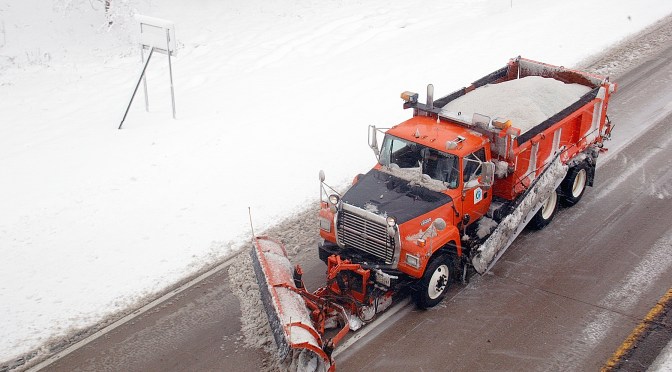
New study to shed light on environmental impacts of deicers

Even naturally derived products like corn syrup and beet juice can impact the environment when applied to salt mixtures for winter roadways.

A wide range of products, including the ones mentioned above, are added to deicing mixes to limit the amount of salt needed for Minnesota roads each winter. However, although information is available about the corrosive properties of various deicing chemicals, less is known about the toxicity of these compounds, especially to the aquatic environment.

Thanks to a recently completed project sponsored by the Clear Roads Pooled Fund, MnDOT winter maintenance personnel will better understand the relative toxicity of eight common deicing agents, which also include non-organics like Magnesium Chloride, Calcium Chloride and Potassium Acetate.

“Because the state has been trying a lot of different alternative chemicals, we wanted to get a better handle on the environmental impacts,” said MnDOT engineer Tom Peters, the technical liaison for the 26-member, Minnesota-led pooled fund for winter maintenance research.

In January, researchers plan to release a concise summary of the toxicity rankings to help winter highway maintenance managers consider both expected levels of service and potential harm to the environment when selecting a deicer.

A Dec. 3 webinar available on the Clear Roads website discusses their findings.

About Clear Roads

Minnesota is the lead state for the Clear Roads Pooled Fund, which conducts rigorous testing of winter maintenance materials, equipment and techniques. Other recent and upcoming research (see our Technical Summary on the program) includes a winter maintenance cost-benefit analysis toolkit, snow removal techniques at extreme temperatures and environmental factors that can cause fatigue in snowplow operators.

You can learn more about Clear Roads via the project’s e-newsletter.