
Tag Archives: unmanned aircraft systems

Future of Mobility: Urban air mobility

June 26, 2023

What’s next in transportation?

The Future of Mobility series collects the perspectives of top U researchers and other national experts. In 17 articles, the authors scan the horizon and reflect on critical transportation topics. Each article recommends action steps for public officials and policymakers.

CTS is highlighting the articles over the course of the year. This month, we explore two aviation-related articles:  Safety and Urban Air Mobility by Demoz Gebre-Egziabher and Advanced Air Mobility by Susan Shaheen and Adam Cohen.

Autonomous aircraft and drones that can move people and goods in new ways are coming to our cities, writes Gebre-Egziabher. Often referred to as urban air mobility (UAM), these new transportation concepts are the flying equivalent of the autonomous car—and they raise just as many important questions about safety, use, and operations. Local communities and agencies are stakeholders that must have a say in safety and provide clear guidance to those developing technologies for UAM, he says.

Shaheen and Cohen write that aviation is undergoing rapid change around the world. A variety of technological advancements and industry investments in electrification, alternative fuels, automation, vertical take-off and landing aircraft, uncrewed aircraft systems, and air traffic management are enabling innovations in aircraft designs, services, and business models. They recommend driving the industry forward with an emphasis on social and environmental benefits, including humanitarian, aeromedical, and emergency response.

Unmanned aircraft systems create buzz of activity, but challenges remain

In late 2013, Amazon.com announced that it plans to someday use unmanned aircraft systems (UASs) to deliver packages. Amazon is not alone in considering these systems—the list of potential uses for this technology is rapidly expanding. Where is this technology headed, and what does it mean for the region, and for transportation?

State and national experts discussed these issues at an April 30 forum hosted by the Airport Technical Assistance Program (AirTAP), a part of CTS.

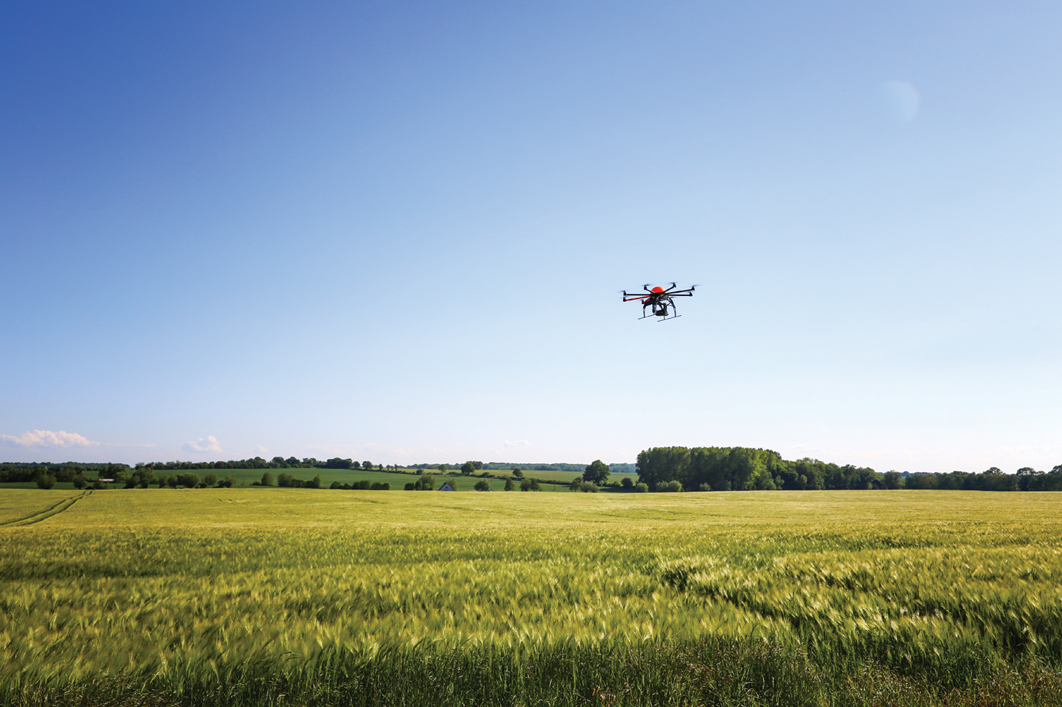
Often referred to as drones, modern UASs can be used for a broad range of activities, from aerial photography, surveying, precision agriculture, and communications to disaster response, wildlife research, and infrastructure protection.

Potential uses of UASs include precision agriculture.

A hurdle to broader use is the lack of rules and regulations. Last November the Federal Aviation Administration (FAA) released its first annual roadmap outlining policies, regulations, technologies, and procedures needed to safely integrate UASs into U.S. airspace; it plans to issue regulations by 2015.

“The greatest challenge is integrating UASs into the National Airspace System,” said Brigadier General Alan Palmer, director of the Center for UAS Research, Education, and Training at the University of North Dakota. “We want to do this safely, we want to do no harm, and we want to be sure not to violate somebody’s personal space. We do not have any regulations for standards, training, certification, or anything like them. But we will get there.”

Other concerns include privacy issues and the existing aviation/navigation infrastructure, which did not account for a future including UASs when it was built 50 years ago.

To learn more about the forum, read the full article in the June issue of Catalyst. In addition, a proceedings from the event will be available on the AirTAP website this summer.