
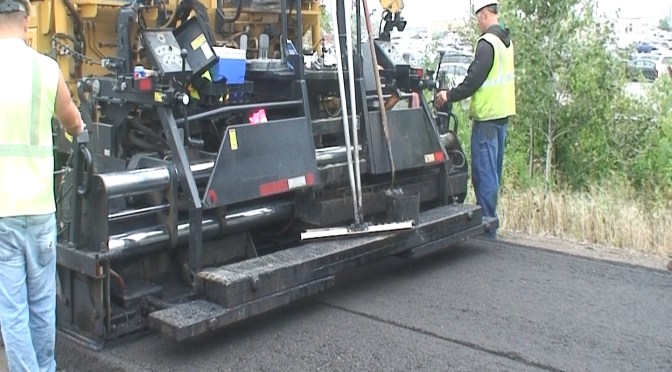
The use of recycled asphalt pavement (RAP) materials in asphalt pavement construction provides numerous benefits, including reduced material costs, fewer environmental impacts and decreased demand for virgin aggregates and asphalt binders. While previous research has examined the performance of RAP materials, less attention has been given to their compaction properties. This project examined RAP mixtures with varying RAP contents to better understand their implications for pavement construction and environmental sustainability.
What Was the Need?
Road projects commonly use RAP in asphalt mixtures to reduce material costs, conserve virgin materials and improve pavement construction sustainability. However, concerns remain that increased RAP content could reduce compactability and crack resistance, negatively impacting pavement performance.
A better understanding of RAP material characteristics and mixture behavior is therefore critical to developing mixture designs that can reliably provide pavement durability and field performance. This project investigated RAP mixture design, compaction behavior at varying RAP contents, the impact of graphite nanoplatelet (GNP) modification and the low-temperature performance of different RAP mixtures.
What Did We Do?
This study analyzed RAP samples from three projects that used the same pavement mixture. Because RAP materials are not uniform, investigators evaluated the samples using processed black-and-white curves, chunk index, gradation, moisture content and binder content. For example, the chunk index measure material homogeneity, with higher homogeneity being desirable for mixing with virgin materials.
The first phase of testing analyzed RAP mixtures containing 25%, 40% and 50% RAP using a gyratory compactor. A mix design spreadsheet documented the proportions of virgin aggregates and RAP needed to achieve target gradations.
Next, investigators evaluated the compaction performance of GNP-modified RAP mixtures by comparing a 50% RAP mixture with and without 6% GNP at compacting temperatures of 135°C, 115°C and 95°C. Previous research indicated that adding GNPs to RAP mixtures can significantly improve low-temperature flexural strength and allow contractors to compact asphalt mixtures to higher densities, potentially improving pavement durability and performance.
Lastly, the project examined the low-temperature strength, fracture and creep performance of RAP mixtures by performing semi-circular bend fracture and bending beam rheometer mixture tests on blends containing 0%, 25%, 40% and 50% RAP.
What Did We Learn?
Gyratory compaction testing showed that mixtures with higher RAP contents required fewer gyrations to reach the target air void level. Specifically, the 50% RAP mixture achieved the targeted 5% air voids with fewer gyrations than the 40% and 25% mixtures. Investigators concluded that the improved compaction was likely due to a greater contribution from mobilized binder under the heating and mixing conditions. As RAP content increased, the amount of effective binder also increased, improving lubrication between aggregate particles and reducing resistance to densification.
Adding 6% GNP moderately improved compaction and reduced gyration demand, although the benefits diminished at lower compaction temperatures. Lowering the compaction temperature from 135°C to 115°C had little impact, but reducing the temperature further to 95°C significantly increased gyration requirements. These findings suggest that adding GNP could improve compactability and may allow for some reduction in heating and compaction temperatures.
Low-temperature semi-circular bend and bending beam rheometer testing showed that RAP mixtures had fracture energy comparable to the virgin mixture and generally higher fracture toughness and flexural strength. Within the range of 25% to 50% RAP, increased RAP content did not result in significant differences in low-temperature creep or strength behavior.
“These results provide promising evidence for potentially increasing the use of RAP materials, but more work is needed to implement it for use in the field,” said Eddie Johnson, Researcher, MnDOT Office of Materials and Road Research.
Overall, the findings demonstrated that RAP mixtures prepared under appropriate laboratory conditions can achieve satisfactory compactability and low-temperature performance. However, replicating these preparation conditions in the field may be challenging and costly.
What’s Next?
While project findings support the continued use of RAP mixtures, additional research could further improve understanding of RAP performance, including:
- Quantifying binder activation based on RAP source, heating temperature, mixing procedure and mixing duration.
- Evaluating the effect of the RAP heating process on binder mobilization and compaction performance.
- Conducting field validation of findings from this project, particularly the improved compactability with higher RAP contents and the benefit of adding GNP.

