
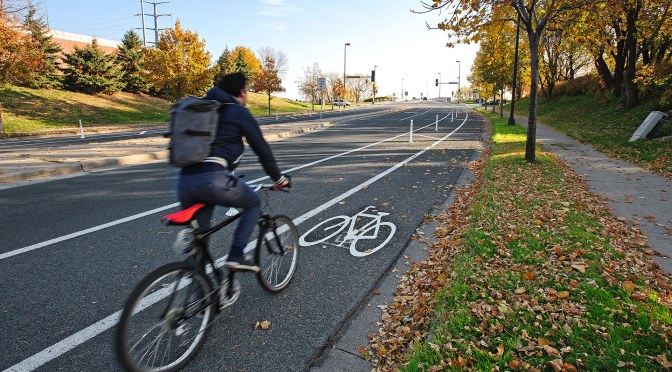
MnDOT relies on estimates of annual average daily traffic volumes to plan and maintain safe, effective transportation network infrastructure for all travelers. Estimating traffic volumes for nonmotorized road users such as bicyclists and pedestrians has been challenging because monitors are limited compared to vehicle traffic counters. Data from mobile devices, routinely collected through a variety of platforms, offers a potential source of traveler routes. Using monitored nonmotorized traveler data to validate mobile datasets, researchers produced a data visualization tool to estimate bicyclist and pedestrian counts within the Twin Cities area.
Continue reading Using Mobile Device Data to Estimate Bicyclist and Pedestrian TrafficTag Archives: pedestrian traffic

Crowdsourcing meets transportation planning with bike and pedestrian data counts
Increasing active transportation is an ongoing effort for transportation planners. Biking and walking can help decrease auto dependence, air pollution, and climate change and improve public health. Plus, it can help transportation agencies meet their strategic goals. The challenge? Making good decisions requires good data, and data for walking and biking trips can be hard to find.
Continue reading Crowdsourcing meets transportation planning with bike and pedestrian data counts
New guidelines developed for counting bike, pedestrian traffic

To prepare for a multimodal future, state agencies must be able to plan and engineer a transportation system for all modes of transportation, including bicycle and pedestrian traffic.
The Minnesota Bicycle and Pedestrian Counting Initiative was launched to develop consistent methods for monitoring non-motorized traffic across the state. Researchers developed guidelines for manual counts using state and national examples, and they also created methods for extrapolating annual traffic volumes from short-duration automated counts, for integration into MnDOT’s vehicular count database program.
The guidance developed for manual counts includes forms, training materials, public information for passers-by, links to smartphone applications that provide counting locations and spreadsheets for reporting results.
MnDOT hosted six workshops and a webinar to introduce local officials to the initiative and recruit participants for pilot field counts. Researchers then analyzed how these field counts could be used with existing automated counts to extrapolate daily or annual data.
MnDOT has installed some of the very first automated counting equipment on a state road — Central Avenue NE in Minneapolis (on the bike lane) and Highway 13 in Eagan (on a shoulder). As of 2012, six agencies in Minnesota counted non-motorized traffic (annual reports are available from the city of Minneapolis and Transit for Livable Communities), and even though comprehensive data is not yet available, Minnesota is a leader in this type of monitoring with more than 1,000 manual count locations and 32 automatic count sites.
Because of Minnesota’s experience, researchers collaborated with the National Cooperative Highway Research Program’s national Methodologies and Technologies for Collecting Pedestrian and Bicycle Volume Data research project, due for release in 2014, and contributed to the Federal Highway Administration’s effort to update its Traffic Monitoring Guide to include a chapter on non-motorized traffic.
Learn more:
- Technical Summary (PDF, 1 MB, 2 pages)
- Research Report (PDF, 1 MB, 69 pages)
 Crossroads