

Public transit systems are instrumental for reducing auto travel and related greenhouse gas (GHG) emissions. But how much of a reduction depends in part on how transit lines operate—on dedicated right-of-way (ROW), in mixed traffic, or some variation.
Continue reading Dedicated transit lanes help attract riders, reduce carbon emissionsTag Archives: light rail
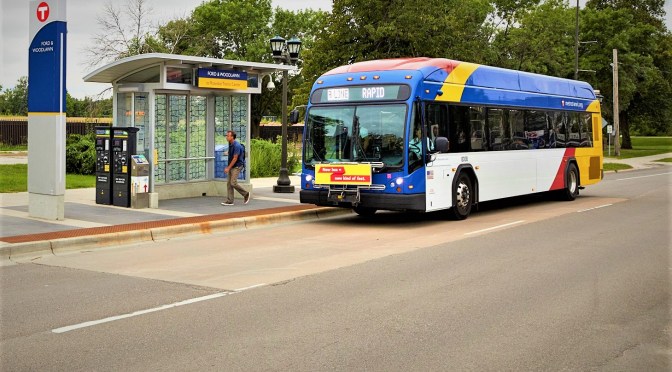
Property Values Remain Stable after Opening of Twin Cities Bus Rapid Transit Line
This article was originally published in Catalyst, January 2022.
Arterial bus rapid transit (BRT) has gained momentum in the Twin Cities as a less-expensive alternative to light-rail transit. However, this expansion of BRT has also raised concerns that the new lines will spur an increase in housing values and neighborhood gentrification, potentially displacing low-income residents. A new study eases these concerns: It found that the A Line BRT route encouraged ridership but had no effect on housing values.
Continue reading Property Values Remain Stable after Opening of Twin Cities Bus Rapid Transit Line
Urban Rapid Transit Reduces Traffic on Nearby Roads
Light rail transit and bus rapid transit in the Twin Cities provide urban residents with fast, safe and reliable transportation. These transitways have the potential to attract more riders and further reduce automobile traffic, relieving the growth of congestion on nearby roads as people decide to be transitway passengers rather than motorists.
Continue reading Urban Rapid Transit Reduces Traffic on Nearby Roads Crossroads