This webinar may not be related to MnDOT research, but we thought you might find it interesting if you drink coffee.
Join CTS and Patrick Hessini, CTS Executive Committee member and head of supply chain at Cameron’s Coffee, for an in-depth look at the challenges and logistics of today’s supply chain. Grab a cup of coffee and bring your lunch as we learn about where and how we get our coffee from trees to mugs.
Registration
This webinar is free, but registration is required. Once you have registered, you will receive an email confirmation with a Zoom link. The link should not be shared with others; it is unique to you.
Freight transportation is evolving rapidly, and its future success will require managing increased residential demand, planning for equity, and incorporating micro-delivery options such as cargo e-bikes. At the 2024 CTS Transportation Research Conference, three experts shared their knowledge of these trending topics in a session focused on the future of urban freight.
In response to the increasing demand for residential package delivery spurred by the shift towards online shopping, U of M Department of Industrial and Systems Engineering PhD student Can Yin shared her research on mobile parcel locker scheduling. Yin explained that in the growing ecommerce market, last-mile delivery is the most expensive and time consuming. While door delivery is commonly used, it can be unsecure and inconvenient for customers.
“Parcel lockers are an alternative, but they come with the disadvantages of limited locations, expensive fixed cost, and the inability to adapt to varying demand,” Yin said.
A newer, more flexible alternative is the use of mobile, vehicle-based parcel lockers, which offer greater flexibility, higher accessibility, and lower fixed costs—particularly if autonomous vehicles eliminate the need for driver salaries. However, mobile parcel lockers also create challenges for e-commerce businesses such as estimating demand and customer choices.
To address these challenges, Yin’s research team developed a mobile parcel locker demand-estimation model. Additionally, the researchers found that compared with stationary lockers, mobile lockers offer a better value and demand fulfillment.
Another challenge surrounding the rapid growth of e-commerce and urban freight is racial equity in urban freight planning. In his presentation, University of Washington Urban Freight Lab researcher Travis Fried explained how his research is seeking to better understand these inequities and create a framework for mitigating them.
The past and present systems that perpetuate the segregation of people and neighborhoods have been well documented. However, Fried said there is little research exploring how these patterns play out in freight planning and their impacts on air quality, health, and road safety for people of color. Fried’s research looked at high-volume traffic exposure and found that low-income populations of color were disproportionately exposed to e-commerce traffic.
“By our most conservative estimate, BIPOC [Black, Indigenous, and people of color] populations were exposed to 35 percent more traffic related to last-mile home delivery on average, despite ordering less than half as many packages as white populations,” Fried said. That’s because delivery facilities and highways are disproportionately located near historically marginalized neighborhoods, he explained.
In light of this finding, Fried emphasized the importance of including equity considerations when prioritizing urban freight strategies. “Solutions focused on the upper end of the distribution chain have outsized benefits for marginalized communities, so we need to consider that in our cost-benefit evaluations and engagement strategies,” he added.
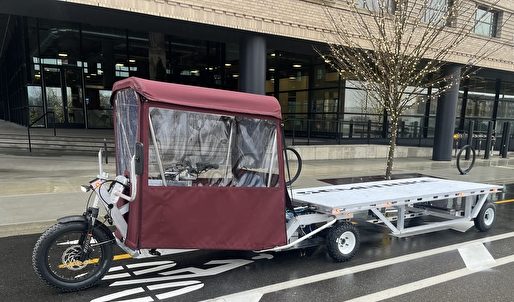
Using cargo e-bikes for last-mile freight delivery was the topic of the session’s final presentation from Marc Liu of Civilized Cycles. Liu explained how his company’s innovative semi-trike—which has as much cargo capacity as a small delivery van—can be used to move a significant amount of cargo over short distances, particularly within campus environments such as universities, hospitals, residential developments, and military bases.
Semi e-trike from Civilized Cycles
“Regardless of what these campuses are moving, they have the same core challenge of moving as much cargo as possible while keeping operating costs as low as possible,” Liu said. “On top of that, emissions and safety are key concerns because most of this happens in pedestrian-heavy areas.”
Liu explained that the first customers for the cargo e-bikes are micro-mobility fleet operators at the forefront of sustainable transportation including Lime, Net Zero Logistics, and Amazon. Moving forward, the company is targeting campus environments for expansion. Liu said that “economics drives adoption” and believes the key to adoption is offering an affordable, American-made product that reduces vehicle fleet costs, increases safety, improves efficiency, and reduces greenhouse gas emissions.
Reprinted from CTS News, March 19, 2024 —Sophie Koch, contributing writer
Hydrogen is getting a lot of attention in recent years as a potential fuel source in the transportation sector. However, it is important to consider the pros, cons, and limitations of this molecule when deciding how to use it.
The goods that continuously move through Minnesota by road, rail, air, water, and pipelines drive the state’s economy, making efficient freight transit—and excellent freight infrastructure—a high priority for the Minnesota Department of Transportation (MnDOT).
An influx of electric trucks is expected on our highways, but where will they charge? Few public stations today can serve large freight vehicles. The challenge? Fast chargers are expensive, and new ones need to be placed strategically to keep pace with growing demand.
Article originally published in Catalyst, February 6, 2023.
Supply chains aren’t normally at the top of the news, but pandemic-related disruptions and empty shelves have put them there. What does the future hold for freight and supply chain resilience? Speakers at the 25th Annual Freight and Logistics Symposium reviewed recent challenges and discussed how to make supply chains more cooperative, connected, and resilient.
Diversity, equity, and inclusion (DEI) are becoming increasingly important factors in the modern workforce. Integrating DEI is not only a strong moral move that can set an organization apart from its peers but also a way to promote innovation, attract talent, and retain valuable employees in a tight labor market.
The Minnesota Department of Transportation (MnDOT) has 137 truck stations across the state. These stations house and allow maintenance of MnDOT highway equipment as well as provide office and work space for highway maintenance staff. Within 20 years, 80 of these stations will need to be replaced as they reach the end of their effective life spans. Researchers developed a geographic information system based modeling tool to determine the most effective locations for truck stations in the state. Using data from many sources, a new research study has determined that MnDOT could rebuild 123 stations, relocate 24 on land available to MnDOT and combine two. MnDOT would save millions of dollars using the location optimization alternatives over the 50-year life cycle of a typical truck station.
The second phase is nearing completion for a project aimed at creating a Unified Permitting Process (UPP) for oversize/overweight (OSOW) vehicles in Minnesota. One outcome of this phase is a roadmap that will define steps for future phases, including statewide implementation.
Currently, haulers need to apply for OSOW permits with each individual roadway authority they will travel through. MnDOT, counties, townships, and cities all administer permits for their own roadways—so several different permit applications and processes can be required for a single haul.
“The streamlined permitting process is expected to increase efficiencies for the freight industry, which is good for our economy,” says Clark Moe, systems coordinator with MnDOT’s Operations Division, Office of Maintenance. “It will also enable more effective enforcement and help us preserve the quality of our road network.”
Through the UPP, agencies should have a better idea of what’s happening on their roads, says Rich Sanders, county engineer for Polk County. “Throughout the state, there are a lot of hauls we don’t even know about, let alone if they will use a restricted bridge or road.”
UPP Phases I and II
Phase I of the UPP project examined the feasibility of implementing a permitting platform. Completed in 2017, this phase included listening sessions across the state with the hauling industry, local agency engineers, law enforcement, state agencies, and MnDOT staff. Eighteen public and private entities collaborated to develop policies, processes, and plans for UPP technology. The final report concluded that a reference platform system for processing permit applications would be the best approach to explore.
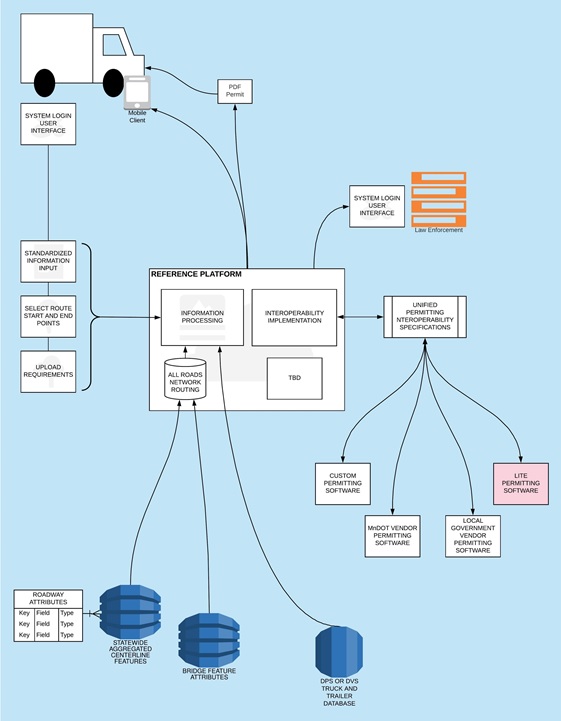
The permitting platform will connect various software and data sources
Phase II was a proof-of-concept pilot project spanning St. Louis County, Polk County, the City of Duluth, and MnDOT Districts 1 and 2. The goal was to see if a permitting platform would work across jurisdictions connecting various permitting software and using multiple system processes. “The platform has to be usable in different ways and be able to channel payment back to MnDOT or a county or city,” Sanders says. “Phase II showed UPP could work.”
Phase II also underscored the complexity of the issues to come. “The vision is for haulers to enter their license data, and the required permit data would automatically populate the permit,” says Mitch Rasmussen, assistant commissioner with MnDOT State Aid. “But all kinds of software systems are now in use by local agencies, and MnDOT’s Office of Freight and Commercial Vehicle Operation is preparing to replace the two online systems it’s been using for decades. All the systems will need to talk to the unified platform. It will take time and money to build. The roadmap from Phase II can help us get there.”
Policy and fee differences are another challenge. To gather context and ideas, MnDOT recently completed a Transportation Research Synthesis to explore the practices of other state transportation agencies in setting, collecting, and distributing permit fees for heavy commercial OSOW vehicles (see related article). Another MnDOT study is under way to gather basic data about the permit fee policies of counties in Minnesota and throughout the country, including authority for the fees, cost range, and fee types.
When Polk County switched from a paper system to an electronic one, industry started applying for permits more consistently, Sanders says. With the paper system, five or six permit applications would be faxed in each year, and approval could take two days. But with its online system, the county received 201 applications between January 1 and October 26, 2018. “Approval might take us 30 seconds,” he notes.
UPP work to date has been funded by MnDOT and the Minnesota Local Road Research Board. Others involved include the Federal Highway Administration, state agencies (Minnesota Department of Public Safety, Driver and Vehicle Services, Minnesota State Patrol, Minnesota IT Services Geospatial Information Office), associations (Minnesota Association of Townships, Minnesota County Engineers Association, Associated General Contractors of America), private businesses (ProWest, SRF Consulting, Midstate Reclamation & Trucking, Tiller Corporation), and educational institutions (Upper Great Plains Transportation Institute, NDSU; Alexandria Technical & Community College). UPP Phases I & II were a unique collaborative public-private partnership to resolve a long-standing problem.
Next phases and final outcome
Moving forward, Phase III will begin development of the unified system using real data from multiple road authorities and databases in MnDOT Districts 1 and 2. Phase IV will take the platform beyond Districts 1 and 2 and roll out the system for testing statewide. Estimated completion is two to three years.
“Under current plans for the unified system, Minnesota road authorities will continue to set their own fees and may be able to connect their existing software, although some interoperable adaptations will be needed,” Moe says. “The new permitting process will focus on education for haulers, permitting agencies, and the public, as well as engineering decisions by agencies. This, in turn, will lead to increased enforcement effectiveness to help preserve road quality while boosting the economy.”
“Many decisions are still on tap,” Rasmussen adds. “There’s no decision yet of who’s going to own it and manage it, for example, or what fees might be recommended. There are a million moving parts, and many agencies and interests are involved. But we’re taking big strides toward our central goal: putting the right load on the right road, the right way, right away.”
Researchers produced a proof-of-concept for developing a one-stop permitting process that would allow commercial haulers to plan a travel route and secure all required permits from a single source. MnDOT is working to develop a first-of-its-kind, unified permitting process to consolidate the requirements of every jurisdiction in the state into a single, quick-response platform that meets the needs of haulers.
“From a hauler’s perspective, the permitting process can be very cumbersome. Each agency’s application is different as are the general provisions that haulers need to follow,” said Renae Kuehl, Senior Associate, SRF Consulting Group, Inc.
“As carriers, we’re trying to do our due diligence in getting permits. But the current process can lead to significant safety and legal risks,” said Richard Johnson, Transportation Manager, Tiller Corporation.
What Was the Need?
Hauling oversize or overweight freight on Minnesota’s roadway system—highways, county roads, township roads and city streets—requires approval by each governing authority along the route. Roadway managers must review hauler travel plans to make sure size and weight limits for vehicles and loads will not endanger roadway facilities, hauler equipment and personnel before issuing the over-size or overweight permit.
Any single hauling route may require permits from multiple roadway authorities, each with different application procedures and response times. Some governing bodies, MnDOT among them, issue these permits online and can turn them around in minutes. Other agencies issue permits by mail, fax or email, which can take several days.
Haulers, however, may not have time to wait for a permit. If equipment breaks down at a loading site, for example, replacement equipment is needed immediately to meet contract deadlines and avoid paying labor costs for idle workers. A construction emergency may also demand large equipment be towed to a site. In situations like these, haulers often make the trip without appropriate permitting, accepting the legal and safety risks.
What Was Our Goal?
To simplify the permitting process, Minnesota local agencies would like to develop an online permitting application process that would allow permit-seekers to determine routes based on their vehicle and load size, and secure all necessary permits at one time. This research, the first phase of a multiphase study, aimed to determine the feasibility of a one-stop, unified permitting process by studying its technological and operational needs and gathering input from various stakeholders.
What Did We Do?
Investigators worked with the Technical Advisory Panel (TAP) and a group of policy experts from county and state agencies, commercial haulers and consultants to identify audiences with a stake in a unified permitting process. During meetings in northern Minnesota and in the Twin Cities area, investigators and TAP members met with key stakeholders: haulers and representatives from industry organizations; seven MnDOT offices (including Freight and Commercial Vehicle Operations, Information Technology, Maintenance and Geospatial Information); Minnesota counties; the City of Duluth; the Duluth-Superior Metropolitan Interstate Council; Minnesota State Patrol; the State Patrol Commercial Vehicle Section; and a county sheriff’s office.
The research team identified the challenges and needs of each stakeholder and organized the concerns according to policy, process and technology. Then they explored solutions that would allow the development of a one-stop permitting process.
What Did We Learn?
Researchers determined that a unified permitting process is feasible. Policy issues include the need to standardize general provisions statewide, such as travel hours, insurance requirements and warning devices such as flagging needs. For example, currently the color of flags and lettering on banners vary from jurisdiction to jurisdiction; well-framed general provisions could make these requirements more uniform to serve multiple jurisdictions. The information required by each governing authority in its permit applications could also be normalized.
Process issues were about workflow. More than 80 percent of hauler requests are repeat-able: A commercial haul may be run on the same route with the same-size load three times a month for four months and may not require a full reapplication each time. Some agencies rely on paper, fax or emails to receive permit requests; others purchase permit-ting software; still others build their own software. These systems could be made more uniform so they could interact and share information among agencies.
Technology issues called for an interoperable system that could bring together geographic information system (GIS) capabilities and regulatory data that could be both received and shared. Mapping data could identify each permit required along a route being developed, and a portal could allow agencies to share information as well as allow permit-seekers to enter information and retrieve permits themselves. A portal could also integrate different software packages while offering information like Minnesota’s Gopher State One Call digging hotline.
What’s Next?
In Phase II of this project, which has already begun, researchers will develop a pilot portal that allows users to create route plans, identify permits needed and apply for all permits in one action. Investigators will test the platform with a three-county group. If this effort is successful, researchers will build a unified permitting process for use within all jurisdictions in Minnesota.
MnDOT is also enhancing its software for handling oversize/overweight permits and carrier credentials. Transportation Research Synthesis 1704 surveyed state agencies about current offerings.








 Crossroads