
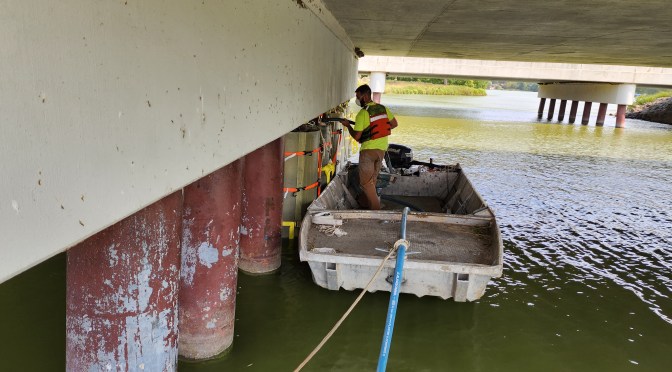
In recent years, advancements in bridge repair techniques and technologies promise to offer more options for strengthening an existing bridge’s in-water piles, eliminating the need to reroute both water and traffic. This project investigated other states’ experiences with several products on the market and provided an opportunity for Minnesota’s engineers to evaluate two vendors’ systems on a bridge in need of restoration.
Continue reading Repairing In-Water Bridge Supports Using Innovative Methods and MaterialsAll posts by mndotresearch

Understanding the Performance of Road Base Stabilization Additives
Full-depth reclamation (FDR)—an effective and efficient pavement reconstruction method—can be made even more sustainable by strengthening the road base. Laboratory and field testing of proprietary stabilizers used to amend FDR material illustrated improvements in pavement stiffness and economic benefits over time. New pavement design standards for base stabilizers can guide road engineers in choosing the optimal products for sustainable roads.
Continue reading Understanding the Performance of Road Base Stabilization Additives
New Smartphone App Uses GPS Technology to Warn Drivers of Lane Departures
Preventing vehicles from drifting out of traffic lanes is a top safety priority for transportation officials. An ongoing research project has produced a smartphone app that alerts drivers when their vehicles drift from a lane. The current phase of the project improved upon earlier versions of the app by adding GPS and significantly increasing the effectiveness of lane departure detection.

Designing Channelized Right-Turn Lanes to Increase Pedestrian and Cyclist Safety
The use of channelized right-turn (CRT) lanes at intersections can improve driver safety and traffic mobility but can be challenging for bicyclists and pedestrians, particularly those with sight or other impairments. This project examines the current practice of CRTs to identify design solutions and mitigation strategies to better accommodate the safety and accessibility needs of all road users.
Continue reading Designing Channelized Right-Turn Lanes to Increase Pedestrian and Cyclist Safety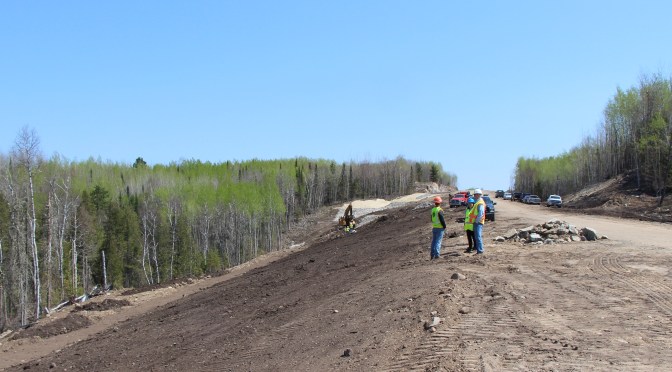
Reusing Local By-Products to Create Sustainable Roadside Soil
Vegetated roadsides in Minnesota help control stormwater quantity and pollutant levels before the water reaches lakes, streams and communities. Because leftover soil from road construction generally does not support filtration and plant growth, MnDOT and local engineers have continued research to identify organically rich, locally available industrial by-products to amend the soil. Engineered soil mixes with materials such as dredge sand, coarse street sweepings and ash sawdust show high potential for providing a sustainable, efficient solution.
Continue reading Reusing Local By-Products to Create Sustainable Roadside Soil
Safety Considerations Associated with Driverless Shuttles
Driverless vehicles present an enticing opportunity for increased traffic safety and reduced labor costs. However, technical issues and concerns remain regarding the interaction between driverless vehicles and human drivers. This project included observing and analyzing the interactions of a driverless shuttle and other road users in a pedestrian-heavy area to develop strategies for decreasing potential threats. Increasing the speed of the driverless shuttle and displaying clearer electronic messaging on the back of the shuttle could improve safety challenges.
Continue reading Safety Considerations Associated with Driverless Shuttles
Improving Pedestrian Safety on Reservations in Minnesota
MnDOT has identified Native Americans as one of six priority populations in the state that experience disproportionate risks as pedestrians. To access everyday services such as grocery stores, workplaces and schools, pedestrians may have to cross a state or county roadway at unmarked crossings. Installing traffic safety countermeasures at these crossings is intended to reduce the risk faced by pedestrians. This project analyzed pedestrian safety at 23 locations within seven reservations and the effectiveness of countermeasures implemented at six locations.
Continue reading Improving Pedestrian Safety on Reservations in Minnesota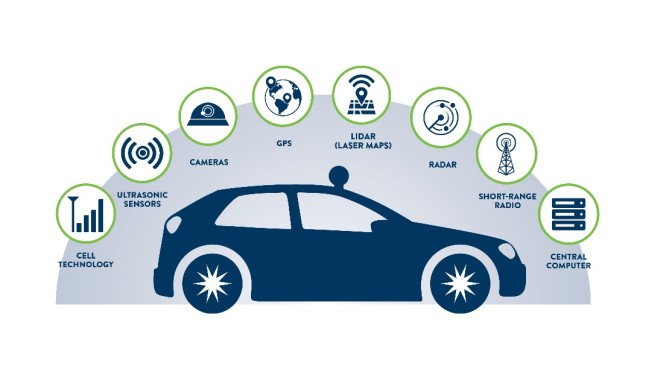
Remote driving of autonomous vehicles: Are we there yet?
Reprinted from Catalyst, December 6, 2024
Since the 2004 DARPA Grand Challenge, connected and autonomous vehicles (CAVs) have been highly anticipated and widely discussed. Today, Teslas with “autopilot” and General Motors vehicles with Super Cruise driver-assistance technology are already on roads, and pilot “robotaxi” services operate in several major US cities.
However, most CAVs are currently classified, at best, as Level 4 by the Society of Automotive Engineers. This means they are designed and operated with specific, predefined conditions—known as their operational design domain (ODD)—and must stop safely when those conditions are no longer met. Despite advancements in artificial intelligence and machine learning, there is still a long way to go before fully autonomous, or Level 5, vehicles become a reality.
Partial remote driving, or teleoperated driving (ToD), has emerged as a potential interim solution. With ToD, a remote operator can take control if a CAV encounters conditions beyond its ODD. Enabled by 5G cellular networks, ToD has shown promise in controlled settings, but the question remains whether current 5G networks can reliably support remote driving on a large scale.
In a recent project, University of Minnesota researchers investigated the feasibility of and critical networking requirements for remote CAV operation. The project was led by Zhi-Li Zhang, a professor in the Department of Computer Science and Engineering, and Rajesh Rajamani, a professor in the Department of Mechanical Engineering. Their work was supported by CTS seed funding, which aims to help CTS scholars develop expertise in emerging areas and foster strategic relationships that position them for future funding opportunities.
According to Zhang, 5G was designed to enable low-latency applications—those that process high volumes of data with minimal delay. In reality, today’s commercial 5G networks mainly support conventional mobile broadband access, especially to improve download speeds. But when it comes to teleoperation, higher uplink speeds and low latency in both directions are essential, Zhang says.
To test 5G’s potential, the research team used the MnCAV Ecosystem’s research vehicle—which is outfitted with cameras and lidar sensors—to conduct repeated driving experiments on commercial 5G networks in downtown Minneapolis. The study focused on end-to-end uplink performance of sensor data from the vehicle to a remote teleoperation station, analyzing how well these networks could support responsive, safe control.

Results showed that while transmitting a single video stream from a CAV is feasible, adding additional streams, especially from lidar—essential for depth perception—can strain the network. The researchers also found that, even in the case of a single video stream, latency increased when the vehicle was traveling at higher speeds and at handover points between 5G base stations, posing risks for safe and reliable remote driving.
These findings highlight fundamental challenges for remote driving on commercial 5G. However, thanks in part to this CTS-funded project, Zhang, Rajamani, and other researchers from the University of Minnesota and the University of Michigan were awarded an NSF grant to study further solutions.
One approach the researchers are exploring in this project is a new “predictive display” mechanism that leverages generative artificial intelligence to overcome the latency challenge of 5G networks. The mechanism uses recent but slightly delayed (e.g., by 0.5 seconds) data to predict the CAV’s current surroundings. Early tests suggest that this method could improve remote driving performance by masking the 5G network delay, helping teleoperators drive more effectively. However, the researchers say further work is needed to refine the technology and make remote CAV operation reliable and robust at scale.
—Krysta Rzeszutek, CTS digital editor
Related research by MnDOT

Revised Stormwater Maintenance Guide Updates Common Practices and Offers Innovative Options
Practices for managing stormwater runoff have evolved over the years. Changes to regulations, land use and weather patterns impact how transportation agencies integrate stormwater control options into road and waterway networks. Local agencies have used a stormwater maintenance guide produced by the Local Road Research Board (LRRB) in 2009. Over a decade of new research and the development of new tools for stormwater control necessitated revisions to the guidance document. The updated Stormwater BMP Inspection and Maintenance Resource Guide provides recommendations for enhancing traditional stormwater practices and presents new, innovative strategies and guidance on stormwater best management practices (BMPs).
Continue reading Revised Stormwater Maintenance Guide Updates Common Practices and Offers Innovative Options
Ensuring Resilient Pavements in the Face of Increasing Heavy Rains
Warmer winters and more frequent severe rainfall events in Minnesota threaten the integrity and longevity of pavement foundations. Understanding the impacts of saturated pavement layers can help MnDOT design resilient roads. An exploration into the relationship between climate conditions over time and pavement foundation stiffness on test road sections led to the development of a pavement foundation saturation prediction model. The model supports the production of a preliminary geographic information systems (GIS) based pavement vulnerability framework that can guide road engineers in prioritizing maintenance in at-risk areas to ensure strong, durable pavements.
Continue reading Ensuring Resilient Pavements in the Face of Increasing Heavy Rains Crossroads