

The production and use of construction materials for transportation projects have varying impacts on the environment based on factors such as production process, transportation and material inputs. To mitigate negative outcomes, MnDOT sought to incorporate environmental impacts into the procurement process for concrete mixtures and concrete pavement. This project provided a framework for considering environmental impacts and standardizing a reporting system to encourage the use of low-carbon construction materials in infrastructure projects.
Continue reading Incorporating Sustainability into the Procurement ProcessAll posts by mndotresearch

Utilizing Recycled Tires to Treat Stormwater
Repurposing old tires as tire-derived aggregate (TDA) is a stormwater management practice that could retain phosphate in underground treatment systems and prevent it from reaching the soil, surface waters and groundwater. However, chemicals from the TDA may leach into the soil and water sources. This project identifies the environmental impacts and cost-effectiveness of deploying TDA to manage stormwater in Minnesota cities and counties.
Continue reading Utilizing Recycled Tires to Treat Stormwater
Enhancing Safety for Pedestrians and Bicyclists at Roundabouts
Compared to traditional intersections, roundabouts have been proven to decrease serious crashes. However, because drivers yield rather than stop upon entering roundabouts and at crosswalks, public concerns about pedestrian and bicyclist safety remain. Research and field evaluations into driver yielding and speed behaviors generated insights to guide local transportation agencies and MnDOT to further enhance pedestrian safety at roundabouts.
Continue reading Enhancing Safety for Pedestrians and Bicyclists at Roundabouts
TZD Traffic Safety Hotdish: Research in Action—Perspectives from Minnesota’s Traffic Safety Research Ecosystem
July 16, 2025
1:00–2:15 p.m. Central
Virtual via Zoom
Join us as our very own “Roads” Scholars share more about their recent traffic safety research. Presenters from the University of Minnesota and Minnesota Department of Transportation (MnDOT) will share findings from recent projects and talk about the collaborations that drive traffic safety research throughout Minnesota.
Speakers
- Jackie Jiran, PE—MnDOT
- Max Moreland, PE, PTOE—MnDOT
- Nichole Morris, PhD—University of Minnesota
- Mark Wagner, PE—MnDOT
- Kyle Shelton, PhD—University of Minnesota; Moderator
Registration
The webinar is free to attend, but registration is required. Once you have registered, you will receive an email confirmation with a Zoom link. The link should not be shared with others; it is unique to you.
Credit
Attendees are eligible for 1.25 Professional Development Hours (PDHs). Download the PDH credit form (PDF) for your records.
For complete information, go to TZD Traffic Safety Hotdish.

Pavement Markings to Support Automated Vehicles
Automated vehicles (AVs) using advanced driver assistance systems depend on pavement markings to accurately track roadway lanes. While MnDOT continues to ensure human drivers easily and effectively detect and interpret various pavement markings, the agency also wanted to understand marking designs and characteristics that support AV functions. Field observations in different locations, during the day and at night, using different data collection methods allowed researchers to evaluate the impact of various pavement marking properties on AV lane-keeping functions. Results support MnDOT in producing pavement marking guidance that is responsive to changing needs.
Continue reading Pavement Markings to Support Automated Vehicles
An Evaluation of Vehicle Identification Technology
To successfully manage the state road network, MnDOT needs a thorough understanding of the number and type of vehicles on the road. To obtain this information, the agency upgraded existing inductive loop infrastructure at select locations to enable these sensors to collect vehicle classification data. This project evaluated the accuracy of the inductive loop upgrade and its life cycle costs to determine its viability for future use on Minnesota roads.
Continue reading An Evaluation of Vehicle Identification Technology
Refining Max-Pressure Traffic Signal Control to Improve Traffic Flow
Effective traffic signal control technologies facilitate optimal traffic flow and travel time. Building on previous research, this project made significant progress toward field implementation of a novel adaptive signal control technology. This research phase demonstrated the max-pressure traffic signal algorithm can successfully integrate into Hennepin County traffic signal hardware and respond to changing traffic conditions in real time, providing confidence to move to the next step and test the system in the field.
Continue reading Refining Max-Pressure Traffic Signal Control to Improve Traffic Flow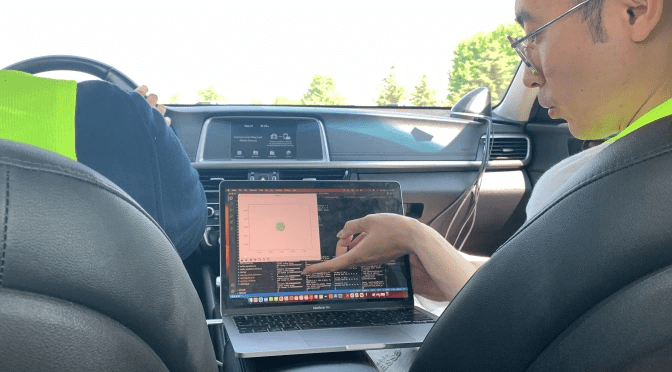
Developing Technology to Prevent Vehicles from Running Red Lights
Crashes that result from vehicles driving through red lights are often very serious because they are typically right-angle or side-impact crashes. While newer vehicles have many standard safety features such as lane departure warning and brake assistance systems to support drivers, they do not have technologies to help prevent driving through red lights. This project developed an algorithm that integrated traffic light phasing information with GPS data to warn drivers when they were approaching a red light, providing valuable driver assistance and improving traffic safety and efficiency.
Continue reading Developing Technology to Prevent Vehicles from Running Red Lights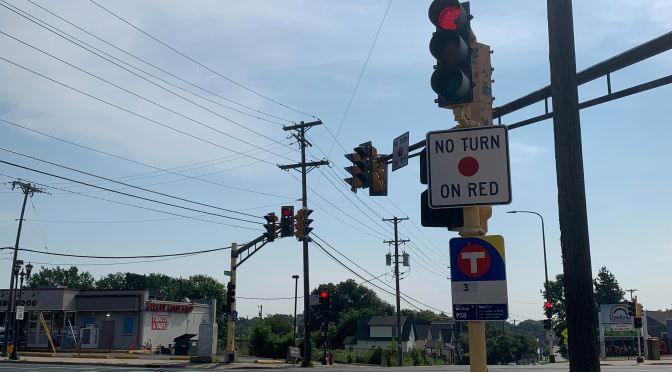
Comparing the Effectiveness of No Right Turn on Red Sign Types at Traffic Signals
Preventing right turns on red at traffic signals is a generally effective pedestrian safety measure. But when pedestrians are absent, allowing right turns on red can improve traffic flow. Unlike static signs that prohibit right turns on red, dynamic No Right Turn on Red (NRTOR) signs can be activated when pedestrians are present. Comparing driver compliance with dynamic and static signs indicated that each sign type may have its own benefits.
Continue reading Comparing the Effectiveness of No Right Turn on Red Sign Types at Traffic Signals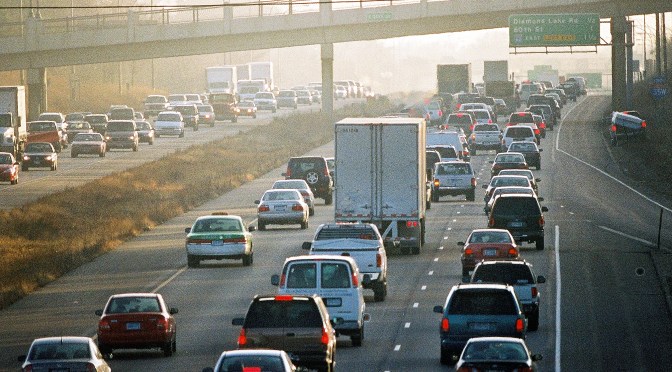
Assessing Reliability and Resilience on Freeway Corridors
Drivers and businesses benefit from a freeway network that is predictable and able to withstand disturbances such as construction, incidents and poor weather. To provide a high level of service on freeways, traffic managers monitor and assess traffic flows and speeds under various conditions. In this project, investigators analyzed and identified the most vulnerable portions of the Twin Cities freeway network and enhanced an analysis tool to provide better estimates of travel-time reliability and operational resilience.
Continue reading Assessing Reliability and Resilience on Freeway Corridors Crossroads