
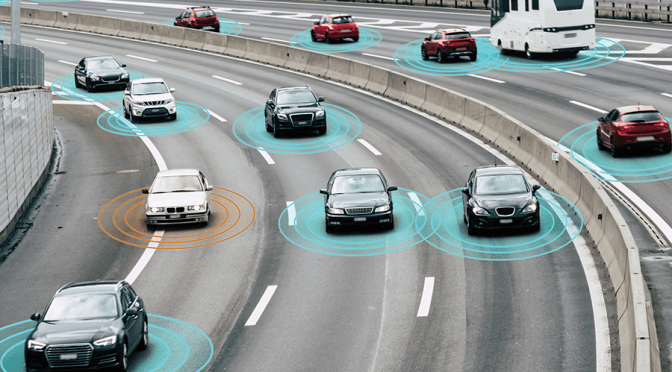
Newer vehicle safety features, such as automated emergency braking (AEB), can reduce crashes. However, evaluating the safety effects of AEB requires combining data on crashes, vehicle characteristics and safety equipment. This project integrated several data sets to estimate the effect of AEB systems on rear-end crashes on highways in the Twin Cities metro area.
What Was the Need?
Newer vehicles often include advanced safety features, but measuring their benefits can be challenging. Estimating crash rates requires data on crash frequency and exposure, or how much vehicles are driven. Because direct exposure data are not available for AEB-equipped vehicles, investigators needed an alternative method for estimating their presence on the road.
This project developed a method for estimating the proportion of vehicles equipped with AEB and comparing their crash rate with that of vehicles without AEB. Investigators then used these estimates, along with assumptions about traffic growth and AEB adoption, to develop a spreadsheet tool that predicts annual rear-end crash frequencies over 20 years.
What Did We Do?
Investigators incorporated three sources of data into an induced exposure model:
- Reported rear-end crashes on highways in the Twin Cities metro area.
- Records for all vehicles involved in the reported crashes, including vehicle identification numbers (VINs).
- Data sets linking VINs with information about vehicle automation features.
When a record included a VIN but did not identify the vehicle’s automation features, investigators estimated its automation status using tools and data maintained by the National Highway Traffic Safety Administration.
The resulting model estimated the proportion of vehicles equipped with AEB and compared their crash rate with that of vehicles without AEB. Investigators then developed a spreadsheet tool that uses assumptions about traffic growth and AEB adoption to predict annual rear-end crash frequencies over a 20-year period.
“This tool has promising potential and could be valuable to agencies in 5 to 10 years as vehicle AEB data becomes more reliable,” said Scott Meier, Project Manager at MnDOT’s Connected Automated Vehicle Office.
Investigators also surveyed vehicle owners about the availability of driver-assistance features and their attitudes toward automated safety technologies.
What Did We Learn?
The induced exposure model provided the information needed to estimate how increasing use of AEB could affect rear-end crash frequencies. The analysis found that the crash rate for AEB-equipped vehicles was approximately one-third the rate for vehicles without AEB.
In one model scenario, AEB-equipped vehicles began with an 18.5% market share that increased by 15% annually. Under those assumptions, the predicted number of rear-end crashes was 53% lower after 12 years, when AEB-equipped vehicles would reach a 99% market share. Users can adjust the rates of AEB adoption and overall vehicle travel in the spreadsheet tool. Although the results vary depending on these assumptions, the most likely scenarios predict that rear-end crashes will decline over the next 20 years. The rate of decline depends largely on how quickly AEB-equipped vehicles become prevalent.
The predictions have two primary limitations. First, although estimates are available for the overall crash reductions associated with vehicle automation, applying those estimates to specific road segments or roadway types requires assumptions. Second, users must specify how quickly the safety technology will be adopted, and future adoption rates remain uncertain.
The survey indicated that respondents generally accepted automated safety features and that the use of these technologies will likely increase as older vehicles are replaced.
What’s Next?
This project developed statistical methods and a spreadsheet tool that extend the induced exposure approach to estimate how vehicle automation affects crashes in specific geographic areas. Although the tool was designed to predict rear-end crashes on highways in the Twin Cities metro area, state and local agencies could adapt the approach to other roadway types and crash types.
The tool’s accuracy and usefulness will improve as more complete information becomes available about which vehicles are equipped with AEB. Under a federal safety standard, AEB systems are scheduled to become standard on all new passenger cars and light trucks by September 2029. This requirement should make AEB equipment data more consistent and support more accurate predictions.

