
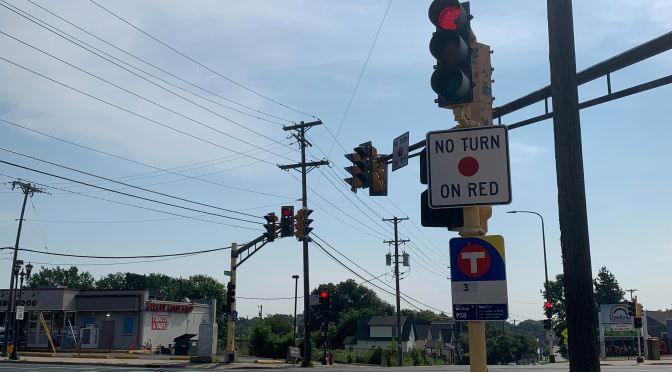
Preventing right turns on red at traffic signals is a generally effective pedestrian safety measure. But when pedestrians are absent, allowing right turns on red can improve traffic flow. Unlike static signs that prohibit right turns on red, dynamic No Right Turn on Red (NRTOR) signs can be activated when pedestrians are present. Comparing driver compliance with dynamic and static signs indicated that each sign type may have its own benefits.
Right turns on red after stopping at signalized intersections have been allowed for decades to save fuel and improve traffic flow. But right turns on red are also a source of conflict between vehicles and pedestrians or other vulnerable road users trying to cross at intersections. Fixed or static NRTOR signs can reduce this conflict but may impede traffic flow.
A potential solution is a dynamic NRTOR sign, which only illuminates at set times of the day or when needed to allow pedestrians to cross safely. Because dynamic NRTOR sign use is not widespread, little is known about its effectiveness. MnDOT was interested in comparing dynamic and static NRTOR signs to understand the differences in driver compliance, operational and maintenance needs, and strategies for optimizing the use of dynamic signs.
What Did We Do?
A literature review revealed many studies on right turns on red in general, but a lack of evidence on the long-term effectiveness, cost-effectiveness and maintenance requirements of dynamic NRTOR signs. A field evaluation involved measuring driver compliance at eight intersections: six with dynamic and two with static NRTOR signs. One dynamic sign illuminated at certain times of the day, and the other signs were pedestrian-activated.
For two weeks during both the summer and fall, streamed video collected from video detection systems at the intersections with pedestrian-activated dynamic NRTOR signs showed when Walk indications were lit and the NRTOR sign was activated. High-resolution data from vehicular and pedestrian signal changes, which MnDOT routinely collects, validated the correlation between the Walk indications and NRTOR sign activation. Researchers manually reviewed video data during sign activation periods to identify noncomplying vehicles turning right.
“MnDOT is striving to make signalized intersections as safe and efficient as possible for pedestrians. A properly utilized No Right Turn on Red sign is one of the tools that can be used when appropriate,” said Susan Zarling, state signal and lighting engineer, MnDOT Office of Traffic Engineering.
Video data collected from the two locations with static NRTOR signs and the NRTOR sign activated by time of day allowed for automated extraction of event data. Any vehicles turning right when the signal was red were considered noncompliant and easily identified. To assess the reliability and cost-effectiveness of dynamic NRTOR signs, researchers also surveyed state transportation agency and city traffic engineers.
What Did We Learn?
Over 4,500 hours of video from intersections with static or dynamic NRTOR signs showed similar results: 92% of drivers complied with static NRTOR signs while 87% adhered to most of the dynamic signs. The time-of-day activated sign had a nearly 93% compliance rate, indicating restricting right turns at certain times may be effective. Additionally, the time-of-day activated sign improved a problematic traffic flow issue near the observed intersection.
Pedestrian activations of the dynamic NRTOR signs, however, only occurred about once for every two hours of video. More weeks of video data would have resulted in more robust results. Additionally, identifying intersections with similar road geometry characteristics for this comparison proved challenging. Dynamic signs, for example, tended to be in suburban environments where driver line of sight was longer.
Anecdotal observations of the dynamic sign locations suggested drivers obeyed the signs when a pedestrian was present, but turned right once the path was clear even if the NRTOR sign was still activated. Evidence also indicated dynamic NRTOR signs appeared to help alert drivers to the presence of pedestrians as compared to an intersection without any sign.
The survey of transportation agency staff elicited 27 responses. Most provided positive reports of sign reliability, although a few agencies reported issues in extreme weather. Respondents also generally reported the device installation and maintenance costs were not burdensome, and nonroutine maintenance issues were rare.
What’s Next?
While the dynamic NRTOR signs observed in the study were no more effective than static signs in preventing drivers from making right turns on red, results suggested that dynamic signs prompted drivers to see pedestrians. In-depth observations of vehicle movements when pedestrians are present would be needed to substantiate the pedestrian visibility benefits of dynamic signs.
 Crossroads