

Originally published August 6, 2024 in Catalyst
Upcoming Webinar: Friday, December 6, 2024, from 1:30–3:00 pm.
For more information and to register, go to: Unlocking Autonomous Transportation Potential—Key Insights.
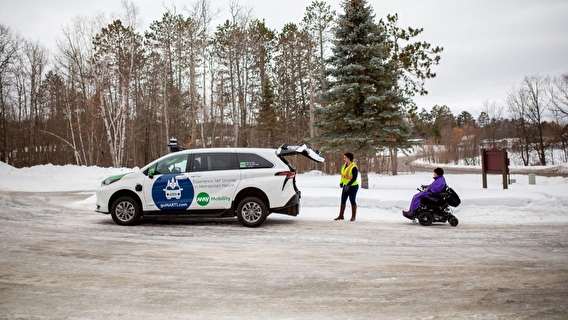
On the roads of Grand Rapids, Minnesota, you may spot a seemingly ordinary Toyota minivan doing groundbreaking work. Since October 2022, five self-driving shuttle vans—with onboard operators for safety—have offered free, on-demand rides as part of the Minnesota Autonomous Rural Transit Initiative (goMARTI) pilot program. It’s a collaborative effort between multiple stakeholders and partners to conduct a first-of-its-kind demonstration of self-driving shuttles in a rural setting.
To make the most of the knowledge gained through this innovative project, U researchers conducted two studies sponsored by the Minnesota Department of Transportation (MnDOT) following goMARTI’s 18-month pilot phase.
The first study reviewed past efforts identifying the transportation needs of underserved populations in Grand Rapids and evaluated how the goMARTI pilot project addressed those needs. The work was led by Frank Douma, director of state and local policy and outreach in the Institute for Urban and Regional Infrastructure Finance at the Humphrey School of Public Affairs.
The study found goMARTI is successfully filling previously unmet transportation needs in the Grand Rapids community. The service is available to those who are unable to drive, including young people and those with mobility challenges (three of the vans can accommodate wheelchairs). goMARTI also provides a reliable form of transportation for the entire community and helps educate residents about connected autonomous vehicles.
“Many individuals who are unable to drive or lack consistent access to a vehicle reported a positive experience with goMARTI and want to see the service expanded and continued,” Douma says. “It’s a sign of a successful project when the main suggestions for improvement are to increase the service.”
In the second project, Thomas Fisher, director of the Minnesota Design Center, envisioned mobility hubs for autonomous vehicle shuttles operating in small towns or cities outside of metro areas. Mobility hubs are an emerging trend in planning focused on collecting a variety of mobility options (such as buses, trains, shared bikes, and scooters) at points where people can easily and safely move from one mode to another. However, most existing mobility hubs are designed for larger urban and suburban environments.
“While the mobility hub concept was originally developed for urban settings, we found it could be successfully scaled down to suit smaller cities and towns where there are just as many mobility needs—just not as many people,” Fisher says.
The designers conceptualized hubs with flexible, movable components that fit within one or two parking spaces and are no wider than a sidewalk. The designs ranged from simple to complex based on the street type. They also focused on accessibility, with accommodations for individuals with motor, visual, auditory, and cognitive impairments.

Although the first 18-month goMARTI pilot demonstration is complete, the program (and the learning opportunities it offers) has been extended. In May 2023, the USDOT’s Federal Highway Administration awarded the Minnesota Department of Iron Range Resources and Rehabilitation a $9.3 million Advanced Transportation Technology and Innovation grant to continue the goMARTI demonstration. The grant will allow goMARTI to expand its fleet and the area it serves—and continue toward its goal of service for all in the Grand Rapids community.
“The goMARTI project has been an excellent learning experience for MnDOT and our many project partners,” says Thomas Johnson-Kaiser, MnDOT’s CAV-X engagement and project manager. “Being the first large-scale deployment of autonomous vehicles in a rural environment with harsh winter weather, the lessons learned will be extremely valuable for any future deployments of autonomous vehicles or microtransit.”
10 Key Takeaways
- Expect that onboard operators will perform multiple roles. Operators are key to rider safety, comfort, and acceptance, playing an important role in communicating with passengers, sharing their expertise, and securing wheelchair riders.
- Optimize stop locations. Identifying and creating optimal stop locations is an important but challenging step that needs to balance rider and traffic safety, accessibility in a variety of weather conditions, and community demand.
- Introduce new, complementary technologies. Autonomous vehicles are only one of the technologies the goMARTI program introduced; on-demand transportation and app-based services were also new concepts for many people in the community.
- Create a call center. Having a local call center available 24/7 to answer questions, help with app installation, or book rides over the phone was essential for reaching target populations, many of whom were not technologically savvy.
- Involve, adapt, and evolve . Empowering the community to help shape operation hours and stop locations increased community buy-in. Frequent updates to the stops and routes allowed goMARTI to adapt and evolve in response to community feedback and recommendations, leading to increased ridership.
- Play the long game. Having a local presence and strong, engaged community ambassadors in a rural community amplifies and accelerates adoption, but recognize that rural community buy-in can take a long time.
- Choose the best AV for the job. Having an autonomous vehicle capable of traveling the speed limit and not disrupting other traffic flow is mandatory for community acceptance. Additionally, using several off-the-shelf vehicles allows for redundancies and helps ensure service reliability.
- Fill a need. A major driver of the program’s success was its ability to fill an unmet need in the rural community for microtransit and mobility-on-demand services, particularly for riders with limited access to cars including older adults, teens, and riders with disabilities.
- Offer year-round technology. Just like human drivers, the autonomous driving kit installed in the goMARTI vehicles can adjust driving behaviors for sunny summers and snowy winters. Taking advantage of this driving adaptability allowed for optimized performance year-round.
- Recognize how transportation can change lives. Providing the opportunity for travel to social, educational, recreational, and medical events and appointments can change people’s lives for the better.
More Resources
- Final Report: The Grand Iron Range CAV Initiative: History, Partnerships, and Community Engagement
- Policymaker Summary: The goMARTI Self-Driving Shuttle Pilot Program
- Story Map: Mobility Hubs in Grand Rapids
 Crossroads