Tag Archives: Signal timing

With new signal timing method, Twin Cities traffic could flow more smoothly

Reprinted from Catalyst, May 12, 2023.

Eliminating intersection bottlenecks is one of the most persistent and difficult challenges for traffic engineers. A new mathematical theory called “max-pressure signal control” has been proven to achieve maximum throughput for entire city road networks, but it has not yet been used in practice. In a new study, U of M researchers brought the theory several steps closer to real-world use and found that it could offer many benefits to Minnesota road users.

“For most intersections and demand periods, we found that max-pressure control offered significant improvement over current signal timings,” says Michael Levin, an assistant professor with the Department of Civil, Environmental, and Geo- Engineering. “Large reductions in delay—sometimes over 50 percent—suggest that this new method of signal timing could achieve higher throughput during peak demand and be more responsive to queues.”

To achieve these findings, researchers began by addressing some aspects of max-pressure signal timing that would make it difficult to implement in a real-world setting. First, researchers addressed its assumption that all roadways had separate turning lanes by adapting the mathematical model to accommodate mixed travel lanes.

Another drawback of the original formula is that the signal control doesn’t operate on a cycle; this could cause long wait times when demand is uneven and make the signal cycle unpredictable for both drivers and pedestrians.

“To solve this issue, we modified the formula to include a maximum waiting time and require that the phase selection follows a cycle,” Levin says. “This allows traffic engineers to create an ordered set of phases for each intersection.”

Once the updated version of max-pressure control was developed, researchers tested it in simulations of two corridors in Hennepin County, Minnesota. The simulations revealed numerous potential benefits including reduced environmental impacts and reduced road user costs resulting from travel time savings and lower fuel costs.

“The findings show that our new max-pressure control formula will reduce the average queue length during peak hours and that vehicles will not wait as long at intersections,” Levin says. “We can also predict higher throughput and faster vehicle speeds, all of which will mitigate congestion and improve quality of life.”

In addition, a cost-benefit analysis shows that the total value of travel time savings is considerably larger than the cost to implement max-pressure control.

The project’s success led researchers to explore the possibility of a real-world pilot project with available traffic signal hardware. They found that the traffic signal technology currently used in Hennepin County could be upgraded to support a pilot study, laying the groundwork for a future real-world test of this promising new signal timing method.

The project was funded by the Minnesota Local Road Research Board (LRRB). Phase two of the work, also funded by the LRRB, is underway.

Writer: Megan Tsai

More Information

Making SMART Signals even smarter

Your drive home may be a few minutes quicker today thanks to a team of researchers who are making it easier for Minnesota engineers to retime traffic signals.

It normally costs $3,500 to retime a signal due to the time involved in collecting the data and optimizing timings. But over the past several years,  MnDOT-funded research has helped develop the SMART Signal system, which not only collects traffic and signal-phase data automatically, but also identifies under-performing traffic signals and generates optimal signal timing plans with minimal human intervention.

Traffic delays typically grow 3 to 5 percent per year due to outdated signal timing; however, most traffic signals in the United States are only re-timed every two to five years (or longer).

“Large-scale deployment of the SMART Signal system will significantly change the state-of-the-practice on signal re-timing because MnDOT won’t have to retime a traffic signal based on a fixed schedule,” said University of Michigan researcher Henry Liu (formerly a University of Minnesota professor), who began developing the system in the mid-2000s. “Instead, because of the reduced cost of signal data collection and performance measurement, signal retiming becomes performance-driven rather than schedule-based.”

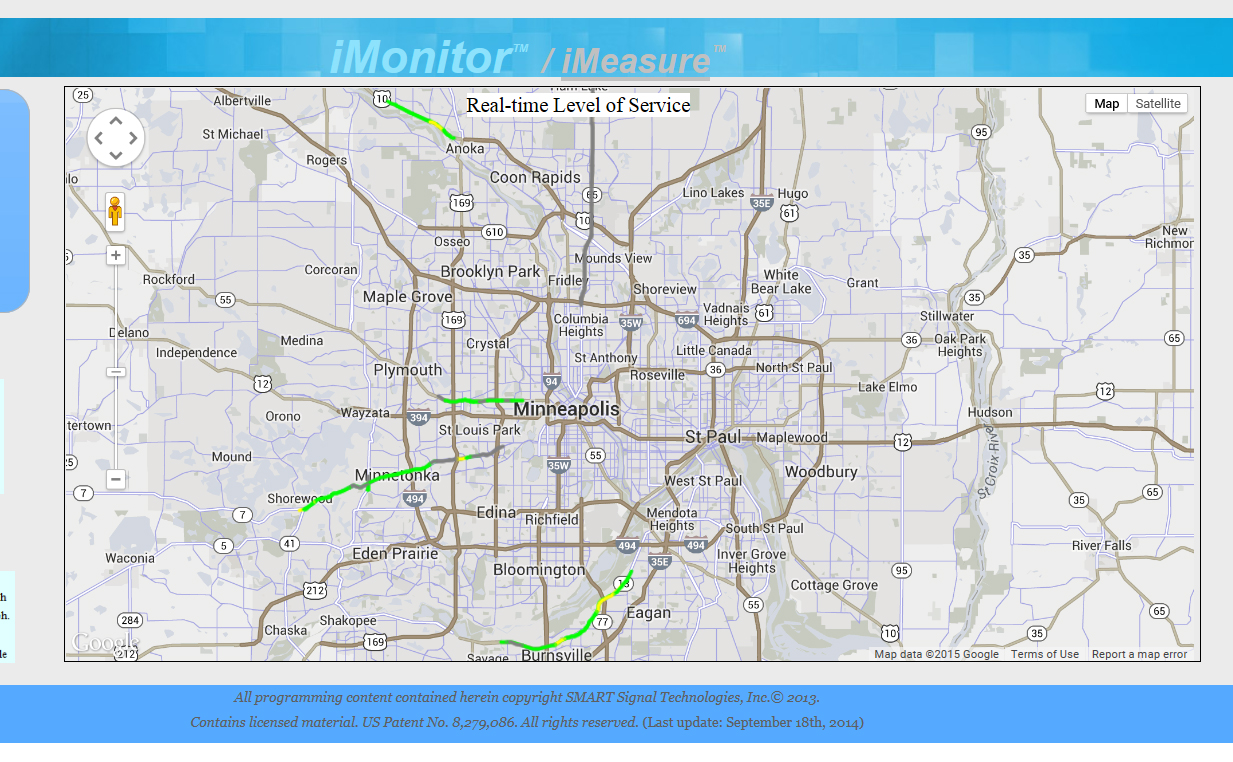
You can view the traffic monitoring on corridors with SMART-Signal systems on this website, http://dotapp7.dot.state.mn.us/smartsignal/.

MnDOT (along with many cities and counties) embeds loop detectors in road pavements that notify a traffic signal that a vehicle is present. Staff normally must manually track wait times to determine how the signal timing is affecting traffic.

But SMART Signal automates much of this process by recording how long a vehicle waits at an intersection and automatically reporting the data (along with signal timing) to a central server. The data — viewable in real-time on this website  — can then be analyzed to determine traffic patterns and optimal signal timing.

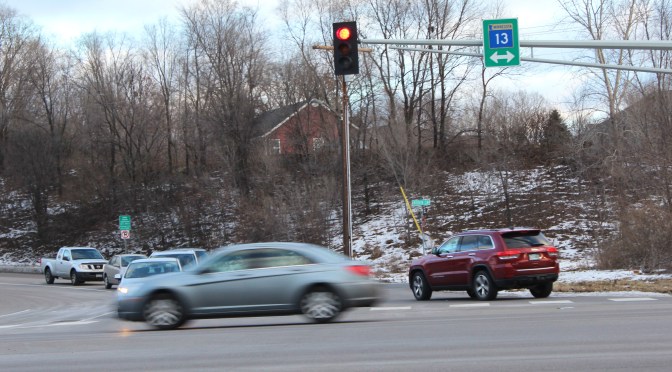
Recent enhancements to the SMART Signal system were successfully tested on Highway 13 in Burnsville, reducing vehicle delay there by 5 percent.  The benefit could be in the double digits for corridors with worse traffic delays.

SMART Signal — which stands for Systemic Monitoring of Arterial Road Traffic — has been installed at more than 100 Minnesota intersections and is currently in the process of commercialization.

The latest research optimizes the system’s ability to reduce traffic delays by developing a framework to diagnose problems that cause delays at traffic signals and an algorithm that automatically optimizes the signal plan to address these problems. The software upgrade has since been integrated into all SMART Signal intersections.

Across the country, the financial benefit of retiming signals has been shown to be tremendous. On San Jose Boulevard in Jacksonville, Florida, for instance, traffic delays in one corridor dropped 35 percent and resulted in an annual estimated fuel savings of $2.5 million.*

“Data collection and performance monitoring are critical for improving traffic signal operations, and yet before the development of the SMART Signal system, these tasks were prohibitively expensive for most agencies because of the number of signals involved,” Liu said.

Future Applications

Liu is also looking at other potential applications for SMART Signal :

  • Improving safety at intersections with unusually high crash rates and predicting which intersections are likely to have elevated crash rates in the future.
  • Developing traffic signal timing models for diverging diamond intersections.
  • Determining how traffic and vehicle routes are affected by construction lane closures and detours on signalized highways.

A real-time adaptive signal control, which would automatically adjust signal timings based on current conditions, is not currently feasible with the SMART Signal system because it would require additional vehicle sensors. The latest SMART Signal research does, however, automate the data collection and calculations that would help the development of such a system.

Data collection
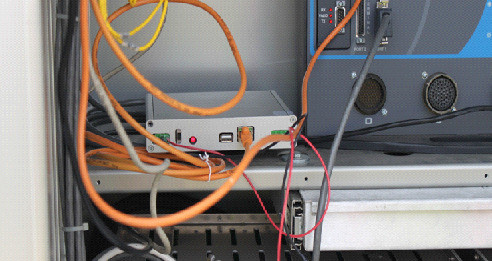
A data collection unit collects event-based traffic and signal data and sends it to a remote center for analysis.

*The Benefits of Retiming Signals,” ITE Journal, April 2004

Note: This blog post was adapted from an article in the latest issue of our newsletter, Accelerator. Click here to subscribe.

Related Resources

Research Project: Automatic Generation of Traffic Signal Timing Plan (2015)

(Development of the SMART-SIGNAL system began with Real-Time Arterial Performance Monitoring System Using Traffic Data Available from Existing Signal Systems (2009). It continued with Research Implementation of the SMART SIGNAL System on Highway 13 (2013) , which refined the system and its user interface, and Improving Traffic Signal Operations for Integrated Corridor Management (2013), which developed data-based strategies for relieving congestion by adjusting signal timings.)