All posts by Christine Anderson

TZD Traffic Safety Hotdish: A Roadmap for Traffic Safety Culture Research and the Road Ahead

Wednesday, July 17, 2024  
10:00 – 11:15 a.m. CDT

About the Event

This free virtual event will highlight the Traffic Safety Culture Research Roadmap, recently released by the National Academies of Sciences, Engineering, and Medicine

Wes Kumfer, who led the creation of the roadmap, will review its development and contents. Jay Otto will share example projects and show how they fit into research on traffic safety culture. Join us to learn how you can identify traffic safety culture research needs and get insights to take back to your own organizational cultures!

Speakers

Dr. Wes Kumfer is an engineering research associate at the UNC Highway Safety Research Center (HSRC) with a focus on crash analysis and workforce development. His primary research interest is traffic safety management through a systems-oriented approach. While at HSRC, Kumfer has worked on pedestrian crash modeling, Safe System implementation, and engineering evaluation. He uses this experience as a member of the Road to Zero Coalition steering group and as an instructor for HSRC’s Road Safety Academy.

Jay Otto is a researcher and co-director for the Center for Health and Safety Culture at Montana State University. He received a bachelor’s and master’s degree in engineering and is fascinated by human behavior, how mindsets and systems influence behavior, and ways of growing cultures within communities and organizations that foster improved health and safety.

Registration 

The webinar is free to attend, but registration is required. Once you have registered, you will receive an email confirmation with a Zoom link. The link should not be shared with others; it is unique to you.

Credit

Attendees are eligible for 1.25 Professional Development Hours (PDHs). Download the PDH credit form (PDF) for your records.

More Information

Contact Linda Dolan at ldolan@umn.edu.

Sponsors

This event is offered by the Minnesota Toward Zero Deaths Program and the Minnesota Departments of HealthPublic Safety, and Transportation, with funding from the National Highway Traffic Safety Administration. It is hosted by the University of Minnesota’s Center for Transportation Studies.

OPERA project: Benefits and limitations of liquid-treated sand

Reprinted from MnLTAP News May 30, 2024

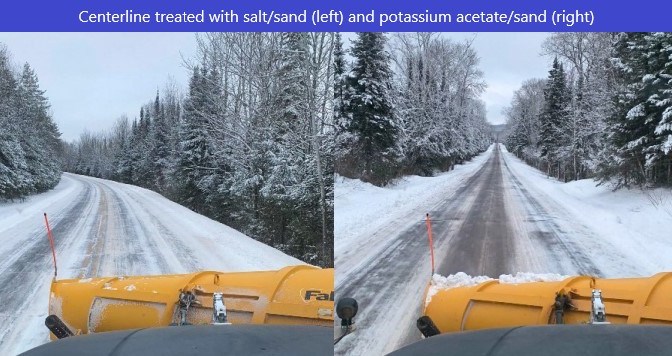
The Cook County Highway Department has been on a mission to combat chloride pollution infiltrating Minnesota’s pristine wilderness. To that end, the department has set a goal for chloride-free winter maintenance, starting from annual road salt use that averages 300 tons. Staff experimented with liquid-treated sand to reduce the use of granular road salt while maintaining road safety. 

Continue reading OPERA project: Benefits and limitations of liquid-treated sand

Rural Needs, Statewide Answers: Demographics, Health Care Access, and Community Engagement

Monday, May 13, 2024, 9:00–11:30 am, In Person

Join CTS for their annual all councils meeting to explore topics related to CTS’s 2024 theme of Rural Needs, Statewide Answers: Improving Transportation for All Communities.

The event is free to attend, but registration is required. Please register by Friday, April 26

Continue reading Rural Needs, Statewide Answers: Demographics, Health Care Access, and Community Engagement

2024 CTS Transportation Research Conference

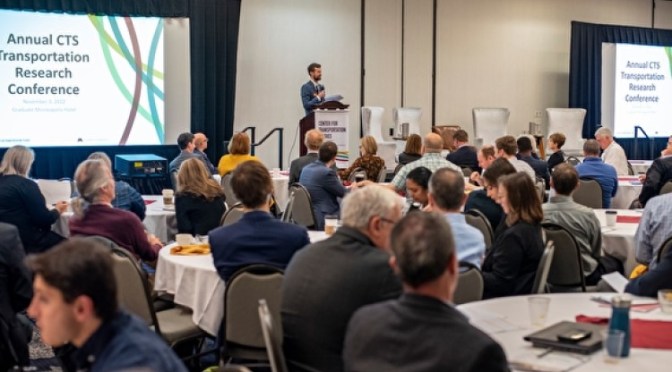
Mark your calendar for our annual conference! The event convenes researchers and practitioners from Minnesota and the Upper Midwest to highlight new learning, emerging ideas, and the latest innovations in transportation. Attendees learn about research findings, implementation efforts, and engagement activities related to a variety of transportation topics.

Continue reading 2024 CTS Transportation Research Conference

States Explore Fee Alternatives to Fund Roadway Infrastructure

Reprinted from CTS News; March 5, 2024
—Pam Snopl, CTS senior editor

The fuel tax is the backbone of our roadway funding system, but its ability to generate revenue is under pressure: more vehicles are using less fuel—or no fuel at all. In response, many states are turning to alternative revenue mechanisms to help bridge the funding gap.

Continue reading States Explore Fee Alternatives to Fund Roadway Infrastructure

‘Transportation Insecurity’: A New Metric to Evaluate Programs and Guide Decision Making

Reprinted from CTS News, December 7, 2023
—Sophie Koch, contributing writer

Reliable transportation has a huge impact on quality of life. Many Americans, however, are unable to travel where and when they need to go, and policymakers lack tools to measure the extent of the problem. 

Continue reading ‘Transportation Insecurity’: A New Metric to Evaluate Programs and Guide Decision Making

COVID-19 pandemic substantially changed commuting patterns, job access

Reprinted from CTS News, October 9, 2023

Patterns of movement in cities, especially office job commutes, were substantially altered in 2021 by telework, economic change, and other responses to COVID-19, according to new research from the Accessibility Observatory at the University of Minnesota. While the immediate effects of these behavioral changes, such as reduced congestion and lower transit ridership, have been well documented, new data reveals deeper impacts that differ by the three modes studied: auto, transit, and biking.

Continue reading COVID-19 pandemic substantially changed commuting patterns, job access

Researchers Identify Freight Data Sources, Create Guidance to Aid Infrastructure Planning

The goods that continuously move through Minnesota by road, rail, air, water, and pipelines drive the state’s economy, making efficient freight transit—and excellent freight infrastructure—a high priority for the Minnesota Department of Transportation (MnDOT).

Continue reading Researchers Identify Freight Data Sources, Create Guidance to Aid Infrastructure Planning

Model Helps Identify Strategic Sites for Truck Charging Stations

An influx of electric trucks is expected on our highways, but where will they charge? Few public stations today can serve large freight vehicles. The challenge? Fast chargers are expensive, and new ones need to be placed strategically to keep pace with growing demand.

Continue reading Model Helps Identify Strategic Sites for Truck Charging Stations

With new signal timing method, Twin Cities traffic could flow more smoothly

Reprinted from Catalyst, May 12, 2023.

Eliminating intersection bottlenecks is one of the most persistent and difficult challenges for traffic engineers. A new mathematical theory called “max-pressure signal control” has been proven to achieve maximum throughput for entire city road networks, but it has not yet been used in practice. In a new study, U of M researchers brought the theory several steps closer to real-world use and found that it could offer many benefits to Minnesota road users.

“For most intersections and demand periods, we found that max-pressure control offered significant improvement over current signal timings,” says Michael Levin, an assistant professor with the Department of Civil, Environmental, and Geo- Engineering. “Large reductions in delay—sometimes over 50 percent—suggest that this new method of signal timing could achieve higher throughput during peak demand and be more responsive to queues.”

To achieve these findings, researchers began by addressing some aspects of max-pressure signal timing that would make it difficult to implement in a real-world setting. First, researchers addressed its assumption that all roadways had separate turning lanes by adapting the mathematical model to accommodate mixed travel lanes.

Another drawback of the original formula is that the signal control doesn’t operate on a cycle; this could cause long wait times when demand is uneven and make the signal cycle unpredictable for both drivers and pedestrians.

“To solve this issue, we modified the formula to include a maximum waiting time and require that the phase selection follows a cycle,” Levin says. “This allows traffic engineers to create an ordered set of phases for each intersection.”

Once the updated version of max-pressure control was developed, researchers tested it in simulations of two corridors in Hennepin County, Minnesota. The simulations revealed numerous potential benefits including reduced environmental impacts and reduced road user costs resulting from travel time savings and lower fuel costs.

“The findings show that our new max-pressure control formula will reduce the average queue length during peak hours and that vehicles will not wait as long at intersections,” Levin says. “We can also predict higher throughput and faster vehicle speeds, all of which will mitigate congestion and improve quality of life.”

In addition, a cost-benefit analysis shows that the total value of travel time savings is considerably larger than the cost to implement max-pressure control.

The project’s success led researchers to explore the possibility of a real-world pilot project with available traffic signal hardware. They found that the traffic signal technology currently used in Hennepin County could be upgraded to support a pilot study, laying the groundwork for a future real-world test of this promising new signal timing method.

The project was funded by the Minnesota Local Road Research Board (LRRB). Phase two of the work, also funded by the LRRB, is underway.

Writer: Megan Tsai

More Information