
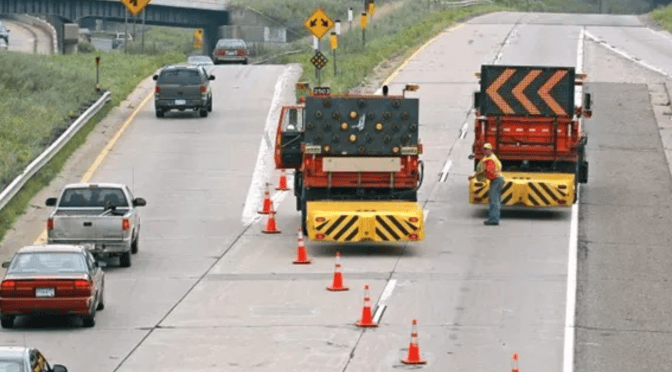
Highway construction sites present significant safety challenges to workers and the traveling public. Technologies have been developed to reduce work zone risk, but current options are often a significant expense that relies on prebuilt infrastructure or other upfront setups. This project developed a safety warning system that integrated advanced analytical algorithms with a low-cost and easily scalable sensor network consisting of wearable alert units for workers, collision detection devices for heavy equipment and intrusion detection sensors for traffic cones.
Work zones are extremely hazardous environments where workers, heavy construction equipment and vehicles interact. Effectively warning workers of vehicle intrusions or moving equipment in real time could significantly improve work zone safety.
This research sought to develop, refine and validate an integrated and affordable Internet of Things (IoT) enabled wearable sensor network. IoT links people and technology through connectable devices and sensors to allow for remote monitoring and analysis. The resulting system could provide a foundation for a safety warning system that can detect and warn workers to immediate dangers.
What Did We Do?
This project developed a safety alert system that uses algorithms to incorporate data collected from sensors during work zone activities. The algorithm combines data from GPS and inertial measurement unit sensors with received signal strength indicator measurements, which mitigates the weaknesses of each sensor type. A cloud-based mesh network collected the data to allow for observation and analysis via a web-based user interface.
A long short-term memory model then used the data to learn temporal patterns that improve position and velocity accuracy. The output served as the foundation for a dynamic hazard zone model able to adjust real-time safety boundaries based on equipment speed and direction to ensure safety alerts are accurate and responsive to fluid work zone conditions.
“This project showed great promise for wearable sensor technology with positive feedback from workers and successful testing. Field testing in larger work zones and establishing a plan for manufacturing and marketing are key next steps to future implementation,” said Michelle Moser, work zone engineer, MnDOT Office of Traffic Engineering.
The system’s hardware, produced by a 3D printer, consists of wearable alert units for workers, collision detection devices for equipment and intrusion detection sensors for traffic cones. Laboratory experiments calibrated the system and evaluated optimal placements of wearable devices and workers’ ability to perceive alerts. Additional laboratory tests assessed the accuracy of the alert system using the three sources of sensor data to reduce positional errors.
Two separate field tests were conducted in active work zones during routine pavement maintenance activities, with investigators monitoring the system without influencing the workers. These tests evaluated interactions among the wearable devices, equipment-mounted devices and intrusion-detection units to detect dangerous events and hazards. Additional testing allowed investigators to refine the algorithm and improve reliability.
What Did We Learn?
Evaluation of the accuracy of the alert system across different motion paths demonstrated that using three sources of sensor data was more reliable and significantly reduced positional errors than using GPS data alone. Laboratory testing confirmed that alerts with vibration and sound signals effectively warned workers who then promptly responded to the warnings. The simulations examining dynamic hazard zones further showed their value as the adjustable boundary thresholds outperform static zones by maintaining high detection accuracy while minimizing false alarms.
In the field, the warning system successfully provided alerts to near-miss incidents and intrusions. During the second field test, the system provided 10 accurate alerts, generated no false alarms and had only two missed alerts caused by a hardware failure that is easily correctable. Feedback from workers indicated the alerts were clear and the devices were comfortable to wear, which are both essential for practical use in active work zones.
Because of its relatively low cost, this warning system could potentially serve as an effective system to enhance safety at highway construction sites. The key integration of three sources of data through analytical fusion models enabled effective hazard detection and alerting. Further, using a cloud-based server and user interface offered a complete digital record of work zone activity and provided real-time monitoring and post-event analysis.
What’s Next?
This research established a foundation for integrating IoT-based sensing, localization and alert systems into work zone safety practices. To improve performance, further testing and refinement are needed along with addressing manufacturing challenges.

