
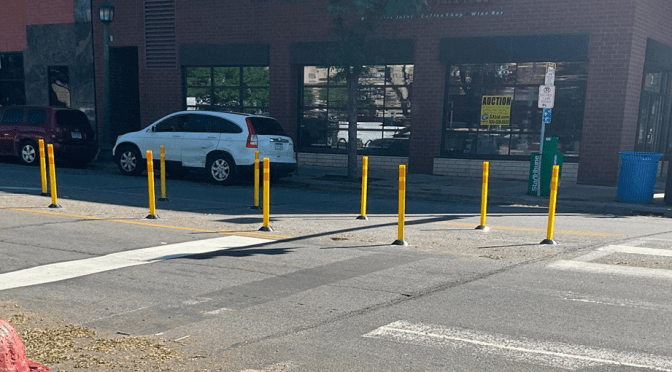
To enhance pedestrian safety at intersections, transportation agencies may install temporary or permanent infrastructure such as curb extensions or pedestrian refuge islands. While more permanent infrastructure with concrete is generally considered effective, specific details about temporary infrastructure with flexible delineators (or bollards), such as installation, use and safety impact, would be valuable to optimize cost-effectiveness. This project evaluated both temporary and permanent pedestrian infrastructure at crossing sites to measure the effects on pedestrian safety and driver behavior.
Pedestrian safety remains a high priority for transportation agencies across Minnesota. To reduce pedestrian injuries and fatalities, agencies pursue mitigation strategies such as installing pedestrian-friendly infrastructure. Permanent installations are typically effective but expensive. More detailed information is needed about the safety of less expensive temporary infrastructure to better justify their use.
This project evaluated the effectiveness of temporary and permanent pedestrian installations such as curb extensions and pedestrian refuge islands on pedestrian and driver behavior. The results provide valuable data for transportation agency engineers and planners to incorporate into pedestrian infrastructure safety strategies and planning to balance implementation costs with expected benefits.
What Did We Do?
Investigators evaluated safety outcomes for 12 intersections in Minneapolis and St. Paul before and after the installation of pedestrian safety infrastructure. These intersections represented a variety of traffic control types and pedestrian infrastructure.
At signalized intersections, investigators installed three temporary and two permanent curb extensions and one temporary pedestrian median refuge. At unsignalized intersections, two temporary and one permanent curb extensions were installed, along with two temporary and two permanent median refuges. Pre- and post-installation measurements were taken at all but one location.
These measurements included staged pedestrian crossings focused on drivers stopping for pedestrians. Drivers were in right-turning vehicles at signalized intersections and in vehicles traveling straight at unsignalized intersections. These two driving maneuvers are most likely to lead to conflict with crossing pedestrians at these intersections.
Video data from crossings by the public at these crosswalks was used to examine pedestrian behavior; a novel computer algorithm incorporating artificial intelligence used the same video data to estimate vehicle speeds.
What Did We Learn?
Results indicated that pedestrian-focused infrastructure positively impacts pedestrian safety. The safety benefits directly stemming from the infrastructure are difficult to quantify because of the varying location characteristics that affect driver and pedestrian behavior, such as the presence of on-street parking, volume of pedestrians crossing, vehicle traffic volume and types of drivers and pedestrians.
“These results provide both state and local agency staff members with important information to consider as they work to maximize benefits from pedestrian infrastructure installations,” said Mitchell Kiecker, pedestrian and bicycle engineer, MnDOT Office of Transit and Active Transportation.
Both permanent and temporary median refuges positively influenced pedestrian safety, especially by reducing vehicle speeds. More specifically, at both signalized and unsignalized intersections, temporary refuges reduced vehicle speeds; at unsignalized locations, these refuges increased the likelihood of drivers stopping for pedestrians. Reducing speeds not only leads to fewer crashes but also reduces the severity of crashes that do occur.
Permanent curb extensions at signalized intersections resulted in decreased average driver speeds. Investigators warned that using temporary curb extensions at signalized intersections may adversely affect the likelihood of drivers stopping for a crossing pedestrian, and the impact on average speed was mixed, likely due to the increased complexity of the intersections that may have appeared cluttered and distracting to drivers. At unsignalized intersections, temporary and permanent curb extensions resulted in a slight decrease of average driver speed and no observed effect on stopping likelihood and pedestrian behavior.
Overall, the results indicated mostly positive benefits of using quick-build temporary infrastructure, especially for refuges. The rates of drivers stopping for pedestrians at temporary refuges improved at unsignalized intersections, and average speeds decreased at temporary refuges at both signalized and unsignalized intersections. The effects of permanent infrastructure appear to be either neutral or positive across their installations.
What’s Next?
These results offer valuable insights for transportation engineers and planners to consider as they develop and implement strategies to mitigate dangerous conditions for pedestrians. A 2013 assessment of costs found that permanent curb extensions and median islands cost on average approximately $13,000 each, or approximately $18,000 in 2025 dollars. While costly, these safety measures prove extremely valuable if they significantly enhance safety outcomes.
Given these costs and the number of variables present at locations of potential installations, agencies may want to make decisions on a case-by-case basis. Further, upon installing temporary infrastructure, agencies should monitor the ongoing performance to ensure the installation is realizing expected benefits and not creating a less pedestrian-friendly environment.
 Crossroads