
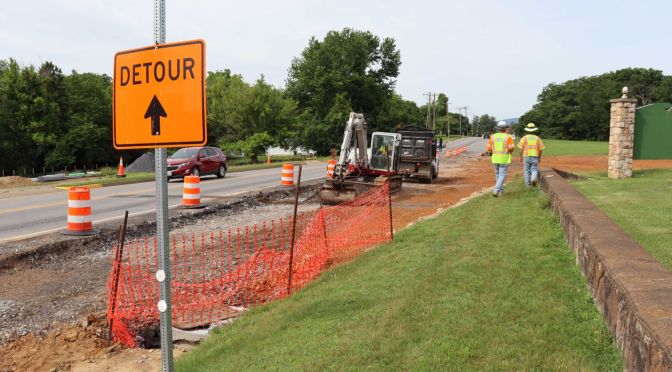
Detours for highway construction projects direct heavy freight vehicles onto local roads that were not designed to accommodate the frequency of heavy loads. Detours to these local roads often accelerate pavement deterioration that shortens their service life and requires additional repair. This project examined the structural and economic impacts of detours on local roads to develop a framework for optimizing detour routes that limit pavement damage while maintaining traffic mobility.
Highway detours route heavy trucks onto local roads that were designed to support only a limited number of these heavy loads over their service life. Consequently, accelerated pavement damage occurs, and reimbursements to counties are often not enough to restore the roads to their pre-detour service life. Designing detour routes that direct heavy trucks away from the most vulnerable local roads could mitigate the negative impacts.
This project developed methods and a framework for quantifying detour-related consumption and optimizing detour routes to minimize long-term impacts on Minnesota’s road network. The results could offer insight to state and local traffic engineers as they design future detour routes.
What Did We Do?
A literature review evaluated current approaches for estimating pavement consumption costs. Investigators reviewed processes for assessing pavement structural damage using nondestructive testing (NDT) methods, including a falling weight deflectometer and ground-penetrating radar. They also calculated the remaining service life (RSL) for numerous detour and haul road sites in Minnesota.
“This framework represents a promising starting point to map detour routes that will minimize pavement consumption on the available local network,” said Tim Andersen, pavement design engineer, MnDOT Office of Materials and Road Research.
A multiclass traffic assignment model integrated with MnDOT’s CUBE framework was developed to predict changes in car and truck traffic patterns caused by construction-related closures. The model provided insights into congestion, rerouting behavior and increased truck flows on local roads.
Pavement performance curves were used to assess the reduction in RSL, and loss of effective service area was used to assess pavement performance curves that estimated detour-related consumption. Investigators then coupled these estimates with traffic pattern predictions to develop an optimization algorithm that would map detour routes to minimize truck-related pavement consumption and still consider efficient travel routes for vehicles.
Investigators synthesized the project’s findings into a framework that allows MnDOT and local agencies to quantify pavement consumption and optimize detour planning and routing. This framework integrates pavement condition data, NDT results, performance curves and traffic pattern predictions with map optimization tools.
What Did We Learn?
Pavement consumption assessment results demonstrated the significant impact of detours on local roads. For example, a case study of a road in Goodhue County found that a three-month detour due to rehabilitation activities on U.S. Highway 61 reduced the adjacent local road’s service life by more than two years and decreased the effective service area by more than 25%.
To mitigate these negative impacts, investigators developed a detour route optimization tool to identify locations for detour signs. Simulations using the optimization tool designed detour routes with significant reductions in truck flows on vulnerable roads that maintained network efficiency.
The proposed framework has five steps:
- Collect essential network data such as rehabilitation history, pavement layer thickness and precalibrated performance curves.
- Quantify pavement consumption by using the RSL or loss of area under the performance curve methodology.
- Optimize a detour routing tool that incorporates traffic assignment model predictions for truck miles on restricted roads for a given detour.
- Execute an algorithm that identifies optimal detour signage through simulation testing.
- Validate and compare proposed routes using truck flow reductions on critical routes, RSL consumption assessments and other metrics.
Additional practical recommendations stemming from the project include the adoption of performance curve-based evaluations, standardized NDT protocols and the use of traffic modeling for detour planning.
What’s Next?
This project provides analytical tools for data-driven outputs when estimating pavement consumption and mapping detour routes. The framework for designing detour routes balances the mitigation of infrastructure damage with mobility and overall network efficiency.
However, the outputs are based on many assumptions, and better-quality data for local roads is required for more accurate assessments of pavement condition and traffic patterns used to model and optimize routing decisions. For example, future validations should use field-measured performance curves and real-time traffic feedback.
This work is an effective starting point to better assess pavement consumption and routing detours. Future field studies will help to refine the process for determining pavement consumption assessments and detour routing used by municipal and state transportation agencies.
 Crossroads