
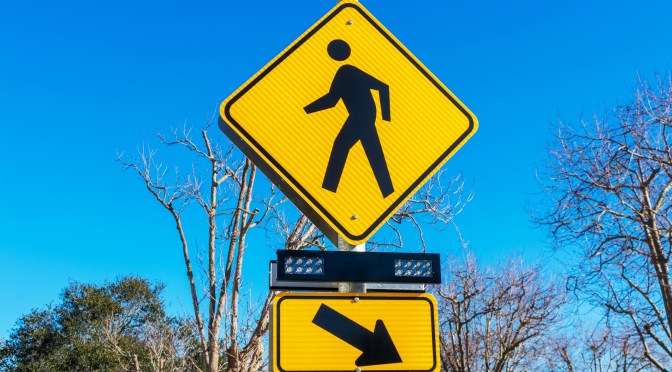
Pedestrian hybrid beacons (PHBs) are one tool to help pedestrians safely cross roads. PHBs provide red-signal control for vehicular traffic when needed at lower installation costs and reduced traffic delays than full traffic signals.
When a pedestrian activates a PHB, it displays a yellow light to vehicular traffic followed by a solid red light and an alternating red “wig-wag” signal similar to a railroad crossing indication. These traffic control devices often have instructional signs explaining PHB operation to drivers. But the size and content of instructional signs vary widely, and drivers are still unclear about the proper actions to take during the PHB phases. The alternating red “wig-wag” display, in particular, has been poorly understood by drivers.
Understanding driver behavior in response to PHB phases and accompanying signs will support improvements to design guidelines. Maximizing driver compliance with PHBs will improve traffic and pedestrian safety.
“Pedestrian hybrid beacons can be a valuable tool to help assign right of way to pedestrians, but their advantages of safety, cost and efficiency can be lost if drivers do not properly comprehend the beacon displays,” said Joe Gustafson, traffic engineer, Washington County. “A better understanding of driver comprehension of PHB displays and supplementary signage will help improve the success of these devices and promote wider deployment.”
Objectives
In a new project, researchers will comprehensively evaluate driver understanding and yielding behavior related to PHB phases with and without supporting message signs.
The objectives are:
- Understand evaluations to date of PHB operations and effectiveness
- Implement a comprehensive driver survey evaluating understanding of PHB phases and message signs
- Develop a simulator experiment comparing flashing pattern and sign options
- Recommend guidelines for optimizing PHB operational design and message signs
Project Details
- Estimated Start Date: 07/01/2024
- Estimated Completion Date: 06/30/2026
- Funding: LRRB
- Principal Investigator: Kakan Dey
- Co-Principal Investigators: Timothy Gates, Peter Savolainen
- Technical Liaison: Joe Gustafson
Details of the research study work plan and timeline are subject to change.
To receive email updates about this project, visit MnDOT’s Office of Research & Innovation to subscribe.
 Crossroads