
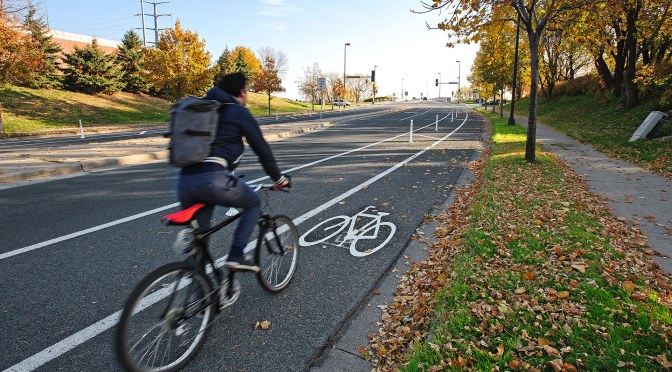
MnDOT relies on estimates of annual average daily traffic volumes to plan and maintain safe, effective transportation network infrastructure for all travelers. Estimating traffic volumes for nonmotorized road users such as bicyclists and pedestrians has been challenging because monitors are limited compared to vehicle traffic counters. Data from mobile devices, routinely collected through a variety of platforms, offers a potential source of traveler routes. Using monitored nonmotorized traveler data to validate mobile datasets, researchers produced a data visualization tool to estimate bicyclist and pedestrian counts within the Twin Cities area.
Making roads safer for vulnerable road users such as bicyclists and pedestrians requires understanding where these users are traveling. Identifying infrastructure needs for nonmotorized users requires an assessment of walking and bicycling networks and estimates of annual average daily bicycle and pedestrian counts.
MnDOT monitors bicycle and pedestrian traffic at 25 locations across the state. But monitoring on the scale needed to accurately estimate the numbers, locations and trends of nonmotorized travelers is resource prohibitive. Mobile data platforms such as StreetLight offer a potential source from which to extract travel counts, based on mode of travel, within a geographic area. But since mobile data sources are relatively new, their accuracy is uncertain. Spatial quality and coverage, for example, vary due to network service differences between urban and rural areas.
MnDOT wanted to leverage data from existing monitors by identifying which mobile device platforms and related datasets can provide nonmotorized traveler data. Understanding what roadway types and contexts are most frequented by bicyclists and pedestrians will support the agency in providing safe infrastructure for nonmotorized travelers.
What Did We Do?
A literature review examined the use of crowdsourced mobile data to estimate and forecast the spatial and temporal distribution of bicycle and pedestrian traffic. A comparison of studies using traditional and mobile data sources in bicycle travel demand models identified correlations of bicycle traffic volume with crowdsourced mobile data.
Researchers combined collected and monitored data with mobile data sources available to MnDOT, including StreetLight and Strava Metro, and incorporated the OpenStreetMap dataset, which contains mapping information collected through aerial imagery, GPS devices and field maps. The combined dataset was used to create route choice and trip distribution models to estimate annual average daily bicycle and pedestrian traffic calibrated with monitored baseline traffic counts in the Twin Cities area.
“This project was a great starting point to understand how to use mobile data for estimating bicyclist and pedestrian traffic, including how to combine it with our monitored data to produce more accurate results,” said Suzanne Scotty, pedestrian and bicycle planner, MnDOT Pedestrian and Bicyclist Data Program.
Processing and modifying the network data supported the production of visualized maps showing estimated annual average daily bicycle and pedestrian travelers on each road segment in the Twin Cities network. Users can modify the interactive maps based on their preferences.
What Did We Learn?
The review of previous studies revealed three types of crowdsourced mobile data used in traffic volume estimation: fitness app, location-based service app and cellular signal data. Variables generated from crowdsourced mobile data were shown to have significant and positive relationships with bicycle traffic.
Applying the available mobile source datasets and monitored bicyclist and pedestrian data to produce travel network models illustrated some inherent limitations of the data sources. Some OpenStreetMap data relevant to bicycle and pedestrian networks, for example, contained errors or inconsistencies. Additionally, StreetLight itself is based on models, and circumstances such as behavior shifts may result in decreased model accuracy. Also, some sources were spatially limited or biased toward certain populations. For example, Strava is primarily used by fitness enthusiasts.
What’s Next?
MnDOT has begun using the visualization tool to obtain rough estimates of bicycle and pedestrian traffic in the Twin Cities area. Additional research is needed to improve accuracy so estimates could support infrastructure decisions. Using mobile data directly, for example, would eliminate the reliance on third-party modeled or simulated data.
MnDOT will consider updating the travel trend system and expanding the analysis and visualization from the Twin Cities area to the entire state. Additionally, data from micromobility users, such as electric scooters, could enhance the analysis.
Though existing mobile data sources proved somewhat limited in producing accurate bicycle and pedestrian traffic estimates, the data visualization tool provides a solid basis from which to improve and expand.
 Crossroads