
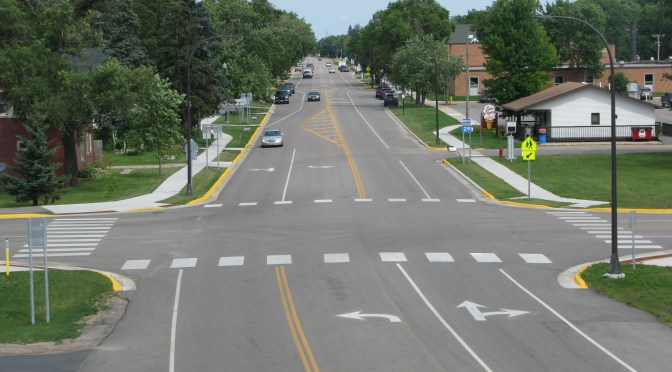
Minnesota Statutes §174.75 requires the MnDOT to follow a complete streets approach in all phases of planning, project development, operation, and maintenance activities. The purpose of the MnDOT complete streets policy “is to address the safety and accessibility needs of users of all ages and abilities. MnDOT assesses user needs at several stages of planning, project scoping and designing, construction, operation, and maintenance.”
An area of particular concern for complete streets is designing in consideration of speed outcomes. This is particularly true in environments where vulnerable road users, such as bicyclists and pedestrians, are present. Traditionally, highways and streets have been designed for a maximum safe speed in consideration of curve radius/superelevation and stopping sight distance. In contrast, the 2018 Green Book has introduced an increased emphasis on flexibility in design. To that end, MnDOT and other agencies have adopted a design approach that instead emphasizes target speed in consideration of the needs of anticipated road users. Speed has a significant influence on the frequency and severity of crashes, particularly those involving vulnerable road users.
To accommodate appropriate speeds, complete streets policies often modify cross-sectional characteristics to create a more accommodating environment for bicyclists and pedestrians. This may include design elements that are intended to reduce vehicle operating speeds. With increasing emphases on performance-based practical design (PBPD), this study aims to examine the impacts of these cross-sectional characteristics on driver operating speeds. The research team will conduct a series of spot-speed studies to examine differences in various speed metrics, providing critical guidance for forecasting the operational and safety implications of design decisions.
“This project will try to determine how design characteristics impact the speed of traffic, particularly in the area of transition such as from rural to urban cross section,” says Duane Hill, MnDOT District 1 Engineer. “This will be helpful for communities and designers to choose how they want the roadway to influence traffic speed which directly relates to bicycle and pedestrian safety.”
Objectives
This project will involve a comprehensive evaluation of how vehicle operating speeds are impacted by roadway cross-sectional characteristics. The project will focus on highway locations where speed control is a particular concern, such as in speed reduction zones (e.g., entering rural towns) or where key cross-sectional characteristics change, such as lane width, shoulder width, or where various design features are introduced, such as bicycle lanes, raised medians, crosswalks, and on-street parking.
A series of on-site field studies will be conducted at a diverse group of roadway locations, which are selected based upon site-specific characteristics and feedback from the technical advisory panel (TAP). These studies will involve the collection of high-fidelity light detection and ranging (lidar) data, resulting in vehicle trajectories, which will be analyzed to assess how drivers adapt their speeds based on changes in their contextual environment. The magnitude of speed reduction will be ascertained for various features, as will the distance over which these speed reductions are sustained downstream. These data will be used to evaluate differences in various speed metrics, including average travel speeds, as well as impacts on other important measures such as speed variance.
The results of these studies will be used to develop guidance that will assist MnDOT and other Minnesota road agencies in estimating what the expected travel speed characteristics will be under numerous contexts of interest. Such guidance will assist in performance-based and context-sensitive design decisions, particularly in circumstances where there are expectations of regular use by pedestrian, bicyclists, and other non-motorized users.
Project Details
- Estimated Start Date: 09/23/2022
- Estimated Completion Date: 06/30/2024
- Funding: MnDOT & LRRB
- Principal Investigator: Peter Savolainen
- Co-Principal Investigators: Tim Gates
- Technical Liaison: Duane Hill
Details of the research study work plan and timeline are subject to change.
 Crossroads