
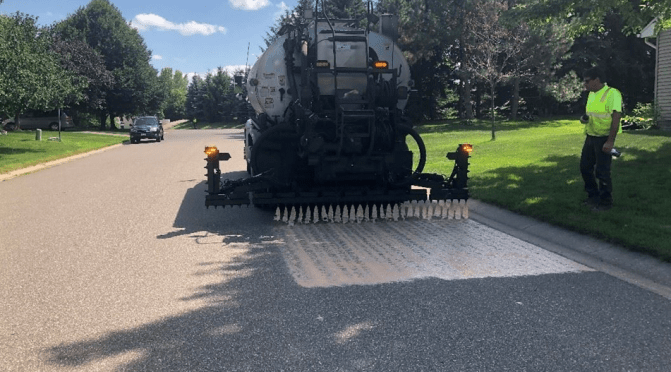
Over time, asphalt pavement becomes stiff and brittle due to oxidation, often leading to surface cracking and distress. To mitigate these damages and extend the service lives of roads, transportation agencies may apply a spray-on rejuvenator (SOR) to restore essential components of the asphalt. This project investigated the short- and long-term effectiveness of 12 SORs that state and local transportation agencies may consider for future use.
Striving to save taxpayer dollars, transportation agencies seek cost-effective strategies to extend the service lives of roads. One strategy to mitigate age-related damage such as surface cracking is the use of SORs, which maintenance staff may apply to an asphalt surface to help restore its integrity.
Many SORs are available to transportation agencies for this practice. The optimal selection depends on factors such as pavement condition, environmental conditions and performance requirements. To inform the purchasing decisions of state and local transportation agencies, researchers measured the performance impacts of 12 SORs and identified appropriate products for varying conditions.
What Did We Do?
Initially, a literature review examined previous work that evaluated SOR effectiveness. Using the review to highlight areas of needed research, investigators assessed the short- and long-term effectiveness of 12 SORs by conducting laboratory and field tests over a 36-month period. The SORs were categorized into two groups: roads with sand/gravel applied after SOR treatment and roads without a sand/gravel application.
Laboratory tests such as the bending beam rheometer, Hamburg wheel tracking and British Pendulum test assessed SOR impacts on pavement stiffness, aging resistance, permeability and rutting resistance. When laboratory testing was completed, the SORs were ranked based on their overall performance.
Field evaluations conducted on two low-volume road test sections at the MnROAD research facility and a local street in St. Michael, Minnesota, measured pavement marking reflectivity, light absorption, mean texture depth, permeability and skid resistance. Investigators collected performance data before the first SOR application and one, 12, 24 and 36 months after application.
What Did We Learn?
The literature review produced a limited amount of research that examined various SORs under consistent field and laboratory conditions and different binders and pavement environments, highlighting the value of the current project.
“This research provides useful information and guidance to state and local transportation agency staff members who are making SOR-related decisions,” said JinYeene Neumann, engineer, Carlton County Transportation Highway Department.
Laboratory and field test results indicated that SORs slow pavement aging, but their effectiveness diminishes and requires reapplication every two to three years, depending on environmental conditions and traffic loads. Investigators recommend regular monitoring of surface friction, skid resistance and reflectivity to maintain SOR effectiveness and safety.
For creep stiffness, SORs had the most significant impact at 20°C. At lower temperatures, differences between treated and control sections were less pronounced. SOR applications did not significantly affect the rutting resistance or permeability of the asphalt mixture. After 24 months, though, permeability increased in most cases, demonstrating that the effectiveness of SORs diminishes over time.
Laboratory test rankings indicated four products were consistently most effective across multiple criteria that included preventing the asphalt from becoming overly stiff and brittle while also minimizing negative impacts on skid resistance and permeability. The remaining eight SORs demonstrated varied performance, with some requiring more frequent reapplication to sustain their benefits.
Field testing results indicated that over time, light reflection from the asphalt surface increased in most test sections, likely due to asphalt aging. However, SOR applications adversely reduced pavement marking reflectivity by over 30% for some products. Friction results showed small reductions in SOR-treated sections immediately after application, but those with sand/gravel regained or exceeded initial friction values after one year.
What’s Next?
Using SORs is a viable strategy for pavement preservation, but long-term effectiveness depends on appropriate selection, periodic reapplication and careful monitoring of surface properties. Proper selection should consider pavement age, binder type, expected traffic conditions and binder compatibility.
The results of this research will be distributed to local and county transportation agencies for decision-making. Future research could conduct similar work on pavements at different stages of aging and examine the long-term impacts of multiple rejuvenator applications to maximize reapplication strategies for varying road, environmental and traffic-volume conditions.
 Crossroads