
Premature cracking in reinforced concrete bridge decks is expensive to repair and may lead to rapid bridge deterioration. Despite changes to mix designs, transverse cracking after casting continues to be a problem in Minnesota. This project evaluated alternative concrete mix designs and reinforcement strategies to mitigate early-age bridge deck cracking, reduce maintenance costs and extend bridge deck service lives.
The onset of early-age cracking on Minnesota bridges increases expenditures for state and local transportation agencies. Research has suggested adjusting the concrete mixture, reducing spacing between reinforcement bars and other strategies to minimize this cracking. MnDOT needed to evaluate the impact of these strategies to identify the most cost-effective solutions that bridge engineers can incorporate into new bridge design and construction practices.
Researchers examined the performance of concrete mixtures with shrinkage reducing admixtures (SRAs) and adjusted fiber content. They also analyzed load testing results of different steel bar reinforcement spacing. The results will help determine future work, such as pilot projects, to further analyze the performance of implemented strategies.
What Did We Do?
A literature review examined research regarding crack mitigation in concrete bridge decks and measures that MnDOT could incorporate into its design and construction practices. The review identified promising strategies that included using SRAs, adjusting the fiber content of concrete mixes and adding supplemental deck support with reduced spacing for steel reinforcement bars within the bridge.
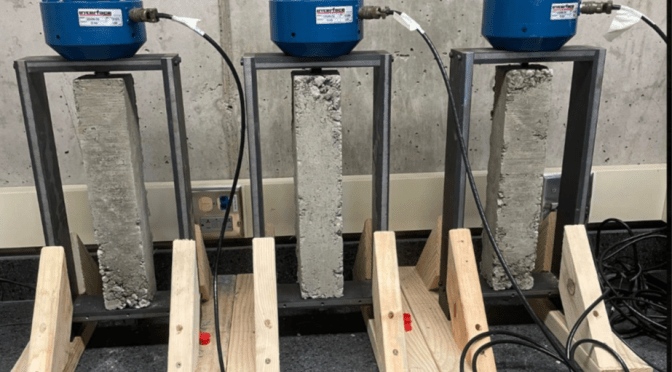
Based on the results of the literature review, laboratory testing evaluated the effects of using SRAs and adjusting fiber content for MnDOT’s current high-performance concrete (HPC) mix. Twelve mixes were evaluated: six investigated the standard HPC mix, four evaluated the use of SRAs, and two evaluated a mix with an adjusted fiber content. Both fresh and hardened concrete samples of each mix were tested to evaluate slump, air content, compressive strength, flexural strength, strain due to unrestrained shrinkage and force due to restrained shrinkage.
“The results of using SRAs in the HPC mix are encouraging and will lead to pilot projects to further evaluate the mix’s performance in preventing early-age bridge cracking,” said Paul Gronvall, principal engineer, MnDOT Bridge Office.
Computer modeling using finite element analysis evaluated the effects of concrete creep and shrinkage, thermal variations and different reinforcement layouts on tensile stress demands in the bridge deck. A model bridge was created based on a typical MnDOT bridge, with six prestressed concrete girders and a 9-inch-thick bridge deck that was 43 feet wide and 100 feet long. Models with the current standard 18-inch steel reinforcement bar spacing were compared to decks with 12-inch spacing, 6-inch spacing, flipped reinforcement layering and bridges with multiple spans.
Load testing examined positive thermal gradients (concrete warmer than girders), negative thermal gradients (concrete cooler than girders), temperature differentials during deck concrete placement, creep and shrinkage, and the interactions among these. Results calculated top surface tensile stresses (indicating the initiation of cracking) and stresses through the depth of the deck (indicating the progression of cracking).
What Did We Learn?
Laboratory results showed the use of SRAs in the HPC mix effectively reduced strain due to unrestrained shrinkage by approximately 25% and forces due to restrained shrinkage by approximately 50%. While the SRAs decreased the workability of the concrete, the fresh and hardened properties met HPC requirements. The mixes with adjusted fiber content were not effective in reducing unrestrained shrinkage strain or force due to restrained shrinkage.
Modeling results indicated creep and shrinkage caused tensile stresses sufficient to initiate cracking. Creep and shrinkage combined with a negative thermal gradient led to certain crack initiation. These results show that minimizing shrinkage and the temperature difference between the concrete and girders are the most effective strategies to reduce cracking on the bridge deck.
Results also indicated that reducing steel bar reinforcement spacing, which provides additional deck reinforcement, is unlikely to reduce crack initiation. But previous research indicates that once cracking has occurred, the additional reinforcement may limit crack widths in the bridge deck.
What’s Next?
Based on these results, investigators recommended adding SRAs to the HPC mix design, drafting instructions for controlling temperature differences between newly placed deck concrete and the girders, and reducing spacing between steel bars in the top mat of longitudinal reinforcement to limit cracking.
MnDOT plans to conduct pilot projects that use SRAs in the HPC mix. The agency will monitor the results for future adoption considerations.
 Crossroads
Useful information, thanks for sharing..!