
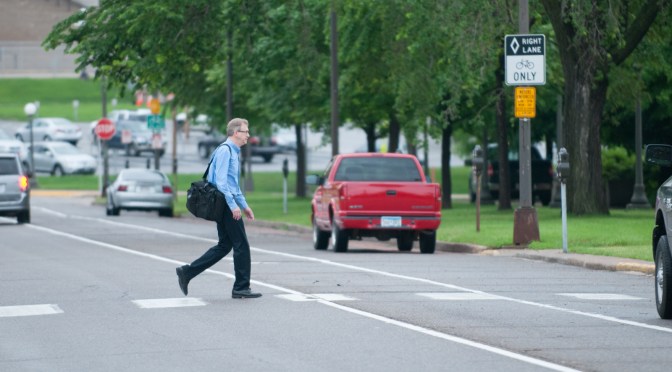
Transportation agencies closely monitor and evaluate roads for needed repairs, but pedestrian infrastructure such as sidewalks receive less attention. When left in disrepair, this infrastructure is susceptible to deterioration and can have significant negative impacts on communities. This project collected and integrated pertinent data and developed a model that measured the deterioration of pedestrian assets to predict the effects of aging. With this additional information, agencies can better prioritize areas of need and allocate resources more effectively to maintain and repair pedestrian assets.
Sidewalks, crosswalks, pedestrian bridges and other pedestrian infrastructure are susceptible to deterioration and aging due to high use, adverse weather conditions and suboptimal construction practices. While designed for a service life of 20 to 40 years, sidewalk deterioration may occur as early as one year into service. Manually identifying assets that need repair or replacement is labor-intensive and expensive. Because there is a misconception that pedestrian infrastructure is low risk, timely maintenance may be neglected. From a legal perspective, adequately maintaining pedestrian infrastructure can lower the risk of accidents and limit liability and exposure to claims under the Americans with Disabilities Act.
This project sought to help MnDOT monitor and identify pedestrian infrastructure needs more comprehensively and at a lower cost. An asset deterioration modeling framework was developed that integrated spatial and temporal data sources, advanced data analytics and predictive modeling for infrastructure managers to better predict asset deterioration, plan maintenance schedules and assist with budgeting allocations.
What Did We Do?
A predictive deterioration modeling framework was developed for pedestrian assets.
A literature review examined practices in pedestrian asset management. The review focused on the importance of effective data collection, evaluation techniques and the use of emerging technologies to determine the condition of pedestrian infrastructure.
A survey of state and local agencies gathered information about current practices in data collection and pedestrian asset evaluation.
“This project has developed a solid framework and proof of concept for a predictor of deterioration rates for pedestrian assets that could offer valuable management information,” said Kristie Billiar, ADA program and policy manager, MnDOT Accessibility.
To support predictive analysis, researchers created a comprehensive pedestrian asset dataset that integrated intricate and expansive historical data from MnDOT. The dataset included detailed pedestrian access routes, land use data, climate data and other influencing factors.
Advanced tools used in the field, including a bicycle equipped with sensors and cameras, and a walking profiler to measure surface roughness, captured detailed information on sidewalk conditions. This approach provided quantitative data for modeling that was more detailed and cost-effective than visual inspections.
Aerial imagery, street view data and field data were used in the model to calculate the deterioration rate of pedestrian assets and predict future conditions.
What Was the Result?
The framework for modeling the deterioration of pedestrian assets could be used to inform decisions related to pedestrian infrastructure maintenance and construction. Researchers collected needed data through innovative processes that were less labor-intensive than previous practices. This collected data, integrated with historical MnDOT pedestrian access data and additional data such as land use and climate data, resulted in a comprehensive dataset allowing for more expansive monitoring of pedestrian assets at a lower cost and a more proactive maintenance strategy.
A significant aspect of this project was the use of innovative tools and approaches to collect field data, such as a bicycle equipped with sensors and cameras. Survey results from 25 states indicated that some agencies continued to rely on traditional methods such as visual inspections for data collection, but other agencies had started using sensors, computer vision and other state-of-the-art methods. These novel approaches resulted in more quantifiable data for modeling in comparison to data collected from traditional visual inspections.
What’s Next?
The results demonstrated that the model could be used to inform and assist decision-making for pedestrian asset management, allocating resources and determining maintenance schedules. MnDOT indicated that the model has established a proof of concept, but that further research is needed for continuing refinement.
A pilot project is planned with a focus on improving innovative data collection methods such as lidar, other remote sensing techniques and the bicycle-based collection system. Future use of the model could result in construction savings, lower life cycle costs, safer pedestrian use and higher accessibility compliance.
 Crossroads