
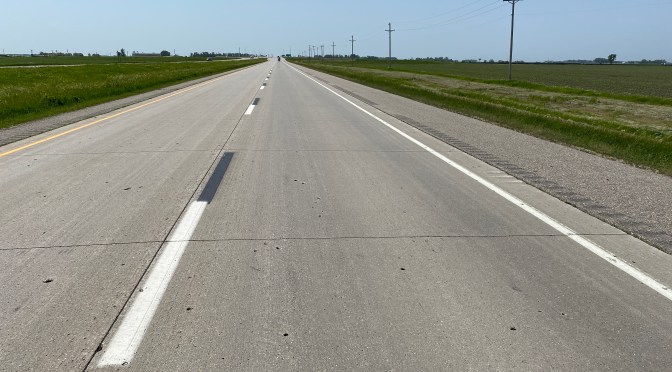
Pavement markings that clearly delineate lanes are important for reducing crashes and improving the safety of drivers. The configurations of these pavement markings—primarily the width and length of the line and the spacing of broken lines—vary from state to state. This project identified driver preferences for pavement marking patterns and widths, which can increase visibility and improve safety.
Pavement marking visibility is important to driver safety. Federal policies provide guidance for pavement marking dimensions, including a standard width of 4 to 6 inches for lane markings.
While Minnesota currently uses the minimum width of 4 inches for center lines and lane lines and 6 inches for edge lines, many states have started using 6-inch-wide markings for all lines based on research that indicates safety benefits. Additionally, the spacing of markings that divide lanes on Minnesota roads does not meet current federal guidelines. These issues highlighted the need for MnDOT to reconsider its pavement marking policies.
“This project helped determine which pavement marking dimensions and spacings people need on Minnesota roadways. That should lead to an increase in safety and driver comfort,” said Ethan Peterson, pavement markings and crashworthy devices engineer, MnDOT Office of Traffic Engineering.
The purpose of this study was to identify driver preferences for pavement marking patterns, dimensions and contrast through a human factors study conducted on Minnesota roads. Additionally, this research collected data regarding machine vision technology used in automated vehicles that was evaluated in previous research.
What Did We Do?
Fifty-six participants with valid driver’s licenses drove an instrumented vehicle through 11 study segments that included different configurations of pavement markings. These configurations differed by:
- Width of lane marking (4 inch or 6 inch).
- Length and spacing (marking lengths from 10 to 20 feet and spacing from 25 to 40 feet).
- Contrast style (black bordering a white marking or a black stripe following the white marking).
Drivers rated the different pavement markings based on visibility and preference using a scale of 1 to 5, with 1 being the least visible or preferred and 5 being the most visible or preferred. Cameras on the vehicle monitored its position relative to the broken lane line pavement markings during the drive.
After the test drive, the drivers completed a survey indicating their marking configuration preference or no preference. The drivers also provided general comments about the pavement markings, suggested improvements that could be made to pavement markings to increase daytime and nighttime visibility, and described their understanding of the meaning or purpose of the black markings in combination with the white markings.
What Was the Result?
The lane line markings preferred most by drivers were 6 inches wide and 12.5 feet long spaced 37.5 feet apart. Segments that had 6-inch-wide markings at 20 to 30 feet and 15 to 25 feet were also highly preferred. MnDOT’s current standard marking of 4 inches wide and 10 feet long spaced 40 feet apart was one of the lowest-rated configurations. Survey results further indicated a preference for 6-inch-wide markings compared to 4-inch-wide markings.
The research team recommended MnDOT change its policy from the current 10 feet long spaced 40 feet apart pattern to the 12.5 feet long spaced 37.5 feet apart broken lane line marking configuration. This pattern was more visible, preferred by drivers and maintains MnDOT’s current 50-foot cycle length.
Some but not all participants liked the contrast markings and understood their value. Results further indicated there was no preference for the style of contrast marking. Contrast markings were recommended in areas where the contrast of the pavement markings with the pavement is low.
What’s Next?
MnDOT is incorporating recommendations from the project for the 6-inch-wide by 12.5-foot-long marking spaced 37.5 feet apart into its guidance policies, including the MnDOT Traffic Engineering Manual, MnDOT Provisions for Pavement Marking Operations and MnDOT Pavement Marking Field Guide. Beginning in 2026, these dimensions will be the standard for pavement markings on new roads and remarking roads in Minnesota.
Additionally, MnDOT will begin to incorporate lag contrast pattern (white followed by black) on concrete roads, which are light in color. A 10- or 12.5-foot-long black stripe will be painted immediately after the white lane marking. While this project did not find definitive evidence for using the black stripe, related MnDOT research has demonstrated its benefits.
More Information
- Research project webpage
- Final report (PDF)
- Research summary (PDF)
 Crossroads
One thought on “Examining Driver Preferences for Lane Line Patterns and Widths”