
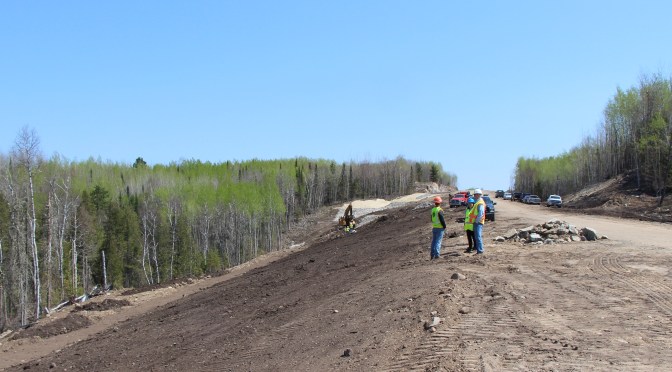
Vegetated roadsides in Minnesota help control stormwater quantity and pollutant levels before the water reaches lakes, streams and communities. Because leftover soil from road construction generally does not support filtration and plant growth, MnDOT and local engineers have continued research to identify organically rich, locally available industrial by-products to amend the soil. Engineered soil mixes with materials such as dredge sand, coarse street sweepings and ash sawdust show high potential for providing a sustainable, efficient solution.
Roadside soil helps support the road base but also receives all the pavement’s stormwater runoff. In addition to increasing volumes of water that can overwhelm stormwater infrastructure and risk flooding, road runoff contains various pollutants and heavy metals that can harm Minnesota’s streams and lakes.
Sufficiently vegetated roadsides—including specially designed bioslopes and bioswales—can help control and filter stormwater runoff. Leftover soil from road construction, however, does not support native revegetation unless amended with organic matter, which can be resource-intensive for the state’s thousands of roadside miles.
Organically rich, permeable soil that filters stormwater runoff can be designed with various materials. Prior research explored creating soil with industrial by-products from sources in northeastern Minnesota to create vegetated roadsides. MnDOT was interested in expanding the potential material reuse statewide and developing guidance for road engineers to create sustainable, engineered soil mixes.
What Did We Do?
After exploring potential industrial by-products from across the state that could be used in a soil mix, researchers selected nine granular or organic materials for testing:
- Sediment from U.S. Army Corps of Engineers dredging operations.
- Recycled concrete aggregate (RCA) from old concrete roadways, obtained from a paving contractor.
- Bottom ash, degritter and lime mud from a pulp and paper mill.
- Beet tailings and VersaLime from a sugar factory.
- Green pine and ash sawdust from a sawmill.
- Waste peat and biochar from a company specializing in peat-based products for pollutant removal.
Laboratory tests assessed gradation, hydraulic conductivity, moisture content and other civil engineering criteria to determine the biofiltration potential of the materials. Environmental assessments included chemical characterization to determine levels of nutrients, metals and other components, and pollutant release and adsorption behavior when the material was subjected to typical stormwater. In greenhouse trials, the materials were used to grow radishes and oats to determine germination rates, plant heights and biomass produced with each material.
The highest-performing materials were combined to create three engineered soil mixes: RCA and ash sawdust, RCA and peat/biochar mix, and dredge sediment and degritter. Each mix contained 80% inorganic and 20% organic matter, and underwent the same testing as the individual materials. Researchers then explored infiltration capacities, pollutant removal and plant growth of grass and flower seed using the three mixes in outdoor plots.
A life cycle assessment of the three engineered soil mixes evaluated material collection and transport along with environmental effects such as energy demand, human health and ecosystem impacts, climate change and water use.
What Did We Learn?
All the mixes exhibited effective stormwater capture and filtration, with organic and coarser materials showing the highest conductivity. All nine materials met environmental safety standards, though some were more efficient at removing pollutants. The peat/biochar mix had the highest adsorption capacity for metals, and bottom ash and lime mud exhibited high phosphate removal rates.
“This project illustrated the potential to reuse recycled concrete aggregate and other by-product materials to create vegetated roadsides that are beneficial in controlling stormwater. The design guide will be a substantial help to support this sustainable practice,” said Dwayne Stenlund, erosion control specialist, MnDOT Office of Environmental Stewardship.
While greenhouse plant growth was generally strong, growth in the outdoor plots was limited, potentially due to the extended dry season. The life cycle assessment revealed the RCA and ash sawdust mix had the lowest impacts, though the RCA and peat/biochar mix produced very similar results.
Results from the research were incorporated into a design guide with recommended practices for using local by-products in engineered soil mixes to obtain optimal biofiltration, stormwater pollutant removal and plant growth. The guide includes a decision tree and processes to ensure MnDOT infiltration criteria are met, determine plant growth capacity and analyze life cycle impacts.
What’s Next?
MnDOT will consider how to implement soil design and decision matrix guidance, including identifying potential industry partners. While no further research is currently planned, exploring the potential to sequester other pollutants of concern could further enhance protection of Minnesota’s environment and roadside sustainability.
 Crossroads