
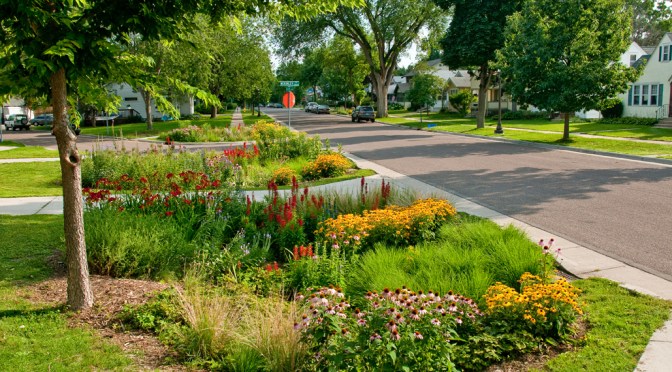
Managing stormwater is important to prevent flooding and associated safety risks; impacts to the environment; and damage to property, roads and bridges. As severe storms increase, MnDOT wants to ensure its stormwater diversion infrastructure can keep communities, roads and ecosystems safe from flooding. New research is helping the agency understand projected stormwater flows and identify cost-effective strategies and other adaptation considerations to manage stormwater.
MnDOT maintains a significant portion of the state’s stormwater infrastructure. The agency uses traditional stormwater control methods, including drainage through pipes, underground storage and ponds, in addition to green stormwater infrastructure methods that rely on soil and plants to intercept and infiltrate water. Green infrastructure may include natural areas and wetlands, rain gardens or stormwater ponds that can evaporate, slowly channel water into lakes and streams, or recharge groundwater.
Stormwater hydraulic system designs have historically been based on older precipitation data sets. More frequent severe storms and population, however, are projected to increase.
“The traditional hydrologic design method of using past observed data must evolve to incorporate precipitation predictions. Stormwater infrastructure needs to accommodate design flow changes,” Erik Brenna, assistant state hydraulics engineer, MnDOT Bridge Office.
MnDOT needed to understand how stormwater flows are expected to change and how existing stormwater infrastructure would respond to future storms. The agency wanted to know which stormwater management strategies could cost-effectively reduce flooding and protect communities from larger and more frequent storms. Both the transportation infrastructure and ecosystems benefit by adopting effective management strategies.
What Was Our Goal?
The goal of this project was to estimate the cost-effectiveness of various conventional and green stormwater management strategies to accommodate predicted future storm events.
What Did We Do?
A literature review explored practices for interpreting and scaling climate models and data sets to predict extreme rainfall events within a watershed, and tools to estimate costs of traditional and green stormwater infrastructure. Researchers then identified three small urban watersheds in Duluth, Minneapolis and Rochester, each with existing data and stormwater models necessary to analyze infrastructure capacity.

Swales in MnDOT’s right of way can infiltrate stormwater runoff from roads.
Various historical and future storm scenarios provided input to model the capacities of a range of infrastructure strategies to prevent flooding. Existing stormwater networks in the three watersheds were evaluated, including retention ponds and grassed swales or dry retention basins. Alternative strategies were also reviewed, including:
- Adding infiltration basins.
- Adding new stormwater ponds.
- Retrofitting existing ponds to be “smart” ponds, which partially drain before a storm.
- Retrofitting existing ponds and adding new smart ponds.
- Upsizing stormwater pipes to convey more water.
Using publicly available tools, models and other data sources, researchers determined construction, operation, maintenance and other costs of each strategy over a 20-year life cycle. Investigators also assessed the costs of underground storage, which performs similarly to a stormwater pond. Combining the costs with the performance of the strategies in controlling stormwater runoff and reducing flooding identified the cost-effectiveness for each strategy.
What Did We Learn?
Climate projections indicate severe storms will increase. The adaptation strategy simulations demonstrated that existing infrastructure is not sufficient to eliminate flooding from a 10-year or higher probability storm (that is, one with a 10% chance of occurring any year), but lower probability potential storms in which most of the rainfall happens over a few hours.
The analysis revealed several general conclusions. Stormwater management practices can be placed upstream of flood-prone communities and other infrastructure such as major highways to prevent the most significant damage in critical locations. Some strategies such as ponds and basins, however, require property that may not be under MnDOT’s control.
“MnDOT’s stormwater infrastructure would likely not prevent flooding from very intense, low-probability storms. For more common uniform storms that happen over a longer period, infiltration basins with deep-rooted vegetation can work wonders handling large amounts of water,” John Gulliver, professor, University of Minnesota Department of Civil Engineering.
Adaptation strategy costs ranged from the least expensive (retrofitting existing ponds into smart ponds and adding extra ponds, though the costs of acquiring additional land were not included) to the most expensive (upsizing stormwater conveyance pipes and installing underground storage). Researchers noted that the potential loss of life and damages to property, infrastructure and natural resources would far outweigh any savings from the baseline scenario of maintaining current infrastructure.
To control flooding, building new stormwater ponds was the most cost-effective adaptation strategy overall in terms of performance. While smart ponds by themselves were inexpensive, they were also relatively ineffective. Storing water underground performed as well as building more ponds, however, the costs associated with underground storage are approximately 100 times more expensive. Increasing pipe size can reduce flooding upstream but exacerbate it downstream.
Rain events with the same volume as 10-year and lower probability storms that occur more uniformly over a longer period are more common than the intense shorter events modeled. For these storms, researchers concluded that infiltration into vegetated areas can accommodate much of the rainfall.
What’s Next?
While this research clearly illustrated that more water storage like retention ponds will help manage an increasing volume of stormwater on a local level, the magnitude of the increases will require additional adaptation methods. MnDOT will consider further research to explore the effectiveness of armoring to re-route water flows, the benefits of using deep-rooted vegetation for infiltration and the impacts of watershed health on stormwater management.
As development occurs around the state and impervious surface area increases, MnDOT will need to continually ensure stormwater is being adequately managed.
More Information
Cover image by Adrian Danciu, courtesy of Capitol Region Watershed District.
 Crossroads