
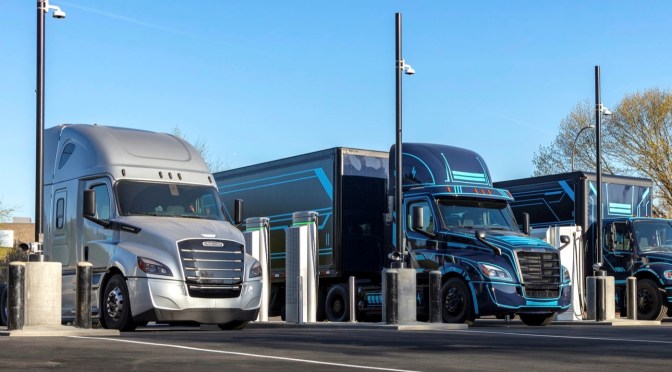
While personal electric vehicles (EVs), electric buses and other transit options are becoming more commonplace, the market for larger electric trucks is still developing. Higher purchase prices, limited driving ranges and access to charging infrastructure all contribute to the delay in adopting larger electric trucks (e-trucks). New analyses suggest optimal locations for e-truck charging stations in Minnesota.
Charging options for personal EVs are increasing, and transit agencies with electric buses and other vehicles provide the necessary charging infrastructure for this sector. But the availability of charging stations for e-trucks remains limited.
“This project helped us understand considerations for e-truck charging stations, such as electric power substation location and capacity. It also identified optimal locations for truck charging stations to support intrastate freight movement,” said Andrew Andrusko, freight planning director, MnDOT Office of Freight and Commercial Vehicle Operations.
MnDOT continually strives to facilitate changes to achieve Minnesota’s greenhouse gas emission (GHG) targets of 30% below 2005 levels by 2025 and 80% by 2050. While the agency has studied electric charging infrastructure needs for light-duty vehicles, significant uncertainties still exist about charging options for medium- and heavy-duty trucks.
Widespread adoption of larger e-trucks may not be imminent. But understanding the infrastructure needs and barriers will help MnDOT proactively address a significant subsector of transportation GHG.
What Was Our Goal?
The goal of this project was to understand the needs and opportunities for e-truck charging stations and to optimize the location of charging stations in Minnesota.
What Did We Do?
After synthesizing existing knowledge about e-trucks, researchers analyzed the electric load needed by e-truck charging stations. Because of the substantial power needs of these vehicles, the charging stations will likely require upgrades to the electric grid. A grid impact analysis helped identify locations that would accept a new electric load while reducing the need for potential upgrades or additional circuits to the grid.
Investigators targeted areas of high potential based on power capacity; proximity to an electrical substation; and reliability, which was based on the number of substations located near each other. Minnesota’s interest in reducing GHG emissions in general also prompted a review of potential renewable energy sources to generate electricity, including on-site solar generation.
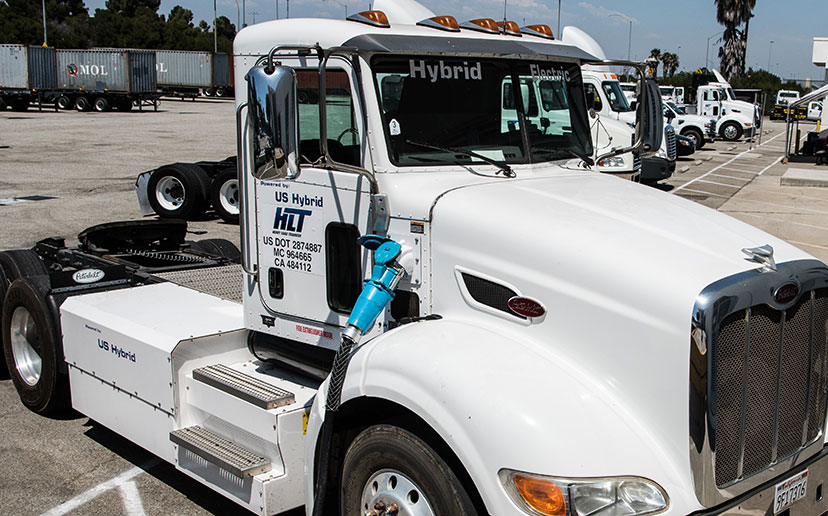
Freight transportation infrastructure needs will be driven by evolving e-truck technology.
A decision analysis process identified candidate locations for charging stations based on the following selection criteria gathered from the literature:
- Access for e-truck users (truck traffic volume).
- Environmental conditions, including flood risk, distance to water resources and land cover.
- Proximity to truck stops, gas stations and EV direct current fast chargers.
- Power supply from the grid network and solar energy.
- Land use and price.
Experts and stakeholders, including staff from MnDOT, the Freight Mobility Research Institute and the American Trucking Association, participated in a survey to compare the relative importance of these criteria. Investigators calculated weights based on the rankings and created geographic information system layers for each criterion to use in a geospatial analysis that identified candidate locations for each criterion.
The candidate locations were pared down using optimization modeling. An analysis of truck trip data revealed the operating costs of diesel and e-trucks, including energy and time costs, due to charging stop detours. The results were used to identify the optimal charging locations to maximize e-truck usage based on total transportation system cost. Finally, researchers estimated the system costs and penetration rates of e-trucks driving 100 to 200 miles with varying numbers of charging stations.
What Did We Learn?
The decision analysis revealed the most important electric charging station criterion for e-truck users: access, represented by truck traffic volume, proximity to truck stop stations and proximity to power substations. The geospatial analysis identified a uniform distribution of candidate charging stations every 20 to 30 miles on major highways as high-priority truck charging station candidates.
“The optimization model is a novel decision-making tool that will help MnDOT maximize its return on investment in charging infrastructure. The model can be expanded to incorporate other contributing factors and inform policy decisions,” said Alireza Khani, associate professor, University of Minnesota Department of Civil, Environmental and Geo-Engineering.
The optimization modeling indicated that distribution of charging stations should be relatively uniform in areas with greater truck trip rates. Also, the most suitable electric grid substations where stations should be located were within or around major urban areas. Solar generation did not prove to be a viable option to fully power truck charging stations.
Based on the reduced per-mile operating costs of e-trucks over diesel trucks, investigators estimated that the adoption of e-trucks would grow sharply as the charging infrastructure is developed, with the growth rate slowing at a higher number of charging stations (30 to 40). Using one-way truck trips data from StreetLight InSight was the primary limitation of the study, as medium- to heavy-duty trucks may be more likely to be engaged in long-haul interstate commerce or multidestination trip chains within the state.
What’s Next?
As technology development continues, understanding intrastate freight hauling charging needs has become an important part of MnDOT’s preparation to facilitate widespread adoption of e-trucks. Many issues need further exploration, including the infrastructure needs for e-trucks involved in hauling refrigerated or bulk commodities and hazardous materials. The agency is considering additional research to explore these and other segments of the freight hauling sector.
Additionally, exploring initial costs of e-trucks and different rates of parts deterioration, government incentives to increase adoption and equity considerations would also support MnDOT’s role in accomplishing state and national GHG goals.
 Crossroads
I think standardized battery packs that can be swapped would be a good solution. It would greatly speed up the time to be back on the road. The recharging can be done at off peak times to reduce the costs of charging as well.