

Managed lanes provide transportation agencies with a strategy for reducing congestion and improving travel times along urban highways. A common perception is that the benefits of managed lanes are greater for higher-income people than for those with lower incomes, often from underrepresented communities. New research illustrates the diversity of managed lane users and provides new metrics and recommendations to factor equity into the highway project planning process.
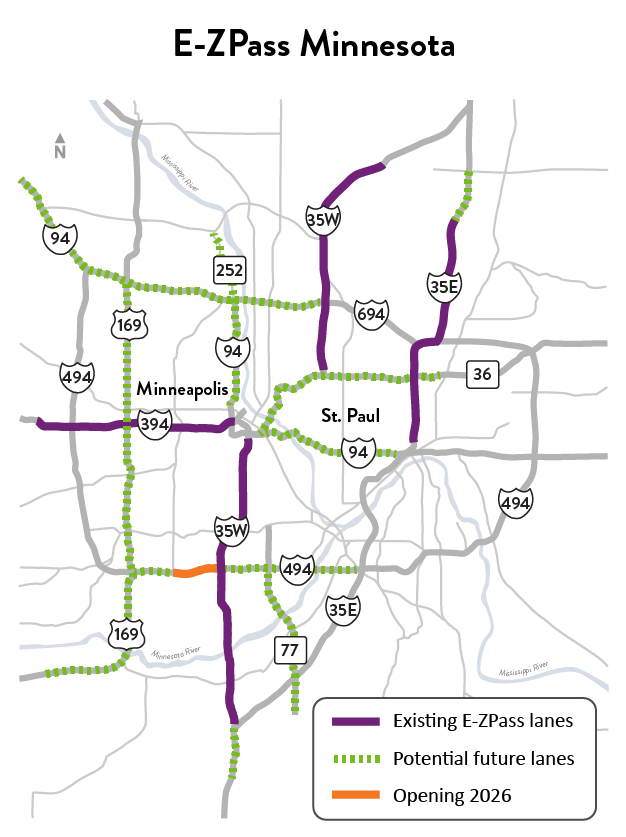
Managed lanes, known as E-ZPass lanes in Minnesota, are available to carpoolers and transit users for free during high-traffic times, while vehicle owners who are driving alone pay a fee.
Local transportation agencies and MnDOT strive to ensure the state’s transportation network, services and decision-making meet the needs of underserved communities. While transportation planning requires environmental and social analyses to identify the potential impacts of a proposed project, disadvantaged populations have been historically underrepresented in the planning process.
“We analyzed and identified metrics that are all feasible to use with existing tools, provide meaningful information to the alternatives analysis process and can be put into practice immediately,” said Camila Fonseca-Sarmiento, director of fiscal research, University of Minnesota Institute for Urban and Regional Infrastructure Finance
Many urban-area highway projects involve an aspect of managed lanes. MnDOT has several managed lane projects in the planning stages. The Local Road Research Board (LRRB) and MnDOT were interested in understanding the demographics of E-ZPass users and new methods to improve equity in planning for managed lanes.
What Was Our Goal?
This project sought to compare the demographics of E-ZPass users with those of the larger travel sheds where the managed lanes are located. The second goal was to improve methods to evaluate equity impacts on demographic subgroups during planning for managed lane alternatives.
What Did We Do?
After reviewing existing literature on equity issues associated with managed lanes, investigators analyzed demographics in four main corridors of Interstate 394 (I-394), I-35W and I-35E using techniques that summarize and visualize both statistical and spatial data distributions. Numerous data sources identified demographic characteristics for travel shed users and E-ZPass lane users (transponder owners, carpoolers and transit riders). Those characteristics included population, income, poverty level, race, education, disability, head of household, age and travel mode.
Researchers then explored methods of measuring and comparing the impacts of project alternatives on different demographic subgroups. Analyses required in environmental assessments or environmental impact statements do not specifically require the consideration of equity impacts. Federal and state legislative and executive actions, however, support and may require agencies to consider equity across populations in project planning.
A review of criteria used in past alternative analyses included an evaluation of metrics to inform whether an alternative could achieve an equity goal for disadvantaged communities in a variety of areas. Investigators identified 27 new or refined metrics to measure equity and then further assessed the suitability of the measures for feasibility given available data and tools, sensitivity to differences in project alternatives, risk of stakeholders not buying into or finding a measure meaningful, and the value of the measure in being actionable or relevant to decision-makers.
Researchers applied a modified list of equity measures to a managed lane project that MnDOT previously analyzed to illustrate how the project’s alternatives performed via the equity metrics. Finally, investigators explored ways to mitigate social, economic and environmental impacts from E-ZPass lane projects.
What Did We Learn?
The comparison of demographics of E-ZPass lane users with the general travel shed population revealed that E-ZPass lane users—about 80% of which are either carpoolers or transit riders—are slightly more racially diverse than the larger population. A lower percentage of people with disabilities, however, use managed lanes than use the travel sheds. There is little income difference between E-ZPass lane users and travel shed users, even though more E-ZPass account holders have higher incomes.
“These results will play a significant role in enabling MnDOT and its partners to further enhance equity on the E-ZPass managed lane system and all the state’s transportation agencies in the overall planning process,” said Bradley Larsen, E-ZPass Policy and Planning Program director, MnDOT Office of Metro District Planning, Program Management and Transit.
Nine measures were identified for transportation agencies to use in evaluating potential equity impacts of project alternatives. Measures consider potential benefits for underrepresented communities in the following areas: transit advantages, such as shorter travel times, increased accessibility to jobs and new trips originating in those communities; improved local road safety; air quality and noise level improvements; and input and involvement from community residents in project alternatives.
Additional recommendations included collecting more demographic data from transponder owners; exploring project enhancement opportunities to improve outcomes in underrepresented communities; and elevating community voices in research, planning, design and implementation efforts.
What’s Next?
Multimodal managed lanes will continue to be a significant part of highway planning in urban areas. Transportation agencies can consider identified metrics in planning a variety of highway projects. MnDOT will use study results in ongoing considerations of a low-income discount program for E-ZPass lanes and public transportation incentive programs.
The agency may also consider developing a program to distribute the benefits of the E-ZPass program more equitably by using excess toll revenue in underrepresented communities adjacent to managed lane corridors for transportation improvements like enhancing transit service and facilities or building sound walls or other environmental mitigation projects.
 Crossroads
One thought on “Maximizing Equity in Managed Lane Planning”