
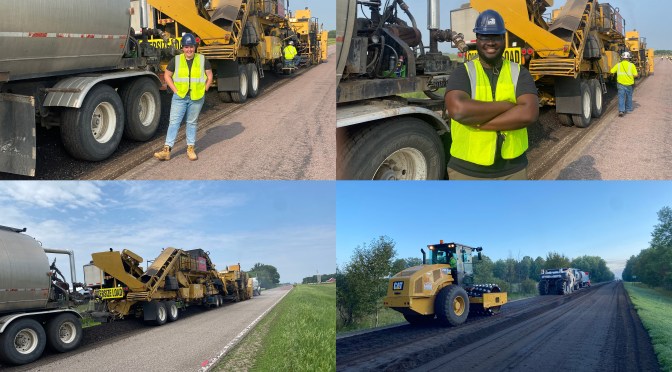
Cold recycling road pavement materials into new road construction is a cost-effective and sustainable practice. However, the properties of these materials must be characterized to adequately design pavement structures. This project developed a framework and tool for transportation agencies to estimate the key material properties of cold recycled materials incorporated into road designs.
What Was the Need?
To increase sustainable practices in road construction and rehabilitation, transportation agencies use recycled asphalt pavement materials to preserve the pavement infrastructure. Cold recycling is one effective recycling method known for its efficient reuse of existing materials, ease of mix preparation and construction, and reduced need for virgin materials and fossil fuels.
Three cold recycling techniques commonly used in Minnesota differ in their methodologies but share a common material composition. Yet engineers often don’t have sufficient information to accurately predict the performance of the recycled material in pavement layers, resulting in underdesigned or overdesigned pavement structures.
This project developed tools and methodologies to better understand the engineering characteristics and capabilities of recycled materials used in subsurface layers of a road to support the pavement layer. The results will inform decisions regarding the appropriate thickness of the pavement layer during the design phase to ensure structural integrity and long-term performance without costly overdesigns.
What Did We Do?
A literature review evaluated cold recycling techniques, material characterization methods, factors affecting mechanical properties, cold recycled pavement design procedures and methodologies for assessing pavement performance.
Field and laboratory assessments involving falling weight deflectometer tests and roughness and rutting measurements determined the early-life performance of pavement structures and the cold recycling layers within the pavement structure. The laboratory assessments determined the factors impacting tensile strength, shear parameters and resilient modulus.
“The rutting prediction model can be implemented into MnPAVE software to improve cold recycled pavement road designs and reduce road construction costs,” said Tim Andersen, pavement design engineer, MnDOT Office of Materials and Road Research.
Prediction models were developed to estimate the tensile strength, shear parameters and resilient modulus of recycled materials. These estimates are essential for predicting the performance of the recycled material layer. Since recycled materials are predicted to perform better, designers can decrease the pavement layer thickness and save costs.
Researchers also developed a cold recycling layer rutting performance function and early-life deviator stress ratio rut threshold to assist in pavement design. First-year field rutting data was analyzed to establish threshold values for early-life rutting performance.
What Did We Learn?
An assessment tool developed in this study accurately estimates the characteristics of the material parameters needed for quality assurance and a cost-effective road design. To estimate tensile strength and shear parameters, the model requires engineered emulsion content, the presence of chemical additives, compacted density and gradation characteristics. Resilient modulus estimates also required these inputs and temperature.
This project also developed a rutting performance function and early-life rutting threshold to mitigate the risk of premature rutting caused by the recycled layer. Investigators adopted a rut depth of 0.125 inches to indicate inadequate early-life performance of the recycled material layer. The corresponding early-life deviator stress ratio rut threshold value of 0.31 is effective at identifying poor-performing sections. Engineers can beneficially reduce this ratio by increasing the recycled layer density, incorporating chemical additives or increasing pavement layer thickness.
These tools, supported by mechanistic analysis and statistical validation, can effectively evaluate and predict the rutting behavior of cold recycled pavement layers.
What’s Next?
Agencies may soon be able to integrate these tools into their pavement design processes to improve the durability of cold recycled pavements and extend the service lives of roads. This better-informed use of recycled materials should reduce the frequency and cost of maintenance and repairs, and decrease work zone closures and associated crashes and fatalities.
Additional analysis of more comprehensive field and laboratory data could improve the accuracy of the prediction model, the rutting performance function and the early-life rut threshold. Future work could address these needs and conduct life cycle assessments focused on reducing construction-related emissions to promote expanded use of cold recycling as a sustainable pavement rehabilitation technique.
 Crossroads