
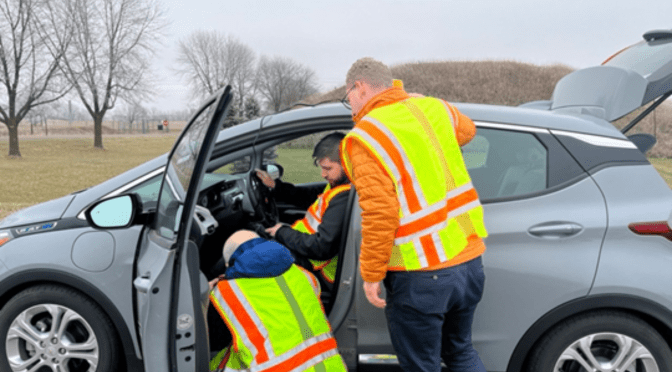
Many modern vehicles continuously track location and performance data such as speed and acceleration. Collecting large amounts of this data to use in machine learning models has many potential applications, including aggregating and evaluating road pavement conditions. This project investigated the feasibility of using large amounts of onboard data from electric vehicles to monitor and assess pavement conditions comprehensively and cost-effectively across a large network.
MnDOT primarily assesses road pavement conditions using a costly Pathways van that requires extensive coordination, specially trained personnel and dedicated equipment. This method is used once per year on MnDOT routes and every other year on County State Aid highways. This sensitive, specialized equipment is limited to operating in the warm summer months.
This research study evaluated a more efficient method that converts onboard data from electric vehicles into continuous pavement condition assessments, which could significantly lower costs while enhancing monitoring activities. This new method leverages vast amounts of lower-cost, low-quality data into valuable pavement condition information to achieve a more comprehensive coverage of Minnesota’s entire state highway system. The data is available throughout the year, which can reveal seasonal changes in the pavements that are not apparent in the current once-per-year data collection.
To evaluate the use of onboard vehicle data to monitor pavement conditions, researchers compared predictive pavement assessments from machine learning models to ground truth assessments and third-party assessments similarly using onboard vehicle data.
What Did We Do?
Investigators adapted methodologies from Denmark’s Live Road Assessment (LiRA) project, which is currently the most comprehensive effort to use onboard vehicle sensors to continuously monitor road conditions. They reviewed the LiRA project and pertinent literature to better understand how data is collected and used to estimate pavement conditions. Next, a comprehensive evaluation of data collection hardware identified the best scanner device that could reliably capture sensor data from test vehicles.
“MnDOT is excited to incorporate the use of onboard vehicle data in its efforts to more effectively and efficiently monitor pavement conditions,” said Curt Turgeon, director, MnDOT Office of Materials and Road Research.
Data collection occurred on three test routes: the MN-36 loop, Metro to Northfield loop and MnROAD facility. Approximately 10,000 data points from these routes were generated and synchronized with MnDOT’s high-precision Pathways van measurements. The scanner collected vehicle data such as location, speed and 3D acceleration, which measures the intensity and complexity of vibrations transmitted from the road through the vehicle’s suspension system. In total, machine learning models used 694 data values to train and predict pavement quality using the International Roughness Index (IRI) for a given pavement section.
The predictive output of eight machine learning models was compared to MnDOT’s Pathways van measurements, which served as the primary ground truth. Test results were also compared to network-level data across diverse road conditions provided by a firm that similarly uses onboard vehicle data via a proprietary method.
What Did We Learn?
Results demonstrated that onboard vehicle sensor data can be used to effectively assess pavement conditions for continuous infrastructure monitoring.
Onboard device testing identified an optimal scanner for retrieving data from electric vehicles. Comparing and validating investigators’ IRI predictions against both MnDOT Pathways van measurements and network-level data demonstrated similar results across diverse road conditions, although accuracy decreased when pavement conditions changed quickly or road surfaces had defects. Predictions were also more accurate on highway segments than local roads due to the challenges of variable urban driving environments.
Of the eight assessment models evaluated, the convolutional neural network model performed best, achieving approximately 94% accuracy on predicting pavement roughness. The performance of each model varied based on environmental factors, data collection conditions and road types.
What’s Next?
MnDOT has recently contracted with the firm that collects network-level data to leverage the benefits of onboard vehicle data. This firm will provide data analysis for integration with pavement condition data collected from the MnDOT Pathways van to improve pavement assessment processes and outcomes.
This onboard data will also allow for year-round pavement assessments, which is important for roads that are subject to a four-season climate. Future implementation of the pavement assessment methodology developed in this project could be useful to engineers who need an immediate assessment of a specific road segment.
As more vehicles become connected and accessible for data collection, the ability to measure and assess pavement more comprehensively and efficiently will improve.
 Crossroads