
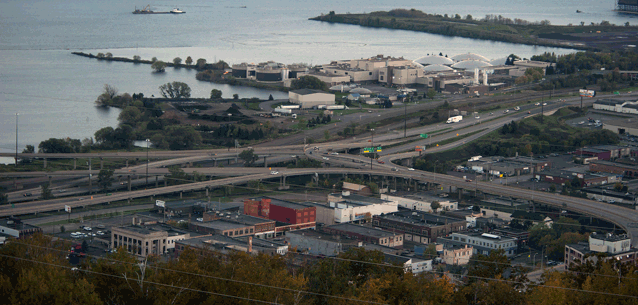
Complex highway interchanges in large metropolitan areas, also referred to as spaghetti junctions, have contributed greatly to enhancing vehicular connectivity and spurring economic growth. But the benefits of this built infrastructure are not evenly distributed, and neighborhoods near these highways are often negatively impacted. This project explored strategies used by other states to mitigate the consequences of spaghetti junctions that MnDOT could implement to improve conditions and livability for similar neighborhoods in Minnesota.
Historically, spaghetti junctions have been built adjacent to existing neighborhoods. While this infrastructure stimulated economic growth in the metropolitan area, it negatively impacted social, environmental and economic conditions in these neighborhoods. Specifically, research has documented social fragmentation, displacement, isolation, reduced property values, local business decline, increased air and noise pollution, soil and water contamination, and associated health risks.
To reduce the negative impacts on similar communities in Minnesota, this project reviewed highway infrastructure redesign projects conducted throughout North America to identify strategies that increase livability in adjacent neighborhoods. Current MnDOT policies and practices were also examined to determine their influence on the level of success of these types of projects.
What Did We Do?
In a review of the literature, researchers documented the negative social, environmental and economic impacts of dense highway infrastructure. Next, a scan of completed projects identified a range of infrastructure design approaches and strategies to address and mitigate negative outcomes, such as the construction of a freeway cap park or the establishment of a highway underpass park.
Using the results of the scan and input from the project’s Technical Advisory Panel, researchers developed case studies of projects. These case studies captured varying geographies, project designs, scopes and demographics, and a range of engagement from public, private and nonprofit sectors and levels of government.
Investigators then analyzed MnDOT policies and guidelines to identify potential areas for improving development and implementation processes.
What Did We Learn?
The scan identified numerous projects and strategies in the U.S. and Canada that were successful in reducing negative outcomes.
Freeway cap parks, a common strategy in which parks are built in the air space above sections of highway that are below grade, address fragmentation and isolation by connecting neighborhoods and other highly used urban spaces.
Highway underpass parks, such as Chicano Park in San Diego, address connectivity, redevelopment and urban aesthetics.
Removing or reconfiguring existing infrastructure is another strategy used to lessen the negative impacts. The removal of San Francisco’s two-level Embarcadero Freeway on its waterfront after the 1989 earthquake is a prominent example.
“The case studies from this work offer ideas, strategies and guidance to enhance and improve the addressing of important issues pertaining to livability and help offset some of the negative consequences of large infrastructure,” said William Goff, transportation planner, MnDOT Metro District.
Case study findings indicate a need for changes in MnDOT practice as a key strategy for successful planning and implementation. More specifically, these revised practices would target the agency’s approach to collaboration with other areas of government, receptivity to participate in projects traditionally outside the agency’s scope and more innovative approaches to engage the public.
Examination of MnDOT policies and guidance identified various obstacles, including public engagement policy limits on providing childcare, transportation expenses and incentives to encourage community member participation.
To complement the findings from the case studies, investigators developed a list of metrics that MnDOT and other agencies can use to assess the impacts of dense highway infrastructure on neighborhoods.
These quantitative and qualitative metrics represent needs in a range of categories, including health and environment, economics, sense of place, connections and safety. The list is comprehensive, and metrics can be tailored to reflect the needs and concerns of each specific project area.
What’s Next?
Project findings identified both potential design and process solutions that increase livability and mitigate the negative effects of spaghetti junctions. Recommendations regarding public engagement are also provided, including early and ongoing engagement throughout a project, intentional and flexible planning for engagement activities, and alignment of goals and objectives with other agencies and stakeholders involved in the project.
Future research could examine the organizational practices and/or internal cultures that may limit the successful implementation of practices identified in this research.
 Crossroads