
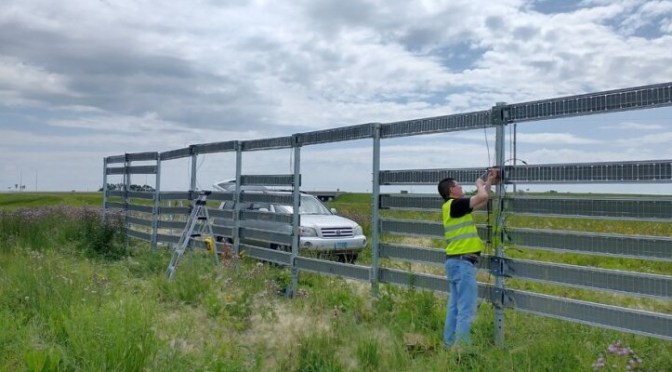
Solar snow fences not only retain the benefits of a traditional snow fence by controlling blowing and drifting snow in winter, they create green energy throughout the year. However, to be effective, the fence must withstand harsh weather elements and produce enough energy to justify the use and cost of solar panels. This project evaluated the installation and performance of a 100-foot solar snow fence for 18 months to determine its functionality and economic feasibility.
Transportation agencies construct snow fences in close proximity to roads to mitigate hazardous road conditions and reduce the cost and material resources needed to clear snow and ice from roads.
However, these structures serve no purpose in months without snow. To increase the utility of snow fences, agencies have begun installing solar panels on these structures, which create clean energy throughout the year without using any additional land.
To determine the functional and economic viability of solar snow fences, investigators installed a solar snow fence and monitored its performance. The results demonstrated operational effectiveness and identified the amount of daily energy production to inform considerations for additional installations.
What Did We Do?
A 12-foot prototype was constructed to evaluate solar energy production, electrical energy storage, and the monitoring and data acquisition system.
After lab results demonstrated the effectiveness of the prototype, a low-voltage, 100-foot solar fence system was installed in Glyndon, Minnesota, with 8-foot above-ground posts and helical piling to stabilize the frame against sagging.
After installation, which was completed in 72 hours, investigators monitored operations and performance for 18 months. Data collection included temperature, moisture, solar intensity, wind speed, and electrical voltage and current. A camera mounted on the fence monitored stability and safety concerns.
“Monitoring the installation of the solar snow fence demonstrated its functionality in harsh weather conditions, and the economic analysis provided MnDOT with guidance for fiscal feasibility,” said Daniel Gullickson, blowing snow control shared services supervisor, MnDOT.
A cost–benefit analysis used economic viability scenarios to evaluate the financial feasibility of future installations. Costs included material, labor, and recycling/disposal for the installation and maintenance of the fence. Benefits included the value of incentives; collected solar energy; and reductions in fossil fuel use, greenhouse gas emissions, and operations and costs related to snow and ice removal on roadways.
Additionally, the analysis evaluated MnDOT’s direct ownership of the system versus third-party ownership through a power purchase agreement (PPA), which allows MnDOT to accrue the benefits of the system without owning it.
What Was the Result?
The solar snow fence generated 10 to 30 kWh per day—enough energy to power an average household—with a payback period of approximately 11 years.
For managing blowing and drifting snow, the solar snow fence outperformed the traditional snow fence due to its lower porosity and higher stiffness. Solar snow fences had the best economic viability if they operated under a PPA.
The length of the fence is a critical factor for economic viability, as those measuring at least one mile will benefit from economies of scale. Design improvements such as longer solar panels, fewer posts and a better connection between the solar panel and the steel post will lower costs and potentially reduce the payback period to five years.
A guide developed as part of this project details 11 steps to implementation, beginning with preparing the land for construction and ending with connecting the output power to snow melting pads or other uses.
What’s Next?
The solar snow fence implementation demonstrated sufficient energy generation and economic feasibility for additional installations, especially if the fence is operated under a PPA and the design is improved.
While the energy created in this implementation was used to melt the snow near the solar snow fence, future installations may be most beneficial near isolated structures such as rest areas to provide energy for lighting, heating and air conditioning or to melt snow on pavement.
Additional research is currently underway to improve efficiency and cost-effectiveness. Overall performance will likely improve as solar snow fence installations increase.
 Crossroads
Great idea. Turning snow fences into power sources is both smart and practical. I’m excited to see where this goes.