
Crashes that result from vehicles driving through red lights are often very serious because they are typically right-angle or side-impact crashes. While newer vehicles have many standard safety features such as lane departure warning and brake assistance systems to support drivers, they do not have technologies to help prevent driving through red lights. This project developed an algorithm that integrated traffic light phasing information with GPS data to warn drivers when they were approaching a red light, providing valuable driver assistance and improving traffic safety and efficiency.
Vehicles driving through red lights are a major cause of crashes and fatalities. Police enforcement can be used to address the issue, but this practice can take up vital resources. An effective countermeasure was needed to warn drivers of the possibility of running a red light. This project explored the use of a red light running warning system (RLRWS) to assist distracted drivers and potentially decrease the rate of serious crashes and improve road safety.
What Did We Do?
Investigators installed a roadside unit at an intersection in Scott County, Minnesota, and equipped a car with a GPS chip and software that could receive location, speed, and traffic signal phase and timing information from the roadside unit. Integrating the location and speed of a car with the timing of the traffic lights provided the foundation for operating the RLRWS.
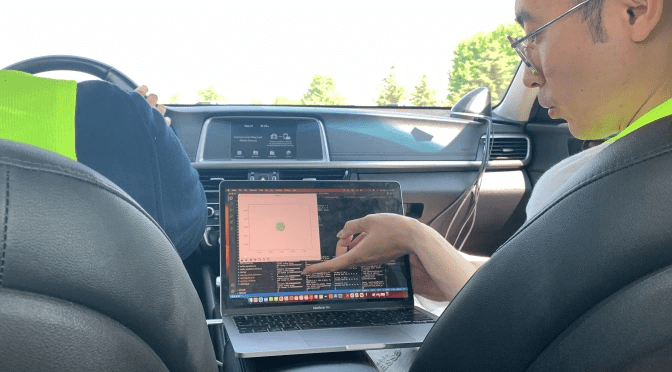
Next, they designed software to generate green, yellow and red warning messages that are based on the algorithm’s output and displayed on a laptop computer screen onboard the vehicle.
“Red light running continues to be a major contributor to serious crashes at signalized intersections. The technology developed in this project has the potential to reduce the risk of these serious crashes through driver warnings,” said Victor Lund, traffic engineer, St. Louis County Public Works.
As the driver approaches an intersection, the warning messages indicate whether the driver should continue to drive normally (green), begin braking to avoid running a red light (yellow) or brake hard to avoid running a red light (red).
After conducting software microsimulations of system performance, the project team evaluated the RLRWS in real time with on-road testing. The team drove the car through the intersection repeatedly to encounter scenarios that would activate the RLRWS.
The car received warning messages when it was within 500 meters of the intersection. These messages appeared on the computer screen as colored circles, and team members recorded the results when the vehicle approached the intersection.
A benefit-cost analysis for initial use of one year assessed the economic and operational impacts of the RLRWS.
What Was the Result?
The results of the microsimulations and on-road testing demonstrated that the RLRWS could provide reliable warnings to prevent drivers from running red lights. For example, the system displayed yellow warnings when it was appropriate for the car to start braking and red warnings when immediate harsh braking was necessary.
When the car approached a green light, the RLRWS displayed a yellow warning because the system determined the light would turn red before the car passed through the intersection, further demonstrating the ability of the RLRWS to compute real-time warnings based on the information received from the roadside unit.
The results of the benefit-cost analysis were estimated based on the cost to equip 640 signalized intersections in the Twin Cities metro area and 10% of vehicles.
The benefits, based on reductions in crashes, fewer traffic citations, road maintenance savings and improved traffic flow, would result in a one-year net benefit of more than $10 million and the annual prevention of approximately 7,000 crashes.
What’s Next?
Funding has been requested for a second phase of research as there is a significant gap between the technology developed in this project and market-ready technology.
Future research would focus on developing technology that better incorporates road conditions, weather, individual driver tendencies and other factors. Additionally, future research would involve equipping multiple cars, driving vehicles through more intersections and testing drivers with a range of driving behaviors.
More Information
- Research project webpage
- Final report (PDF))
- Research summary (PDF)
 Crossroads