
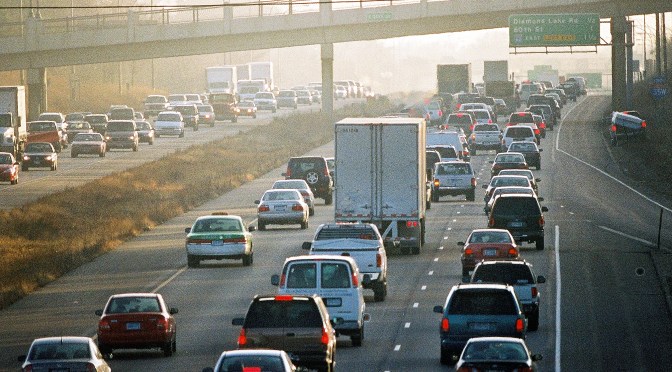
Drivers and businesses benefit from a freeway network that is predictable and able to withstand disturbances such as construction, incidents and poor weather. To provide a high level of service on freeways, traffic managers monitor and assess traffic flows and speeds under various conditions. In this project, investigators analyzed and identified the most vulnerable portions of the Twin Cities freeway network and enhanced an analysis tool to provide better estimates of travel-time reliability and operational resilience.
To effectively operate a freeway network, traffic managers monitor the travel-time reliability and resilience of individual corridors. Previous phases of this research developed a Travel-Time Reliability Estimation System (TeTRES) that estimated travel-time reliability and traffic-flow measures for 48 directional corridors. The current project addressed the needs for continuous assessment of travel-time reliability and traffic-flow measures by populating TeTRES with updated historical data. Further, the metro freeway corridors could be reconfigured in the model to address MnDOT’s operational and planning needs.
Additionally, investigators needed to enhance a preliminary model developed in the previous phase to estimate the operational-resilience index of an individual corridor to quantify its ability to resist and recover from traffic congestion. The results of this analysis could provide a framework for freeway networks to implement design and operational improvements that increase resilience and decrease traffic delays.
What Did We Do?
This project had two primary objectives: to estimate and assess the travel-time reliability trends of the metro freeway corridors under various conditions using TeTRES, and to improve and assess the ability of a resilience model to determine the operational resilience of individual corridors in coping with traffic disturbances and congestion..
To complete the project objectives, investigators:
- Collected and processed historical traffic and nontraffic data (required for travel-time reliability estimation), and populated the TeTRES database with this information.
- Reconfigured the metro freeway network with 74 directional corridors.
- Estimated monthly and yearly travel-time reliability and traffic-flow measures for the 74 individual corridors in the network under various conditions from January 2018 to December 2023.
- Assessed the effects of geometric configuration on travel-time reliability, operational resilience and traffic-flow measures of individual corridors.
- Enhanced a preliminary resilience model to reflect different weather conditions and applied the enhanced model to estimate the operational resilience of the individual corridors in the metro network.
The corridor and network performance analysis included imported nontraffic data such as a sporting event, work zone locations and dates, winter road conditions, weather data and incident data.
What Was the Result?
The findings indicated a significant and sudden decrease in traffic in April 2020 due to the COVID-19 pandemic. Traffic flows in the metro network slowly increased over the next three years but as of December 2023 have not reached pre-pandemic levels. As a result, travel-time reliability throughout the network has improved in both morning and afternoon traffic periods since April 2020 when compared to pre-pandemic measures.
“The software developed gives us meaningful insights into performance on the metro freeway network, such as traffic flow and travel-time reliability, along with a better understanding of roadway design and other characteristics affecting operational resilience,” said Michael Iacono, performance and investment data analyst, MnDOT Office of Transportation System Management.
Routes with low geometric friction served higher traffic flows with better reliability than those with high geometric friction. For example, a route with on- and off-ramps located in close proximity may have a high level of geometric friction, shown by a significant number of cars weaving across lanes in a short segment of freeway.
The enhanced resilience model performed significantly better than the preliminary model. The results identified a correlation between increased geometric friction and decreased resilience and the adverse effects of rainy weather on decreased resilience.
The resilience analysis of individual corridors identified the routes exhibiting consistently low resilience during morning and afternoon traffic periods. Overall, the routes with less geometric friction exhibited greater resilience, resulting in better traffic flow and less travel-time variability.
What’s Next?
The project results could provide a basis for implementing geometric and operational improvements in the metro freeway corridors. Future work could include continued assessment of travel-time reliability and traffic-flow measures of the metro freeway network, improving the geometric friction model by incorporating the connectivity and accessibility of routes to adjacent corridors, and examining the effects of heavy vehicles on resilience throughout the metro network by identifying segments susceptible to congestion.
MnDOT could use the results to prioritize corridors for improvements, making maintenance operations and planning more efficient. The software implemented in this project could analyze the effectiveness of deployed freeway service vehicles that assist with traffic incident clearance.
 Crossroads