
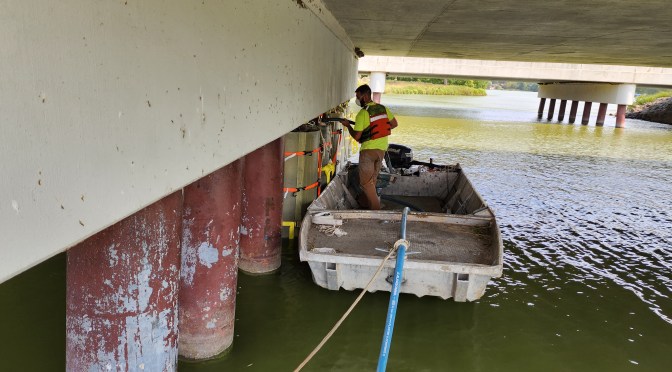
In recent years, advancements in bridge repair techniques and technologies promise to offer more options for strengthening an existing bridge’s in-water piles, eliminating the need to reroute both water and traffic. This project investigated other states’ experiences with several products on the market and provided an opportunity for Minnesota’s engineers to evaluate two vendors’ systems on a bridge in need of restoration.
Repairing a bridge’s in-water foundation is a critical and challenging endeavor. The traditional approach to reinforcing elements below the water’s surface includes building a temporary wall that surrounds the area and running pumps continuously to keep the area dry. This approach may also involve removing the bridge deck to provide easier access for heavy equipment and diverting boat and vehicle traffic until the work is completed.
Several commercially available systems incorporating innovative methods and materials, such as fiberglass-reinforced plastic (FRP) forms or jackets and steel-reinforced grout, allow bridges to remain open to traffic while underwater repairs are completed, eliminating the disruption and environmental impacts of traditional practices. To evaluate the effectiveness and performance of these products under real-world conditions, MnDOT and LRRB partnered on a research project to place two vendors’ systems on a bridge near St. Cloud and compare the installation processes, long-term effectiveness and inspection recommendations involved with each solution.
What Did We Do?
The project began with a review of in-water bridge repair projects that have been completed in other states and a survey of bridge owners from across the country to understand their experiences and the current state of practice for repairing bridges with corroded in-water foundations.
Based on these preliminary efforts, two proprietary product systems — both consisting of an FRP jacket, specially formulated grout and accessories — were selected to be installed on a bridge in central Minnesota with piles that needed structural reinforcement.
“This project allowed us to put a promising repair strategy into practice and see the process firsthand on a Minnesota bridge. Now engineers across the state have a viable option for making these challenging repairs with minimal disruption to traffic.” said Nick Haltvick, North Region bridge construction engineer, MnDOT Office of Bridges and Structures.
The installation process for both systems was nearly identical: Specialized diver-contractors prepared each bridge’s 14 piles by first clearing rocks and debris from the area and using a pressure-washer to clean the structure beneath the water’s surface.
Steel reinforcement was placed around each pile, which was then surrounded in an FRP jacket. After sealing the joints with an epoxy, bridge workers pumped grout into the jacket, allowed it to cure and then applied a final epoxy coating to the top to waterproof the system.
The steps for installing each system were documented to compare processes, identify improvements and note lessons learned. About a year after installation, some of the FRP jackets were removed to allow inspectors to see the results and recommend modifications.
What Was the Result?
Both systems were found to be viable options for repairing in-water bridge piles and are expected to extend the life of the test bridge by at least 20 years. Throughout the installation process, several strategies were identified to help Minnesota’s engineers increase efficiency and improve the results on future projects.
Before construction, an inspection of the underwater conditions should be conducted at the site to identify potential risks and develop a complete scope and plan for repairs. This inspection should assess visibility below the surface, measure flow rate, determine the type of channel material below the bridge, and determine the extent of structural deterioration to provide contractors with a more accurate scope of the work and avoid costly project changes.
Access to the area should also be considered ahead of time as this can dictate the equipment that will be needed and whether tasks such as debris removal would need to be performed manually.
Following the manufacturer’s instructions carefully throughout the installation process is critical to the quality and long-term performance of the repairs. Specifically, ensuring that the pile surfaces are thoroughly cleaned can directly affect material adhesion and determine overall project success.
After construction, the FRP systems should require minimal maintenance, but routine inspections and checks after major storms should be performed to quickly identify and address any damage.
What’s Next?
This project has given Minnesota’s engineers an improved understanding of the costs and benefits of this innovative approach to repairing bridges with piles in water. As the state’s bridges continue to age, this solution will likely be implemented more frequently to increase the service life of Minnesota’s aging infrastructure.
 Crossroads
One thought on “Repairing In-Water Bridge Supports Using Innovative Methods and Materials”