
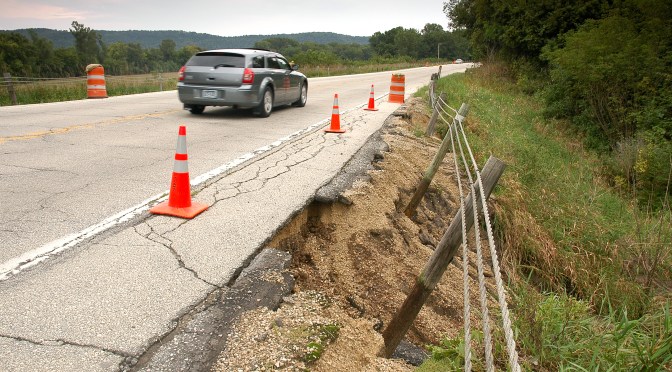
MnDOT continues working on systematically and proactively assessing stability of slopes along its highway system. Efforts are aimed at minimizing the potential for slope failures that could result in threats to public safety and costly repairs.
Technological advances have expanded evaluation and monitoring options. In addition to uncrewed aerial vehicles (UAVs), lidar can be paired with photogrammetry—a method triangulating overlapping aerial imagery—to produce data to process into 3D models of slopes that may impact transportation infrastructure. Furthermore, realistic computational 3D models to assess slope stability under different environmental conditions are becoming more accessible to practitioners and agency staff.
Agency personnel can learn these assessment techniques for ongoing slope evaluation and monitoring. An improved understanding of the stability and vulnerability of sloped areas and changes that may result in response to environmental stressors will support MnDOT in managing transportation assets.
“This research will produce valuable new tools to closely monitor and assess vulnerable slopes along our highways,” said Raul Velasquez, geomechanics research engineer, MnDOT Office of Materials and Road Research. “The proposed framework will support MnDOT in making proactive informed decisions about slope rehabilitation or stabilization activities to avoid costly slope failures.”
Objectives
In a new project, researchers will use state-of-the-art sensor and computing technology to develop high-resolution slope models to monitor and evaluate stability. MnDOT staff will receive training and tools to improve geotechnical asset management practices.
The objectives are:
- Address recommendations and gaps from previous slope vulnerability studies
- Develop a preliminary inspection form to evaluate the need for a more detailed geotechnical investigation and stability analysis of critical slopes
- Identify critical slope sites for collection and processing of data over two years
- Analyze slope stability and assess vulnerability of areas before and after freeze-thaw season
- Assess the value of advanced remote sensing technologies such as UAVs for geotechnical applications
- Provide training and demonstrations on the methods for agency staff
Project Details
- Estimated Start Date: 07/01/2024
- Estimated Completion Date: 04/30/2026
- Funding: MnDOT
- Principal Investigator: Surya S. C. Congress
- Co-Principal Investigators: Bora Cetin
- Technical Liaison: Raul Velasquez
Details of the research study work plan and timeline are subject to change.
To receive email updates about this project, visit MnDOT’s Office of Research & Innovation to subscribe.
 Crossroads