
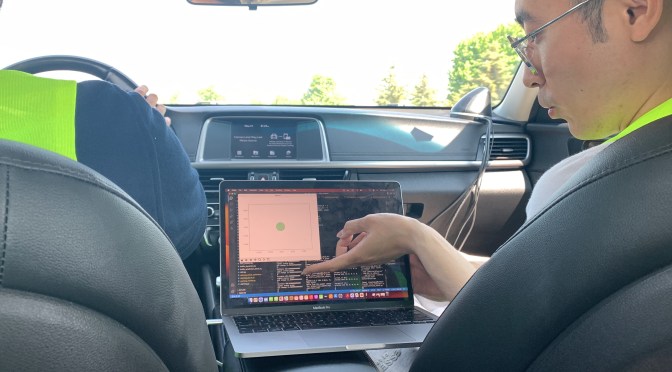
Red light violations remain a prominent issue and high contributor to serious crashes and casualties at signalized intersections. An ongoing research project, funded by the Local Road Research Board, and Federal Highway Administration (FHWA) State Transportation Innovation Council (STIC) Incentive program, is developing and testing a warning system that signals drivers as they approach a red light and prompts them to decelerate.
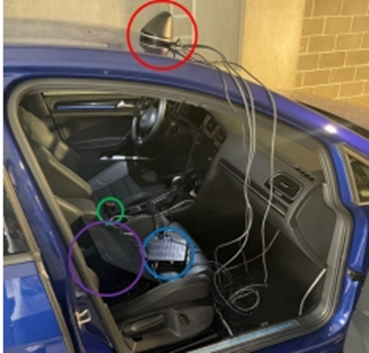
The purpose of this study was to develop a red-light running warning system (RLRWS) to caution drivers ahead of a red light. The system consists of an onboard unit and roadside device that uses dedicated short-range communication receivers and GPS chips to receive location, speed, and signal phase and timing (SPaT). The results are displayed on a computer screen connected to the system. The information is used in the RLRWS algorithm, which uses stop bar locations and continuously updates the warning system as the vehicle approaches the intersection.

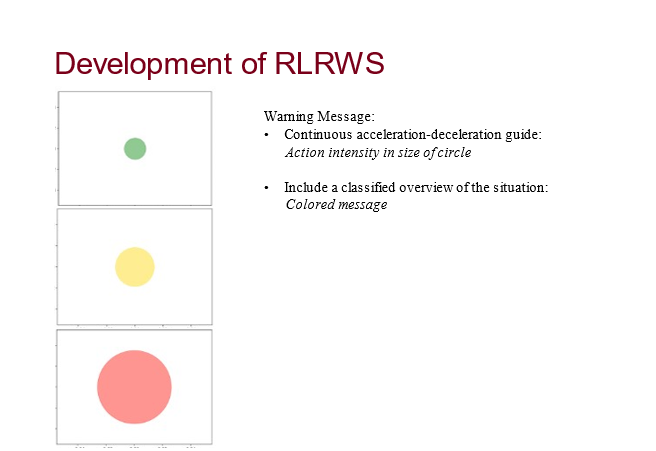
The system has three warning messages based on the algorithm’s output:
- Green: the driver should drive normally and not worry about a red light
- Yellow: the driver should brake at a comfortable rate to avoid running a red light
- Red: the driver should apply hard braking to avoid running a red light
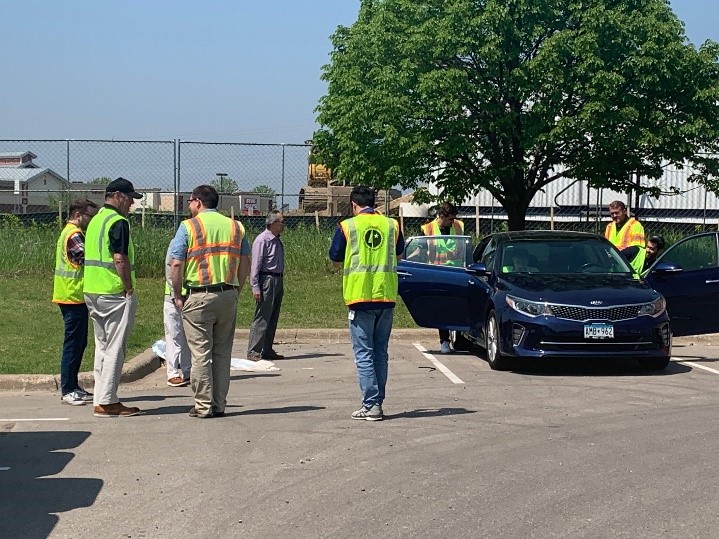
In May, principal investigator, Michael Levin, and co-investigator, Zongxuan Sun, with the University of Minnesota, provided the technical advisory panel a demonstration to simulate the device in real time on Scott County’s Hwy 18 and 21 intersection. Inside the vehicle, the onboard unit receives SPaT and map information from the roadside unit and broadcasts basic safety messages to drivers.
The red-light running warning system is in its final review stages and sparks an initiative to use signal timing data to reduce collision risks at traditional intersections.
“We’re focusing on two areas: 1) developing the driver interface to appropriately assist drivers; and 2) testing by some drivers on a larger number of intersections,” said Michael Levin, principal investigator, University of Minnesota.
A red-light warning system could inform drivers of upcoming red lights at intersections and influence driver decisions. The vehicle integrated system has the potential to reduce human error accidents and is part of an ongoing effort to apply vehicle automation to roadways.
Additional research such as testing at different intersections and conducting multiple runs with test groups can provide more information to the effectiveness of the warning system. The team will publish a final report concluding the findings of the project and potential methods of implementation.
Project Details
This project is set to complete by the end of 2024. To receive an email update when the final report is available, visit MnDOT’s Office of Research & Innovation to subscribe.
 Crossroads
One thought on “Introducing a New Red-Light Running Warning System that Can Potentially Reduce Human Errors at Intersections”