
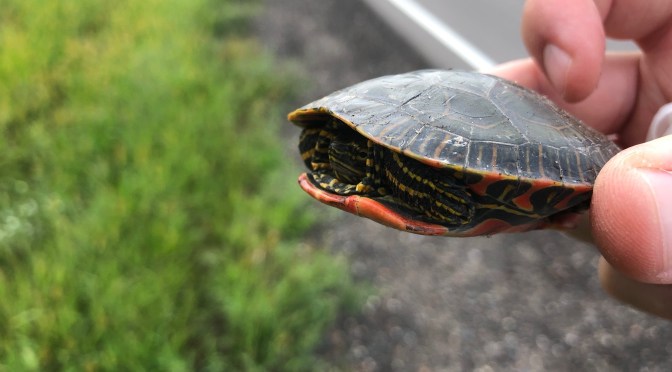
As turtle populations decline worldwide, increased protections (e.g. United States Endangered Species Act) yield increased regulatory burdens. As a consequence, monitoring of imperiled turtle species is imperative to understand both their extant distributions, but also to ensure regulatory compliance.
However, conventional methods for surveying turtles are frequently costly, time consuming, require taxonomic expertise, and unlikely to yield detections without repeated visits. And these burdens are exacerbated when sampling rare, threatened, or endangered (RTE) species. In these instances, innovative technological advances may overcome these limitations, ultimately streamlining monitoring.
Environmental DNA (eDNA) analyses are an emerging technology that has shown great promise in improving detection rates and occupancy estimation over conventional sampling, while increasing efficiencies in detecting turtle species.
“If the use of eDNA technologies improves our ability to determine where endangered turtles reside, the tool will be a valuable addition to our project-delivery toolkit, while also improving regulatory compliance and conservation outcomes – a win-win-win for transportation agencies and turtles,” says Christopher E. Smith, MnDOT wildlife ecologist.
Objectives
The goal of this project is to assess the efficacy of eDNA for detecting Blanding’s turtles and wood turtles across their ranges in Minnesota. The objectives are:
- Optimize field and laboratory methods for Blanding’s and wood turtle eDNA collection and qPCR assays
- Sample representative populations across Minnesota to account for any genetic differentiation as well as aquatic/environmental conditions that could affect detection via eDNA methodologies
- Assess the efficacy of eDNA methodologies to detect these target turtle species in:
- Lotic vs. lentic aquatic systems
- Turtle active season vs. winter hibernation season
- Assess costs associated with implementing eDNA surveys, including sampling design and detection probabilities (sampling effort, number of replicate samples, sample processing, DNA extraction, and PCR replicates) and desired statistical power
Project Details
- Estimated Start Date: 08/04/2022
- Estimated Completion Date: 06/30/2024
- Funding: MnDOT
- Principal Investigator: Mark Davis
- Co-Principal Investigators: Eric Larson, Jinelle Sperry, Maria Sara Costantini
- Technical Liaison: Christopher Smith
Details of the research study work plan and timeline are subject to change.
To receive email updates about this project, visit MnDOT’s Office of Research & Innovation to subscribe.
 Crossroads